
Plantation Agriculture in West and East Africa – SS2 Geography Lesson Note
Lesson note at a glance
- Subject
- Geography
- Class
- SS2
- Topic
- Plantation Agriculture in West and East Africa
- Reading time
- 3 min
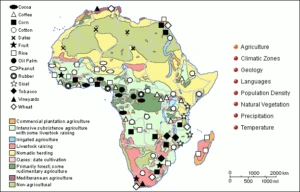
Plantation agriculture is the cultivation of perennial cash crops, such as cocoa, rubber, oil palm, tea and coffee, on a large area of land. It uses a large labour force and large capital, grows one crop on each piece of land (monoculture), and produces mainly for export.
Behavioural objectives
By the end of the lesson, students should be able to:
- define plantation agriculture;
- name the crops grown on plantations;
- state the characteristics of plantation agriculture;
- list the factors that favour plantation agriculture, its importance, its problems and possible solutions;
- name areas of plantation agriculture in East Africa and West Africa.
What is plantation agriculture?
Plantation agriculture is the cultivation of certain crops (usually cash crops) on a large area of land.
Which crops are involved in plantation agriculture?
It involves the planting of perennial crops such as cocoa, rubber, oil palm, tea, coffee and others.
What are the characteristics of plantation agriculture?
- It requires a large area of land.
- It requires a large labour force.
- It involves the cultivation of one type of crop only on a piece of land (monoculture).
- Crops produced are mainly exported.
- All farm operations are mechanised.
- It requires large capital to operate.
- Plantations are mainly owned by the government and large foreign or local companies.
What factors favour plantation agriculture?
- Sub-equatorial type of climate with adequate rainfall.
- Fertility of the soil, especially the volcanic soil in East Africa.
- Availability of cheap labour and adequate capital.
- Availability of a good transport network.
- Presence of large markets to consume or use the products.
Why is plantation farming important?
- Crops produced provide raw materials for industries.
- It is a source of income to the farmers.
- It provides employment. Farmers learn and acquire new skills.
- Plantations are centres of agricultural research.
- Cash crops like cocoa, rubber and coffee, when exported, yield foreign exchange for the country.
What are the problems of plantation agriculture?
- Difficulties in the ion of large expanses of land.
- It leads to nd for town development.
- Inadequate capital and labour (skilled and unskilled).
- Price fluctuation, that is, unstable price of crops in the world market.
- Pests and diseases spread fast because of the monocultural nature and the permanent location of the farms.
What are the solutions to these problems?
- Provision of loans or credit facilities.
- Government participation.
- Provision of roads and other infrastructure.
- Proper management to prevent outbreaks of diseases.
Where are the plantation areas in East and West Africa?
East Africa
- Tea and tobacco plantations in Kenya
- Coffee plantations in Uganda
- Sisal in Tanga District and the coastal area in Tanzania
- Sugar cane in Tanzania and Uganda
West Africa
- Cocoa plantations in Ibadan and Akure in Nigeria, and Kumasi in Ghana
- Rubber in Benin and Harbel (Liberia)
- Oil plantations in Aba and Okitipupa
Evaluation
- Define plantation agriculture.
- State four characteristics of plantation agriculture.
- List three problems of plantation agriculture and one solution to each problem you have named.
- Name two plantation crops grown in East Africa and two grown in West Africa, with one area where each is grown.
Assignment
- Which of the following West African countries is the largest producer of groundnut? (a) Burkina Faso (b) Mali (c) Ghana
- Monoculture is a term associated with (a) arable farming (b) mixed farming (c) plantation agriculture.
- The most important cash crop grown in the Nile Basin is (a) barley (b) cotton (c) groundnut.
- All of the following are true of plantation agriculture in West Africa except that it (a) involves the planting of food crops (b) requires modern technology (c) involves large areas of food.
- Which of the following is not a crop grown on a plantation farm? (a) Cocoa (b) Sisal (c) Maize
Lesson Notes for Other Classes

SS1 Lesson Note
The complete lesson note to guide your studies.

SS3 Lesson Note
The complete lesson note to guide your studies.
