
Solar Energy Storage Technologies – SS2 Solar Photovoltaic Installation & Maintenance Lesson Note (First Term)
Download Lesson NoteLesson note at a glance
- Subject
- Solar Photovoltaic Installation & Maintenance
- Class
- SS2
- Term
- First Term
- Topic
- Solar Energy Storage Technologies
- Order
- Topic 2 of 7 this term
- Reading time
- 3 min
Why Do We Need “Advanced” Batteries?
In our previous lessons, we talked about Lead-Acid batteries (the heavy ones used in cars). While they are cheap, they have problems: they are very heavy, they don’t last many years, and you can’t drain them completely without damaging them.
As we move toward “Advanced PV Systems,” we need batteries that:
- Last longer: (10+ years instead of 2 years).
- Are smaller: To save space in our homes.
- Charge faster: So they can soak up all the midday sun quickly.
Think of advanced batteries like a smartphone battery versus an old flashlight battery. One is “smart” and powerful; the other is basic.
Lithium-ion (Li-ion) – The Current King
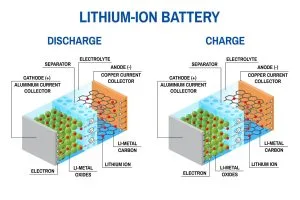
If you have a laptop or a smartphone, you are already carrying a Lithium-ion battery. In solar design, we just use much larger versions of these.
How they work: Inside the battery, Lithium ions move from one side (the Anode) to the other (the Cathode) to create electricity. When the sun shines, the solar panels “push” those ions back to the start to recharge.
Why we love them for Solar:
- High Depth of Discharge (DoD): You can use up to 90% of the energy in a Lithium battery. In an old Lead-Acid battery, you can only use 50% before it starts “dying.”
- Efficiency: Almost all the energy you put in comes back out. Very little is lost as heat.
- Cycle Life: They can be charged and emptied (cycled) 4,000 to 6,000 times.
Flow Batteries – The “Water Tank” Concept
This is a newer technology. Imagine a battery that isn’t a solid box, but two large tanks of liquid.
The Logic: In a Flow Battery, energy is stored in liquid chemicals (usually Vanadium). These liquids are pumped through a central chamber where they react to create electricity.
Why are they “Advanced”?
- No Degradation: Unlike Lithium or Lead-Acid, the liquid doesn’t “wear out.” These can last 20+ years.
- Scaling is Easy: If you want more storage, you don’t buy a new battery; you just buy a bigger tank of liquid!
- Fire Safety: Since the energy is in a liquid that is mostly water-based, they don’t catch fire like Lithium batteries sometimes can if they get too hot.
Comparing the Technologies
When you are designing a system for a client, you have to choose the right tool for the job.
| Feature | Lithium-ion | Flow Batteries |
| Size | Small & Compact | Very Large (needs a room) |
| Best Use | Homes & Small Offices | Large Factories & Mini-Grids |
| Lifespan | 10–15 Years | 20–25 Years |
| Maintenance | None (Zero) | Minimal (checking pumps) |
| Cost | Medium | High (Initial cost) |
Design Considerations for SS2 Students
When adding these batteries to a Hybrid Solar System, you can’t just “plug and play.” You need to consider:
- C-Rating: This is how fast a battery can be discharged. Lithium batteries have high C-ratings, meaning they can power heavy things like ACs or pumping machines easily.
- BMS (Battery Management System): Advanced batteries have a “brain” (a circuit board) inside. It protects the battery from getting too hot or overcharging. If the BMS fails, the battery won’t work.
- Temperature: Even though they are “advanced,” they hate extreme heat. Always install them in a cool, ventilated place—not directly under a hot roof!
Summary Tip: * Use Lithium for a standard house where space is tight.
- Use Flow Batteries for a large farm or a hospital that needs power to last for decades.
This term's Solar Photovoltaic Installation & Maintenance topics
SS2 First Term · 7 topics
First Term Solar Photovoltaic Installation & Maintenance Lesson Notes for Other Topics

Smart Solar Monitoring System
Read the full lesson note.
Environmental Impacts of PV Systems
Read the full lesson note.
Climate Change and Renewal Energy
Read the full lesson note.

Energy Policies in Nigeria
Read the full lesson note.
Hybrid Energy System
Read the full lesson note.

Smart Solar System
Read the full lesson note.
Advanced PV Technologies
Read the full lesson note.

Nigerian and International Standard
Read the full lesson note.
Energy Efficiency in Solar System
Read the full lesson note.

Safety in PV Installation
Read the full lesson note.

Electrical Codes and Regulations
Read the full lesson note.
Grid-Tied Solar Set-Up
Read the full lesson note.
Advanced PV System Design
Read the full lesson note.

Inverter: Meaning, Types & Ratings - (Components of PV System IV)
Read the full lesson note.
Types of Battery in Solar Setup - (Components of PV System III)
Read the full lesson note.
Lesson Notes for Other Classes

Basic 1 Lesson Note
The complete lesson note to guide your studies.

Basic 2 Lesson Note
The complete lesson note to guide your studies.

Basic 3 Lesson Note
The complete lesson note to guide your studies.

Basic 4 Lesson Note
The complete lesson note to guide your studies.

Basic 5 Lesson Note
The complete lesson note to guide your studies.

Basic 6 Lesson Note
The complete lesson note to guide your studies.

