
Inflation – SS2 Economics Lesson Note (Third Term)
Download this term · ₦1,000Lesson note at a glance
- Subject
- Economics
- Class
- SS2
- Term
- Third Term
- Topic
- Inflation
- Order
- Topic 3 of 9 this term
- Reading time
- 7 min
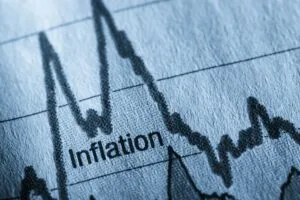
Inflation is a persistent rise in the general level of prices of goods and services.
- Meaning: too much money chases too few goods, so each naira buys less.
- Usual cause: the money supply increases without a matching increase in the volume of production.
- Main types: demand-pull, cost-push, hyperinflation and creeping inflation.
- Control: the government can reduce it through several policies.
Behavioural objectives
- Define inflation and state its types.
- List the causes of inflation.
- State the positive and negative effects of inflation.
- Explain ways of controlling inflation.
- Explain terms such as inflation gap, inflation spiral, disinflation, reflation, stagflation and slumpflation.
- Define deflation and state its causes.
What are the types of inflation?
There are four main types of inflation: demand-pull, cost-push, hyperinflation and creeping inflation.
Demand-pull inflation
Demand-pull inflation is a rise in prices that occurs when demand for goods and services is greater than supply.
- Population increase: more people want goods, so demand rises.
- Higher wages and salaries: workers have more money to spend.
- Excess money supply: more money is available to chase the same goods.
Cost-push inflation
Cost-push inflation is a rise in prices that occurs when the cost of production rises.
- Factor inputs: producers pay for factors of production, so any rise in the price of an input shows in the price per unit.
- Example: if the price of flour, sugar or butter rises, the price of bread rises.
Hyperinflation
Hyperinflation is a very fast rise in prices that makes money lose its value, or its ability to buy goods.
- Causes: war and budget deficits are the major causes.
- Other names: galloping inflation and runaway inflation.
Creeping inflation
Creeping inflation is a slow but steady rise in the general prices of goods and services.
- Speed: prices rise at a low rate each year, for example about 2% per annum.
- Effect: it is mild and is the least harmful type.
How do demand-pull and cost-push inflation differ?
| Point | Demand-pull inflation | Cost-push inflation |
|---|---|---|
| Origin | Demand side | Supply side (production costs) |
| Main cause | Total demand exceeds total supply | Rise in the price of factor inputs |
| Example | Higher salaries increase spending | Dearer flour raises the price of bread |
How is inflation measured?
Inflation is measured with the Consumer Price Index (CPI).
- CPI: an index that tracks the prices of a basket of goods and services that households commonly buy.
- Inflation rate: the percentage change in the CPI over a period, usually one year.
- Formula: (new CPI minus old CPI) ÷ old CPI × 100.
- In Nigeria: the National Bureau of Statistics publishes the CPI.
What are the causes of inflation?
The causes of inflation are factors that raise demand, raise production costs or reduce the supply of goods.
- Excess demand: too much demand for goods and services, as in demand-pull inflation.
- Low productivity: goods are scarce, for example low output in agriculture.
- Increase in salaries and wages: workers have more money to spend.
- High cost of production: producers pass the cost on to buyers.
- Budget deficit: government expenditure is more than its income.
- Increase in population: this forces demand to rise.
- Excessive bank lending: more money enters circulation.
- High cost of importing raw materials: this leads to a high cost of goods.
- Hoarding: keeping goods away from the market to create artificial scarcity.
- Industrial action: strikes and tools-down by workers reduce output.
- Poor storage facilities: goods spoil, so supply falls.
- Excess money in circulation: a mass injection of money into circulation raises spending.
What are the effects of inflation?
Inflation has both positive and negative effects on the economy.
What are the positive effects of inflation?
- Debtors gain: they repay loans with money that is worth less, at the expense of creditors.
- Higher profits: businessmen make more profit when prices rise.
- More investment: the chance of profit stimulates investment.
- High employment: more investment and output create more jobs.
- Economic growth: profits, investment and employment together help the economy to grow.
What are the negative effects of inflation?
- Loss to creditors: lenders lose because money loses its value as inflation persists.
- Distortion in the economy: workers press for increases in wages and salaries.
- Hardship for fixed-income earners: salary earners and pensioners suffer a lot.
- Fall in the value of money: each naira buys fewer goods.
- Balance of payments problems: local goods become dear, so exports fall and imports rise.
- Discourages savings: money loses its value day after day.
- Lower living standard: people can afford fewer goods and services.
How can inflation be controlled?
Inflation is controlled by reducing excess spending, increasing supply and removing the causes of high prices.
Monetary measures
- Interest rate policy: where inflation comes from more money supply, raise interest rates to discourage excess borrowing.
- Contractionary monetary policy: reduce the money supply where it causes inflation.
Fiscal and income measures
- Fiscal policy: taxation reduces the disposable income of workers and so checks spending.
- Wage freezing: the government does not increase salaries.
Supply and legal measures
- Industrialisation: the government encourages industries to make goods and services available.
- Better distribution: remove bottlenecks so that goods flow freely.
- Legislation: pass laws to check the activities of hoarders.
- Subsidies: support farmers and businesses to ease the rising price of inputs such as hoe and cutlass.
What terms are associated with inflation?
- Inflation gap: a situation in which total demand in the economy exceeds the total supply of goods and services available. Work it out by subtracting the money value of actual goods and services available from the total money available for spending.
- Inflation spiral: a price increase makes workers demand higher wages and salaries. This raises the general level of prices further, and the cycle repeats.
- Disinflation: a fall in the rate of inflation, brought about by policies that reduce spending, such as reducing the money supply and raising interest rates.
- Reflation: the state in which prices, employment and output pick up again as a result of deliberate government policy.
- Stagflation: a high rate of inflation together with slowing industrial production.
- Slumpflation: much reduced economic activity together with inflation.
What is deflation?
Deflation is a persistent fall in the general level of prices.
- Cause in brief: the volume of money in circulation is not enough for the prevailing economic situation.
- Relation to inflation: it is the direct opposite of inflation.
How do inflation and deflation differ?
| Point | Inflation | Deflation |
|---|---|---|
| General price level | Rises persistently | Falls persistently |
| Money in circulation | Too much | Too little |
| Value of money | Falls | Rises |
What are the causes of deflation?
Deflation is caused by anything that reduces spending or the money supply.
- Budget surplus: the government fails to spend, so less money circulates.
- Higher bank interest rates: they discourage borrowing, so money supply drops.
- Output above demand: productivity exceeds demand while the money supply decreases.
- Excessive taxation: workers are left with little disposable income, their marginal propensity to consume drops, and prices fall.
Evaluation
- Define inflation.
- Distinguish between demand-pull inflation and cost-push inflation.
- State four causes of inflation.
- Explain three ways of controlling inflation.
- Define deflation and state two of its causes.
Assignment
Answer the following five objective questions and give a reason for each answer.
- An inflation in which the price level rises steadily at an average rate of about 2% per annum is best described as: (a) galloping (b) induced (c) creeping (d) suppressed (e) run-away.
- Inflation in any economy: (a) has no monetary connection (b) implies a sustained decrease in the general price (c) always increases the value of the national currency (d) tends to redistribute income (e) tends to bring down market prices.
- Which of the following statements is not true in an inflation period? (a) the purchasing power of money diminishes (b) wages rise simultaneously with the price (c) more money runs after a limited quantity of goods (d) fixed-income earners lose (e) aggregate real demand exceeds aggregate real supply.
- Inflation caused by an increase in demand is known as: (a) cost-push inflation (b) hyperinflation (c) demand-pull inflation (d) creeping inflation (e) runaway inflation.
- One way to solve the economic problem of inflation in a country is by increasing the: (a) supply of commodities (b) supply of currency (c) salaries of workers (d) demand for commodities.
This term's Economics topics
SS2 Third Term · 9 topics
Get Economics as PDF and Word
Every week of SS2 Economics, Third Term, formatted and ready to print. Ad-free, and the copy lock comes off.
Get this term Card, bank transfer, USSD or OPay
SS2 Economics Lesson Notes for Other Topics

Money
Read the full lesson note.
Financial Institutions
Read the full lesson note.
Public Finance
Read the full lesson note.
Budget
Read the full lesson note.

Capital Market
Read the full lesson note.
National Income
Read the full lesson note.
Theory Of Income Determination
Read the full lesson note.
Theory Of Multiplier
Read the full lesson note.
Basic Tools For Economic Analysis
Read the full lesson note.
Measures Of Dispersion
Read the full lesson note.
Theory Of Consumer Behaviour
Read the full lesson note.

Demand And Supply
Read the full lesson note.
Elasticity Of Demand
Read the full lesson note.
Income Elasticity Of Demand
Read the full lesson note.
Cross Elasticity Of Demand
Read the full lesson note.
Lesson Notes for Other Classes

SS1 Lesson Note
The complete lesson note to guide your studies.

SS3 Lesson Note
The complete lesson note to guide your studies.
