
Standard Separation Techniques for Mixtures – SS1 Chemistry Lesson Note (Second Term)
Download Lesson NoteLesson note at a glance
- Subject
- Chemistry
- Class
- SS1
- Term
- Second Term
- Topic
- Standard Separation Techniques for Mixtures
- Order
- Topic 2 of 4 this term
- Reading time
- 6 min
Separation techniques are methods used to split a mixture into its pure constituents. The method chosen depends on the properties of the substances, such as solubility, particle size, boiling point, density and magnetism. Examples include filtration, decantation, evaporation, distillation, sublimation and chromatography.
Behavioural objectives
By the end of the lesson, students should be able to:
- state why mixtures are separated into their constituents;
- name the standard techniques for separating mixtures;
- explain how each technique works and give examples of where it is used;
- choose a suitable technique for separating a given mixture;
- describe how paper chromatography is carried out;
- state the criteria for purity of a substance.
Why do we separate mixtures?
The importance of separating a mixture into its constituents cannot be overemphasised, since most substances are needed in their pure form. There are many standard separation techniques. Some of these are filtration, centrifugation and decantation. Others include sieving, magnetic separation, sublimation, evaporation, crystallisation, fractional crystallisation, precipitation, distillation, fractional distillation, the use of a separating funnel, and chromatography.
What are the standard separation techniques?
1. What is filtration?
Filtration is a separation technique that involves separating an insoluble solid from a liquid using a filter. For example, a mixture of chalk particles in water can be separated using filtration. Filtration is used in industries such as water purification plants and breweries.
2. What is centrifugation?
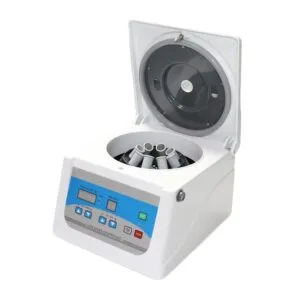
Centrifugation is a standard separation technique used to separate a mixture of insoluble solids from a liquid by using a centrifuge. A centrifuge is a machine which can spin test tubes containing suspensions at high speed. Centrifugation is often used when there is only a small amount of material. In hospitals, blood samples are centrifuged to separate the blood cells from the plasma.
3. What is decantation?
Decantation is a separation technique used to separate a mixture containing an insoluble solid from a liquid. The mixture is allowed to settle. The upper clear liquid is then carefully poured (decanted) into a clean container, leaving the lower solid in the container that originally held the mixture. This is a quick but inaccurate method of separating the components of a mixture.
4. What is evaporation?
Evaporation is a separation technique used to recover a soluble solute from its solvent. For example, salt can be separated from salt solution by evaporation.
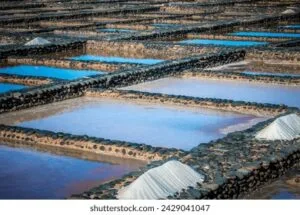
Salt is produced in the San Francisco area mainly by solar evaporation, where seawater is fed into large ponds that are gradually evaporated by the sun and the wind. After the water is evaporated, the salt is collected.
5. What is crystallisation?
Crystallisation is used to obtain pure crystals from a solution of salts that decompose easily on heating. The solution is concentrated by heating. It is then allowed to cool, and crystals start to form. To induce crystal formation:
- Add crystals of the salt (seeding).
- Scratch the inside of the container with a glass rod.
Crystallisation is used in industries where the purity of the product is important, such as the drug and sugar industries.
6. What is fractional crystallisation?
Fractional crystallisation is used to separate two or more solutes (solids) which are present in the same solution. The solutes to be separated must have different solubilities at different temperatures. As the solution is cooled from a particular temperature, the crystals of the relevant solutes appear, leaving the other solutes in the solution.
7. What is precipitation?
In precipitation, a difference in the solubility of a solid in two different miscible liquids is used. For example, FeSO4 is soluble in water but not in ethanol. If ethanol is added to a solution of FeSO4 in water, the FeSO4 will be precipitated out of the solution and can be filtered out.
8. What is sublimation?
Sublimation is the change of state from solid to gas directly through the application of heat. Examples of substances that sublime are iodine and ammonium chloride. Sublimation can be used to separate these substances from other materials. The pure crystal recovered is the sublimate.
9. What is distillation?
Distillation is used to recover a solvent from a solution. It involves vapour rising from a liquid and then condensing into a liquid called the distillate. The solute and other impurities remain in the distillation flask. It is used in gin and water distilleries to manufacture gin and distilled water.
10. What is fractional distillation?
Fractional distillation is used to separate a mixture of two or more miscible liquids based on their boiling points. When two liquids have boiling points that are very close (less than 100 °C), simple distillation becomes difficult. A fractionating column is then inserted into the distillation flask. Fractional distillation is used to separate crude oil into fractions, to separate liquid air into oxygen and nitrogen, to manufacture spirits and to separate a mixture of benzene and methyl benzene.
11. What is a separating funnel used for?
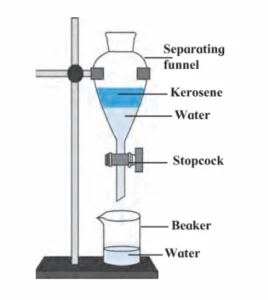
A separating funnel is used to separate immiscible liquids. It depends on the densities of the two liquids: the less dense liquid stays on top and the denser liquid is below. It is used to separate water and kerosene.
Diagram of a separating funnel
12. What is sieving?
Sieving is used to separate solid particles of different sizes. Particles smaller than the size of the sieve (mesh) pass through, leaving behind particles of larger sizes. It is used in gold and diamond mines and in garri industries.
13. What is magnetic separation?
Magnetic separation is used to separate magnetic substances from non-magnetic particles. It is used in the mining and steel industries. It can be used to remove magnetic impurities from tin ores. It can also be used to separate iron filings from sulphur powder.
14. What is chromatography?
Chromatography uses a solvent moving over a porous adsorbent medium (such as paper) to separate mixtures of solutes.
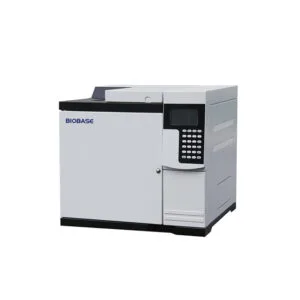
A chemist uses liquid chromatography to analyse a complex mixture of substances. The chromatograph uses an adsorptive medium which, when placed in contact with a sample, adsorbs the various constituents of the sample at different rates. In this way, the components of the mixture are separated. Chromatography has many valuable applications, such as determining the level of pollutants in the air, analysing drugs, and testing blood and urine samples.
Types of chromatography include:
- Paper chromatography
- Thin layer chromatography
- Gas chromatography
- Column chromatography
How is paper chromatography carried out?
A solution, such as ink, is spotted onto the paper near one end. The paper is dipped into an appropriate solvent such as water or ethanol in a closed, air-tight jar. The solvent moves up the paper. The paper is then removed and dried. The different spots on the paper show the different substances the solution (ink or dye) contains.
Chromatography is used in medicine to analyse blood. In industry, it is used to identify petroleum fractions. It is also used in scientific research.
What are the criteria for purity?
The melting point and boiling point of a pure substance are fixed but change in the presence of impurities. Impurities lower the melting point of a substance and increase its boiling point.
A pure substance gives one spot on a paper chromatogram.
Evaluation
- Which technique can be used to separate chalk particles from water?
- Explain how salt is recovered from salt solution.
- Why can a separating funnel be used to separate water and kerosene?
- When is fractional distillation used instead of simple distillation?
- Describe how paper chromatography is carried out.
Assignment
- Explain the following separation techniques: magnetic separation, paper chromatography and sieving.
- Describe how you would separate a mixture of NaCl, PbCl2 and NH4Cl.
- What method can be applied to separate a mixture of iron filings and sulphur?
- Mention two criteria for purity of a substance.
This term's Chemistry topics
SS1 Second Term · 4 topics
- Gas Law
- Standard Separation Techniques for Mixtures
- Acids
- Bases and Salts
Second Term Chemistry Lesson Notes for Other Topics

Nuclear Chemistry
Read the full lesson note.

Shapes and Molecules
Read the full lesson note.

Petroleum and Crude Oil
Read the full lesson note.
Volumetric Analysis
Read the full lesson note.

Qualitative Analysis
Read the full lesson note.
Thermodynamics
Read the full lesson note.
Sulphur
Read the full lesson note.
Non Metals: Oxgyen
Read the full lesson note.

Non Metals: Hydrogen
Read the full lesson note.
Chemical Reactions
Read the full lesson note.

Chemical Equilibruim
Read the full lesson note.
Nitrogens
Read the full lesson note.
Halogens
Read the full lesson note.

Energy, Energy Changes and Biotechnology
Read the full lesson note.

Bases And Salts
Read the full lesson note.
Lesson Notes for Other Classes

Basic 1 Lesson Note
The complete lesson note to guide your studies.

Basic 2 Lesson Note
The complete lesson note to guide your studies.

Basic 3 Lesson Note
The complete lesson note to guide your studies.

Basic 4 Lesson Note
The complete lesson note to guide your studies.

Basic 5 Lesson Note
The complete lesson note to guide your studies.

Basic 6 Lesson Note
The complete lesson note to guide your studies.

