
Classification of Livestock SS1 Livestock Farming Lesson Note
Download Lesson NoteTopic: Classification of Livestock
In our previous lessons, we looked at the history of farming in Nigeria. Today, we are going to group these animals based on a very important feature: how they eat and digest their food.
Not all farm animals have the same kind of stomach. Some can eat tough grass and turn it into meat, while others need grains and soft food just like humans do. Because of this, we divide livestock into two main groups: Ruminants and Non-Ruminants.
What are Ruminant Animals?
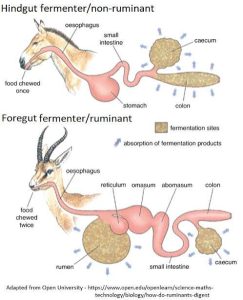
Ruminants are “complex-stomached” animals. They are famous for a behavior called “chewing the cud.” Have you ever seen a cow sitting under a tree, moving its mouth like it’s chewing gum, even though there is no grass in front of it? That is rumination. They swallow their grass quickly, and later, they bring it back up from their stomach to chew it again and make it softer.
Key Characteristics of Ruminants:
- Four-Chambered Stomach: They don’t just have one stomach bag. Their stomach is divided into four sections: the Rumen, Reticulum, Omasum, and Abomasum.
- Hooves: Most ruminants have split (cloven) hooves.
- Diet: They mainly eat forages (grass, hay, and legumes). They can digest tough fibers that humans cannot.
- No Upper Incisors: Instead of top front teeth, they have a tough “dental pad” to help them grip and tear grass.
Examples of Ruminants:
- Cattle (Cows/Bulls)
- Sheep
- Goats
What are Non-Ruminant Animals?
Non-ruminants are “simple-stomached” animals. They are also called Monogastrics. “Mono” means one, and “gastric” refers to the stomach.
These animals have a digestive system very similar to yours. They cannot digest large amounts of grass or fiber effectively. Instead, they need high-energy foods like maize, soy, and palm kernel cake.
Key Characteristics of Non-Ruminants:
- Single Stomach: They have one simple stomach compartment.
- Fast Digestion: Since their food is usually more refined (grains), it passes through them faster than grass passes through a cow.
- Diet: They eat concentrates (poultry mash, pig feed) and kitchen scraps.
- Teeth: Most have both upper and lower teeth to grind their food before swallowing.
Examples of Non-Ruminants:
- Poultry (Chickens, Turkeys, Ducks)
- Pigs
- Rabbits (Note: Rabbits are a bit special because they eat grass, but they are still technically non-ruminants with a special “side-bag” called a Cecum).
- Fish
Why Does This Classification Matter?
As a farmer, you must know which group your animal belongs to so you can feed them correctly.
- For Ruminants: You can save money by letting them graze on open pasture (grasslands). You don’t need to buy expensive grains all the time.
- For Non-Ruminants: You must provide balanced “mash” or “pellets.” If you give a chicken only dry grass, it will starve because its stomach cannot break it down.
Summary Table for Your Notebook
| Feature | Ruminants (Cattle, Goats) | Non-Ruminants (Pigs, Poultry) |
| Stomach Type | Complex (4 compartments) | Simple (1 compartment) |
| Chewing behavior | Chew the cud (Rumination) | Do not chew the cud |
| Main Diet | Grass and hay (Forages) | Grains and tubers (Concentrates) |
| Digestion Speed | Slow | Fast |
A Fun Fact to Remember
Did you know that Pigs are actually very efficient? Even though they have a simple stomach like us, they are excellent at converting waste food into meat very quickly. This is why pig farming is one of the most profitable businesses for modern farmers!
Class Activity
- Go outside and observe any goat or chicken nearby. Watch how they eat.
- Which animal spends more time “grinding” its food even when it’s not actively picking things off the ground?
- Homework: Draw a diagram of a cow’s stomach in your note and label the four parts.
First Term Livestock Farming Lesson Notes for Other Topics

Introduction to Animal Biotechnology
Explore lesson notes covering all topics.

Reproductive Technologies
Explore lesson notes covering all topics.
Animal Welfare and Ethics
Explore lesson notes covering all topics.

Farm Project Development
Explore lesson notes covering all topics.
Sustainable Livestock Farming
Explore lesson notes covering all topics.

Livestock Business Planning
Explore lesson notes covering all topics.

Entrepreneurship in Livestock
Explore lesson notes covering all topics.

Genetic Improvement
Explore lesson notes covering all topics.

Economics of Aquaculture
Explore lesson notes covering all topics.

Fish Marketing
Explore lesson notes covering all topics.

Fish Harvesting
Explore lesson notes covering all topics.

Fish Health and Diseases
Explore lesson notes covering all topics.

Feed Nutrition and Feeding
Explore lesson notes covering all topics.

Fish Breeds and Fingerlings
Explore lesson notes covering all topics.

Fish Pond Construction
Explore lesson notes covering all topics.


Lesson Notes for Other Classes

Basic 1 Lesson Note
The complete lesson note to guide your studies.

Basic 2 Lesson Note
The complete lesson note to guide your studies.

Basic 3 Lesson Note
The complete lesson note to guide your studies.

Basic 4 Lesson Note
The complete lesson note to guide your studies.

Basic 5 Lesson Note
The complete lesson note to guide your studies.

Basic 6 Lesson Note
The complete lesson note to guide your studies.