
Simple Electrical Wiring – JSS3 Home Economics Lesson Note (Second Term)
Download Lesson NoteLesson note at a glance
- Subject
- Home Economics
- Class
- JSS3
- Term
- Second Term
- Topic
- Simple Electrical Wiring
- Order
- Topic 12 of 13 this term
- Reading time
- 2 min
Simple electrical wiring i
Electric Circuit
An electric circuit is a closed loop or pathway through which electric current flows. It consists of interconnected components, such as resistors, capacitors, inductors, switches, and sources of electrical energy (like batteries or generators). The components in a circuit are connected by conductive wires that allow the flow of electric charge. Circuits can serve various purposes, from powering electronic devices to controlling complex systems.
Types of Electric Circuit
- Series Circuit: In a series circuit, components are arranged in a single path for the current to flow. The same current passes through each component one after the other. For example, the stringing lights on a Christmas tree in a series
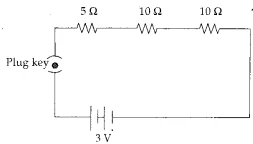
Characteristics:
– The total resistance is the sum of individual resistances.
– The current remains the same throughout the circuit.
– The voltage across the circuit is divided among the components.
– If one component fails (opens), the entire circuit is interrupted.
2. Parallel Circuit: In a parallel circuit, components are connected in multiple paths, allowing the current to flow through different branches simultaneously. For example, household electrical outlets.

Characteristics:
– Each component has its separate branch, and the current divides among the branches.
– The voltage across each component is the same.
– The total resistance is inversely proportional to the sum of the reciprocals of individual resistances.
– If one branch fails (opens), the others remain unaffected.
Comparison of series and parallel circuit
- Voltage:
– Series: Voltage is divided among components.
– Parallel: Voltage is the same across all components.
2. Current:
– Series: Current is the same throughout the circuit.
– Parallel: Current divides among branches.
3. Resistance:
– Series: Total resistance is the sum of individual resistances.
– Parallel: Total resistance is inversely proportional to the sum of reciprocals of individual resistances.
4. Failure Impact:
– Series: If one component fails, the entire circuit is interrupted.
– Parallel: Failure in one branch doesn’t affect others.
EVALUATION: 1. Define the electric circuit.
- Mention and explain the two types of electric circuit
- Sketch the series and parallel connection
This term's Home Economics topics
JSS3 Second Term · 13 topics
- Care Handling of Different Fabrics: Textiles III
- Textiles IV: the Basic Element of Design
- Sewing Machine and Garment Construction Process
- Sewing Machine and Garment Construction Process II
- Food Hygiene and Safety
- Causes and Sources of Food Contamination and Poisoning
- Metal Joining: Metalwork Projects I
- Tools for Metalwork: Metalwork Projects II
- Machine Motion: Motion in Engineering System
- Simple Electrical Wiring
- Woodwork Projects
Second Term Home Economics Lesson Notes for Other Topics

Kitchen Hygiene
Read the full lesson note.
First Aid Box
Read the full lesson note.
Kitchen: Definition and Types
Read the full lesson note.
Types of Home Cleaning II
Read the full lesson note.
Types of Home Cleaning I
Read the full lesson note.
Home Hygiene
Read the full lesson note.
Clothing Construction Continued. (Production of Seam Album)
Read the full lesson note.
Clothing Construction Continued. (Production of Seam Album)
Read the full lesson note.
Review of First Term Scheme of Work
Read the full lesson note.
Sewing Processes (Production Of An Article)
Read the full lesson note.
Basic Stitches (Decorative/ Embroidery Stitches)
Read the full lesson note.
Care Of Cooking Tools And Equipment
Read the full lesson note.
Cleaning Cooking Tools And Equipment
Read the full lesson note.

Basic Sitches (Permanent Stitches)
Read the full lesson note.

Cleaning Agents For Cooking Tools And Equipment
Read the full lesson note.
Lesson Notes for Other Classes

Basic 1 Lesson Note
The complete lesson note to guide your studies.

Basic 2 Lesson Note
The complete lesson note to guide your studies.

Basic 3 Lesson Note
The complete lesson note to guide your studies.

Basic 4 Lesson Note
The complete lesson note to guide your studies.

Basic 5 Lesson Note
The complete lesson note to guide your studies.

Basic 6 Lesson Note
The complete lesson note to guide your studies.

