
Simple Electrical Wiring – JSS3 Home Economics Lesson Note (Second Term)
Download this term · ₦1,000Lesson note at a glance
- Subject
- Home Economics
- Class
- JSS3
- Term
- Second Term
- Topic
- Simple Electrical Wiring
- Order
- Topic 12 of 13 this term
- Reading time
- 5 min
An electric circuit is a closed path through which electric current flows. The two types are the series circuit, with a single path for current, and the parallel circuit, with several paths.
Behavioural objectives
By the end of the lesson, students should be able to:
- define an electric circuit and simple electrical wiring;
- name the two types of electric circuit;
- state the characteristics of a series circuit and a parallel circuit;
- compare series and parallel circuits in terms of voltage, current, resistance and effect of failure;
- sketch a series circuit and a parallel circuit;
- list the parts of a simple wiring system and state basic safety rules.
What is an electric circuit?
An electric circuit is a closed loop or pathway through which electric current flows.
- Components: resistors, capacitors, inductors and switches.
- Energy source: a battery or generator that supplies electrical energy.
- Conductors: wires that join the parts and let electric charge flow.
- Uses: powering devices such as bulbs, fans and radios, and controlling systems.
- Closed path: current flows only when the loop is complete. An open switch breaks the loop.
What are the types of electric circuit?
There are two types of electric circuit: the series circuit and the parallel circuit.
What is a series circuit?
A series circuit is a circuit in which components are joined end to end in a single path for the current.
- Flow: the same current passes through each component one after the other.
- Example: some string lights on a Christmas tree are connected in series.
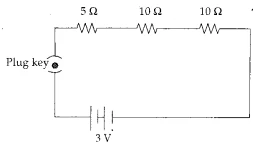
Characteristics of a series circuit:
- Resistance: the total resistance is the sum of the individual resistances.
- Current: the current is the same throughout the circuit.
- Voltage: the voltage is divided among the components.
- Failure: if one component fails (opens), the entire circuit is interrupted.
What is a parallel circuit?
A parallel circuit is a circuit in which components are connected in separate branches, so current flows through different paths at the same time.
- Flow: the current divides at a junction and joins again after the branches.
- Example: household electrical sockets are connected in parallel.

Characteristics of a parallel circuit:
- Branches: each component has its own branch, and the current divides among the branches.
- Voltage: the voltage across each component is the same.
- Resistance: the reciprocal of the total resistance equals the sum of the reciprocals of the individual resistances.
- Failure: if one branch fails (opens), the others remain unaffected.
How do series and parallel circuits compare?
A series circuit has one path for current. A parallel circuit has more than one path. The table shows the other differences.
| Feature | Series circuit | Parallel circuit |
|---|---|---|
| Paths | One path only. | Two or more paths. |
| Voltage | Voltage is divided among the components. | Voltage is the same across all components. |
| Current | Current is the same throughout the circuit. | Current divides among the branches. |
| Resistance | Total resistance is the sum of the individual resistances. | The reciprocal of the total resistance is the sum of the reciprocals of the individual resistances. |
| Effect of failure | If one component fails, the entire circuit is interrupted. | Failure in one branch does not affect the others. |
How do we calculate total resistance?
- Series: R = R1 + R2. Example: 2 ohms and 3 ohms give 5 ohms.
- Parallel: 1/R = 1/R1 + 1/R2. Example: 6 ohms and 3 ohms give 1/6 + 1/3 = 1/2, so R = 2 ohms.
What is simple electrical wiring?
Simple electrical wiring is the safe connection of cables, switches, sockets and lamps to carry electricity from a supply to appliances.
- Home use: sockets and lamps in a house are wired in parallel so each works on its own.
- Switch: a switch is placed in the live wire to control a lamp.
What are the parts of a simple wiring system?
- Cable: copper wire covered with plastic insulation that carries current.
- Switch: opens or closes the circuit to turn an appliance on or off.
- Socket outlet: the point where a plug connects an appliance to the supply.
- Plug: connects an appliance cable to the socket.
- Lamp holder: holds a bulb and joins it to the circuit.
- Fuse: a thin wire that melts and breaks the circuit when current is too high.
- Circuit breaker: a switch that trips automatically when current is too high.
What are the wires in a three-core cable?
A three-core cable has three wires: live, neutral and earth.
- Live wire: carries current from the supply to the appliance.
- Neutral wire: returns current to the supply to complete the circuit.
- Earth wire: carries stray current safely to the ground if there is a fault.
What tools are used for simple wiring?
- Screwdriver: tightens terminal screws.
- Pliers: hold and twist wires.
- Wire stripper: removes insulation without cutting the wire.
- Tester screwdriver: checks whether a wire is live.
- Insulating tape: covers bare joints.
How do we wire a three-pin plug?
- Switch off and unplug the supply before starting.
- Remove about 3 cm of the outer covering of the cable.
- Strip a small length of insulation from each wire.
- Connect the live wire to the live terminal (the one with the fuse).
- Connect the neutral wire to the neutral terminal.
- Connect the earth wire to the earth terminal.
- Tighten the cable grip over the outer covering.
- Fit a fuse of the correct rating and close the plug cover.
What are the safety rules for electrical wiring?
- Switch off: turn off the mains before touching any wiring.
- Dry hands: never handle plugs or switches with wet hands.
- Damaged cables: replace frayed or cracked cables at once.
- Overloading: do not connect too many appliances to one socket.
- Correct fuse: never replace a fuse with ordinary wire.
- Children: keep them away from sockets and bare wires.
- Experts: ask a qualified electrician to do major wiring.
Evaluation
- Define an electric circuit.
- Mention and explain the two types of electric circuit.
- State two differences between a series circuit and a parallel circuit.
- Sketch a series circuit and a parallel circuit.
- Name the three wires in a three-core cable and state the job of each.
Assignment
Draw a series circuit and a parallel circuit, each with a battery, a switch and two bulbs. Write two characteristics under each drawing.
This term's Home Economics topics
JSS3 Second Term · 13 topics
- Care Handling of Different Fabrics: Textiles III
- Textiles IV: the Basic Element of Design
- Sewing Machine and Garment Construction Process
- Sewing Machine and Garment Construction Process II
- Food Hygiene and Safety
- Causes and Sources of Food Contamination and Poisoning
- Metal Joining: Metalwork Projects I
- Tools for Metalwork: Metalwork Projects II
- Machine Motion: Motion in Engineering System
- Simple Electrical Wiring
- Woodwork Projects
Get Home Economics as PDF and Word
Every week of JSS3 Home Economics, Second Term, formatted and ready to print. Ad-free, and the copy lock comes off.
Get this term Card, bank transfer, USSD or OPay
JSS3 Home Economics Lesson Notes for Other Topics
Textiles Study
Read the full lesson note.
Textiles II - Fibres
Read the full lesson note.
Care Handling of Different Fabrics - Textiles III
Read the full lesson note.

Textiles IV- The Basic Element of Design
Read the full lesson note.
Sewing Machine And Garment Construction Process
Read the full lesson note.
Sewing Machine And Garment Construction Process II
Read the full lesson note.
Food Hygiene And Safety
Read the full lesson note.
Causes And Sources Of Food Contamination And Poisoning
Read the full lesson note.

Metal Joining - Metalwork Projects I
Read the full lesson note.
Tools for Metalwork - Metalwork Projects II
Read the full lesson note.
Machine Motion – Motion In Engineering System
Read the full lesson note.
Woodwork Projects
Read the full lesson note.
Family Budget
Read the full lesson note.
Decision Making
Read the full lesson note.

Consumer Challenges And Rights
Read the full lesson note.
Lesson Notes for Other Classes

JSS1 Lesson Note
The complete lesson note to guide your studies.

JSS2 Lesson Note
The complete lesson note to guide your studies.
