Speech Work: The Vowel Sounds – JSS3 English Lesson Note (Third Term)
Download Lesson NoteLesson note at a glance
- Subject
- English Studies
- Class
- JSS3
- Term
- Third Term
- Topic
- Speech Work: The Vowel Sounds
- Order
- Topic 1 of 4 this term
- Reading time
- 5 min
Speech work
Topic: the vowel sounds
In a phonetic definition, vowels are distinguished from consonants in terms of how they are articulated in the vocal tract and the associated patterns of acoustic energy.
When vowel sounds are produced, air escapes relatively unimpededly through the mouth or nose. Such articulation involves only slight moments of the tongue and lips.
Vowels can, therefore, be defined as the sounds produced with neither a complete nor a narrowing of the vocal tract. Vowel sounds are made when there is a free flow of air.
Vowel sounds can also be defined as the sound without obstruction to airflow as it passes from the larynx to the lips. Vowels are normally described concerning four criteria:
- The part of the tongue that is raised front, back, center, or lip.
- The extent to which the tongue raises in the direction of the palate-high, mid, or low. Alternatively, tongue height can be described as close, mid-close, mid-open, and open.
- The position of the soft palate is raised for oral vowels and lowered for nasalized vowels.
- The kind of opening made at the various degrees of rounding or spreading.
Types of vowel sounds
The vowel sounds of English can be classified into three
- Monothongs or pure vowels
- Diphthongs or impure vowels
- Triphthongs
The monophthongs
A vowel is monophthongs or pure when only one sound is involved. The monophthongs are twelve. However, they are further divided into two groups thus: the short and long vowels.
- The Short Vowels: They are so-called due to the brevity of the sounds they denote during the speech process. They are as follows: /i/, /e/, /u/, /əe/, /ə/, /ɔ/, and /ʌ/. The seven short vowel sounds can also be called lax vowels.
- The Fine Long Vowel: Which can also be called the tense vowels are fine. They include /i:, a:, ɔ:, u:, ɛ:/
The twelve monthongs
- /I:/ – This is a long sound, produced by raising the front of the tongue towards the hard palate; the lips are spread to a neutral position, and the air is forced through. Examples are found in words like read, see, chief, key be, etc.
- /i/ – This is a short form of vowel one. it is produced by raising the front of the tongue towards the hand palate. Especially the central position of the palate and the middle part of the tongue is raised slightly higher than the half-closed position and the lips are somewhat spread. Examples; fit, little, hill, ship, etc.
- /e/ – The vowel is produced by raising the front of the tongue and the middle of the tongue to about half the distance between close and open, and the lips between being spread and neutral. Examples are words like bet, egg, spread, pen, get, pet, etc.
- /əe/ – This is produced by raising the blade of the tongue and the middle of the tongue to about one-sixth of the distance between open and close, and the lips between neutral and spread. Examples are words like: – bad, mat, man, match, back, bag, etc.
- /a:/ – This vowel involves the back of the tongue unlike the previous ones, the middle of the tongue is quite low down in the mouth, and the lips are in the neutral position. Examples – father, calm, clerk, laugh, dark, saga, class, pass, etc.
- /ɔ/ – This is articulated with the back of the tongue. While the lips are slightly rounded, the jam is usually open during pronunciation. The vowel is not quite fully back and between open – mid and open in tongue height. Examples not, box, long, spot, bought, because, cop, cough, what, want, etc.
- /ɔ:/ – This is the long variant of vowel 6. It is produced by raising the back of the tongue, slightly raising the middle of the tongue, and rounding the lips very considerably. Examples – saw, law, caught, fought, cord, sword, etc.
- /u/ – This sound is produced by raising the back of the tongue toward the soft palate (root of the mouth), raising the middle of the tongue in a little above half close position, and closely rounding the lips. It is a short vowel with examples – put, foot, book, push, would, could, bought, woman, bosom, circular, bullet, etc.
- /u:/ – This sound is made right at the top and back of the mouth and the lips are moderately rounded. During production, the tongue is raised to a certain height towards the soft palate, and the middle of the tongue is produced by raising the back of the tongue almost to a close position and closely rounding the lips. Examples – two, food, moot, canoe, shoe, do, to, move, mute, rule, fruit, juice, suit, etc.
- /ʌ/- This is a short sharp vowel, produced by raising the back of the tongue, though not fully, raising the middle of the tongue somewhat halfway, and leaving the lips a difficult sound for most Nigerians. Examples: cut, but mother, cup, stuck, done, some, sum, does, worry come, love, couple, etc.
- / ɛ:/ – This is a long weak vowel, which is produced by raising the central part of the tongue and the lips in a central position. Is a central vowel that is often spelled “er”. It is pronounced “air” – – (r) – – (r). examples: fern, bird, girl, earth, journey, tournament, scourge, thirst, thirty, circuit, skirt, etc.
- /ə/ – This is a short, weak vowel, which is produced by raising the central part of the tongue and the lips kept in a neutral position. It occurs mostly in unaccented syllables. It is called the schwa sound. It is generally not articulated with much energy. Examples: Mature, formula, curable, matter, doctor, neighbour, famous, confused, today, etc.
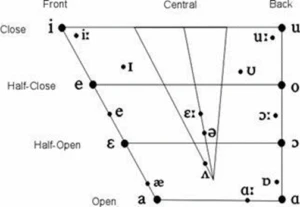
It is the most frequently occurring vowel for monophthongs, it is usual to represent the position where each is articulated in the mouth.
Cardinals vowel chart
This term's English Studies topics
JSS3 Third Term · 4 topics
- Speech Work: The Vowel Sounds
- Grammar & Composition: Noun & Essay Writing
- Vowel Sounds: Diphthongs
- Grammar: Definite & Indefinite Articles
Third Term English Studies Lesson Notes for Other Topics
Reading: Days of The Week
Read the full lesson note.
Vocabulary: Self & Family Members
Read the full lesson note.

Structure: Continuous Actions
Read the full lesson note.
Phonics: Pronunciation Practice II
Read the full lesson note.
Reading: Song on Habitual Actions
Read the full lesson note.
Vocabulary: New Words II
Read the full lesson note.

Structure: Habitual Actions (Simple Present Tense)
Read the full lesson note.

Simple Greetings & Commands
Read the full lesson note.
Phonics: Expressing Gratitude & Farewell
Read the full lesson note.

Reading: Basic Reading Skills
Read the full lesson note.
Vocabulary: New Words
Read the full lesson note.
Structure: Asking About Numbers of Objects
Read the full lesson note.

Phonics: Basic Sounds in Words
Read the full lesson note.
Writing: Word Formation
Read the full lesson note.

Phonics: Pronunciation Practice III
Read the full lesson note.
Lesson Notes for Other Classes

Basic 1 Lesson Note
The complete lesson note to guide your studies.
Basic 2 Lesson Note
The complete lesson note to guide your studies.
Basic 3 Lesson Note
The complete lesson note to guide your studies.
Basic 4 Lesson Note
The complete lesson note to guide your studies.
Basic 5 Lesson Note
The complete lesson note to guide your studies.
Basic 6 Lesson Note
The complete lesson note to guide your studies.