
Thermal Energy: Heat Transfer – JSS2 Basic Science Lesson Note (Third Term)
Download this term · ₦1,000Lesson note at a glance
- Subject
- Basic Science
- Class
- JSS2
- Term
- Third Term
- Topic
- Thermal Energy: Heat Transfer
- Order
- Topic 2 of 8 this term
- Reading time
- 4 min
Heat transfer is the flow of energy from an object at a higher temperature to one at a lower temperature.
- Conduction: heat moves through particle collisions.
- Convection: heat moves through the flow of fluids (liquids and gases).
- Radiation: heat moves through electromagnetic waves.
- Stopping point: heat keeps flowing until both objects reach the same temperature.
Behavioural objectives
By the end of the lesson, students should be able to:
- explain the difference between temperature and heat;
- define conduction, convection and radiation;
- state which of the three methods needs matter to carry the energy and which does not;
- give everyday examples of conduction, convection and radiation;
- name common conductors and insulators of heat.
What are temperature and heat?
Temperature is a measure of the average kinetic energy of the particles in a sample of matter.
- Particle motion: particles vibrate, move about and rotate; the faster they move, the higher the temperature.
- Unit: temperature is measured in degrees Celsius (°C) with a thermometer.
Heat is the energy that flows from a higher-temperature object to a lower-temperature object.
- Cause: the temperature difference between two neighbouring objects makes heat flow.
- Unit: heat is energy, so it is measured in joules (J).
- Example: heat passes from hot water to cold water until both have the same temperature.
| Point | Temperature | Heat |
|---|---|---|
| Meaning | How hot or cold an object is | Energy that flows because of a temperature difference |
| Measured with | Thermometer | Joules (energy unit) |
| Unit | °C | J |
What is conduction?
Conduction is the transfer of heat through a material by particle collisions, with no flow of the material itself.
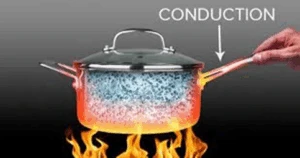
How does conduction happen?
- The hot end of the object gains energy, so its particles vibrate faster.
- These particles collide with their neighbours.
- The neighbours gain energy and pass it on.
- Energy moves along the object to the cooler end.
- Best in solids: particles are close together, so energy passes quickly.
- Poor in gases: particles are far apart, so collisions are fewer.
What are conductors and insulators?
- Conductor: a material that allows heat to pass through easily, such as copper, iron and aluminium.
- Insulator: a material that does not allow heat to pass easily, such as wood, plastic, cloth and air.
Applications of conduction
- Cooling a glass in an ice bucket: heat passes from the drink through the glass to the ice.
- Burning your hand on a hot tripod: heat passes through the metal into your skin.
- Holding the handle of a pan: the handle is made of wood or plastic, which are insulators.
What is convection?
Convection is the transfer of heat from one place to another by the movement of a fluid.
- Fluid: a liquid or a gas, such as water or air.
- Carrier: the moving fluid carries energy with it.
- Not in solids: solid particles cannot flow from place to place.
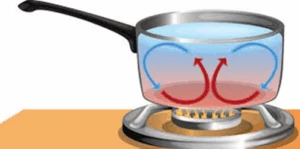
How does convection happen in a pot of water?
- The flame heats the water at the bottom.
- The warm water expands and becomes less dense.
- The warm water rises.
- Cooler, denser water from the top sinks to take its place.
- This repeating flow is called a convection current.
Applications of convection
- Boiling water: convection currents spread heat through the pot.
- Hot air balloon rising: the heated air inside is less dense, so it lifts the balloon.
- Layers of water in a lake: warm, less dense water stays at the surface and colder water stays at the bottom.
- Air conditioning cooling a room: cool air sinks and warmer air rises to be cooled.
- Cooking rice in water: moving hot water carries heat to the rice.
What is radiation?
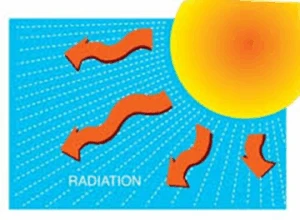
Radiation is the transfer of heat by electromagnetic waves, and it needs no matter to carry the energy.
- Travels through empty space: this is how the Sun’s energy reaches the Earth.
- Dark, dull surfaces: they absorb and give out radiation well.
- Light, shiny surfaces: they reflect radiation, so they stay cooler in sunlight.
Applications of radiation
- The Sun warming the Earth: the energy crosses space as waves.
- Feeling warm in sunlight: your skin absorbs the radiation.
- Feeling heat beside a stove burner: the hot burner gives out radiation in all directions.
- Barbecuing meat with charcoal: radiation carries heat from the glowing charcoal to the meat, and conduction then carries it inside the meat.
What is the difference between conduction, convection and radiation?
| Point | Conduction | Convection | Radiation |
|---|---|---|---|
| How heat moves | Particle collisions | Moving fluid | Electromagnetic waves |
| Needs matter? | Yes | Yes | No |
| Usual state of matter | Solids | Liquids and gases | Any, or empty space |
| Example | Hot tripod | Boiling water | Sunlight |
Evaluation
- What is temperature?
- Define conduction and give two examples.
- How does convection transfer heat?
- Which method of heat transfer does not need matter?
- Explain how heat moves when meat is barbecued with charcoal.
Assignment
Write one sentence each to explain conduction, convection and radiation. Choose one example of each from this note and describe how heat is transferred in it.
This term's Basic Science topics
JSS2 Third Term · 8 topics
Get Basic Science as PDF and Word
Every week of JSS2 Basic Science, Third Term, formatted and ready to print. Ad-free, and the copy lock comes off.
Get this term Card, bank transfer, USSD or OPay
JSS2 Basic Science Lesson Notes for Other Topics
Thermal Energy: Heat Flow
Read the full lesson note.
Reproductive Health - Genetic Counselling
Read the full lesson note.

Abstinence
Read the full lesson note.

Chemicals
Read the full lesson note.
Chemicals: Safety Measures
Read the full lesson note.
Drug Abuse
Read the full lesson note.

Crude Oil And Petrochemicals
Read the full lesson note.
Habitat Of Living Things
Read the full lesson note.
Adaptation of Living Things to Their Environment
Read the full lesson note.
Relationship Between Organisms In The Same Environment
Read the full lesson note.
Uniqueness Of Human Development
Read the full lesson note.
Measurement Of Growth Human Developmental Changes
Read the full lesson note.
Human Growth And Development
Read the full lesson note.
Human Growth And Development - Puberty
Read the full lesson note.
Body Image
Read the full lesson note.
Lesson Notes for Other Classes

JSS1 Lesson Note
The complete lesson note to guide your studies.

JSS3 Lesson Note
The complete lesson note to guide your studies.
