
Fraction: Meaning & Types of Fractions – JSS1 Mathematics Lesson Note (First Term)
Download Lesson NoteLesson note at a glance
- Subject
- Mathematics
- Class
- JSS1
- Term
- First Term
- Topic
- Fraction: Meaning & Types of Fractions
- Order
- Topic 2 of 6 this term
- Reading time
- 2 min
A fraction is a portion or part of a whole. The number at the top is the numerator and the number at the bottom is the denominator. Fractions can be common (proper or improper) or decimal, and fractions with the same value are called equivalent fractions. A pie cut into slices shows how a whole is shared into fractions.
Behavioural objectives
By the end of the lesson, students should be able to:
- explain what a fraction is, and name the numerator and the denominator;
- identify common (regular) fractions, decimal fractions, proper fractions and improper fractions;
- change an improper fraction to a mixed number and a mixed number to an improper fraction;
- find equivalent fractions and fill in the missing numbers in them.
What is a fraction?
A fraction is a portion or part of a whole. Imagine a whole as a complete object.
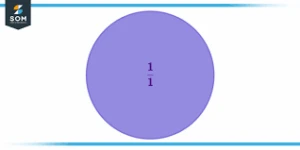
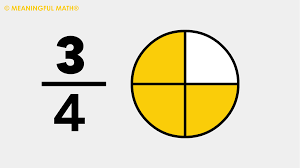
For example, the pie below is a whole that can be cut into sectors (or slices) representing different fractions as follows:
Whole (1)
Half (1/2)

Half-pie
Three-quarters (3/4)
What are the types of fractions?
- Common or regular fractions: ½, ¼, ¾, 3/8 and 5/8 are common fractions. Each is written as one number over another. The number on the top is called the numerator. The number at the bottom is called the denominator.
- Decimal fractions: these are also called decimals, for example 0.897 and 7.864.
- Proper fractions: the numerator is less than the denominator, for example 2/5 and ¼.
- Improper fractions: the numerator is greater than the denominator, for example 8/3 and 12/5.
How do you change between improper fractions and mixed numbers?
Example 1: Change 15/4 to a mixed number.
Example 2: Change to an improper fraction.
What are equivalent fractions?
Fractions that have the same value are said to be equivalent. Examples are ½, 2/4, 3/6, 4/8, 5/10 and 6/12.
Example 1
Convert 2/9 into an equivalent fraction with the denominator 54.
Solution:
2/9 = __/54 (divide the second denominator by the first denominator to obtain the multiplier.)
54 ÷ 9 = 6
Therefore, use the 6 to multiply the numerator: 2 × 6 = 12.
2/9 = 12/54
Example 2
Find the missing parts of these fractions: __/10 = 12/__ = 20/50 = __/80
Solution:
Step 1: Use 20/50 as your reference fraction because both its numerator and denominator are given. 20/50 = 2/5.
To find the numerator of __/10, divide 10 by the denominator 5: 10 ÷ 5 = 2. Use 2 to multiply both parts of 2/5, so 2/5 = 4/10.
Step 2: Use the 2 to divide the numerator of 12/__ to get 6. Use the 6 to multiply 2/5, so 2/5 = 12/30.
Step 3: Use 5 to divide the denominator of 80 to get 16. Use 16 to multiply 2/5, so 2/5 = 32/80.
So 4/10 = 12/30 = 20/50 = 32/80.
Evaluation
- Express each of the following fractions as a mixed number: (a) 9/5 (b) 15/2
- Express each of the following fractions as an improper fraction: (a) 11/2 (b) 43/8
- Copy and complete each of the following:
- 3/5 = __/15
- 4/7 = 12/__ = __/35 = __/49 = 44/__
This term's Mathematics topics
JSS1 First Term · 6 topics
First Term Mathematics Lesson Notes for Other Topics
Whole Numbers - Counting & Writing 1-10
Read the full lesson note.
Whole Numbers - Counting & Writing 1-20
Read the full lesson note.
Whole Numbers 1-30 (Continued)
Read the full lesson note.
Numbers & Quantities 1-20
Read the full lesson note.
Whole Numbers 1-40 (Continued)
Read the full lesson note.
Comparing & Ordering Numbers 1-50
Read the full lesson note.
Counting & Writing Skills Review
Read the full lesson note.
Counting Skill: Numbers 51-60
Read the full lesson note.
Addition: Two 1-Digit Numbers (Sum ≤ 10)
Read the full lesson note.

Counting Skills: Numbers 61-70
Read the full lesson note.

Comparison & Ordering Numbers: 1-50
Read the full lesson note.

Whole Numbers
Read the full lesson note.
Addition and Subtraction of Whole Numbers
Read the full lesson note.
Addition and Subtraction of Whole Numbers
Read the full lesson note.
Division of Whole Numbers
Read the full lesson note.
Lesson Notes for Other Classes

Basic 1 Lesson Note
The complete lesson note to guide your studies.

Basic 2 Lesson Note
The complete lesson note to guide your studies.

Basic 3 Lesson Note
The complete lesson note to guide your studies.

Basic 4 Lesson Note
The complete lesson note to guide your studies.

Basic 5 Lesson Note
The complete lesson note to guide your studies.

Basic 6 Lesson Note
The complete lesson note to guide your studies.

