
The Human Body – JSS1 Home Economics Lesson Note (First Term)
Download this term · ₦1,000Lesson note at a glance
- Subject
- Home Economics
- Class
- JSS1
- Term
- First Term
- Topic
- The Human Body
- Order
- Topic 3 of 9 this term
- Reading time
- 5 min
The human body is the whole physical structure of a person, made up of different parts that each do a particular job.
Behavioural objectives
By the end of the lesson, students should be able to:
- Name some parts of the human body.
- State the functions of the hair and ways of caring for it.
- Name the parts of the eye and state their functions.
- Describe ways of caring for the eyes.
- Name common eye defects.
What are the parts of the human body?
The parts of the human body include the head, eyes, nose, ears, teeth, skin, hands, fingers, nails and feet.
- Position: some parts are inside the body, while others are outside.
- Function: each part has its own job.
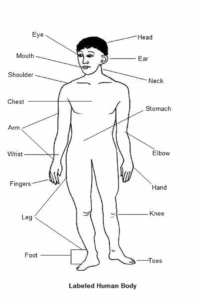
What does each outer part of the body do?
- Head: holds the brain, eyes, nose, ears and mouth.
- Eyes: used for seeing.
- Nose: used for smelling and breathing.
- Ears: used for hearing.
- Teeth: used for biting and chewing food.
- Skin: covers and protects the body, and is the organ of touch.
- Hands and fingers: used for holding, writing, eating and working.
- Nails: protect the tips of the fingers and toes.
- Feet: support the body for standing, walking and running.
What are the five sense organs?
The five sense organs are the eyes, ears, nose, tongue and skin.
| Sense organ | Sense |
|---|---|
| Eyes | Sight |
| Ears | Hearing |
| Nose | Smell |
| Tongue | Taste |
| Skin | Touch |
What is the hair?
The hair is the fine thread-like growth that covers the scalp and other parts of the skin.
What is the structure of the hair?
- Hair follicle: a narrow tube in the skin from which each hair grows.
- Oil gland: a tiny gland near the base of each follicle.
- Oil: made by the gland to lubricate the hair and soften the skin around it.
What are the functions of the hair?
- It protects the head.
- It keeps the head warm in cold weather.
- It improves personal appearance and adds beauty to a person.
How do we care for the hair?
We care for the hair by keeping it clean, combed and oiled.
- Wash or shampoo often: short hair can be washed daily, while long hair can be washed at least once a week.
- Comb or brush thoroughly: this removes dirt and dry scales (dandruff). It also stimulates the circulation of blood and keeps the hair healthy.
- Oil regularly: this prevents dryness of the hair and scalp. Excessive dryness could lead to hair damage.
- Extra tip: use your own comb and brush, and do not share them.
What is the eye?
The eye is the sense organ used for seeing.
- Sense organ: it is one of the five sense organs.
- Parts: it is made up of different parts, and each part has a special function.
- Why learn the parts: knowing them helps you take good care of your eyes.
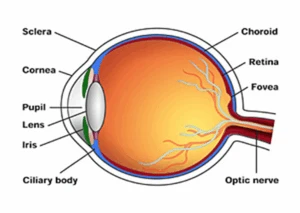
What are the parts and functions of the eye?
The eye has ten parts in this lesson, from the eyebrow on the outside to the retina inside.
| Part | Function |
|---|---|
| The eyebrow | Prevents sweat from running down into the eyes |
| The eyelashes | Protect the eyes from dust and dirt |
| The eyelids | Can close to protect the eye from foreign objects |
| The eyeballs | These are the organs of sight. Each is connected to the brain by the sensory nerve called the optic nerve |
| The cornea | A protective layer. It keeps dust and dirt from passing through the pupil of the eyes |
| The iris | The coloured part of the eye. It surrounds the pupil |
| The pupil | The hole in front of the eyeball through which light rays pass into the eye |
| The lens | A glass-like part of the eye. It focuses the light rays into one spot on the retina, thus forming the image |
| The retina | A light-sensitive spot where images are formed |
| The tear gland | Pours out tears over the front of the eyes. The tears wash away any dust which enters the eye |
How does a person see?
Seeing happens when light from an object enters the eye and forms an image on the retina.
- Light rays from an object pass through the cornea.
- The rays go through the pupil, which is surrounded by the iris.
- The lens focuses the rays into one spot on the retina.
- An image forms on the retina.
- The optic nerve carries the message to the brain.
How do we care for the eyes?
We care for the eyes by protecting them from harm, resting them and eating the right food.
- Do not look directly at an electric light or the sun.
- Use good light when reading or doing any work such as sewing. Poor light strains the eyes.
- Do not wash your eyes with disinfectant unless on a doctor’s advice.
- Do not fix your eyes on one thing for a long time. Avoid excessive screen time (television) and reading, writing or sewing for a very long period. Relax the eyes by looking up from time to time.
- Eat food rich in vitamin A, such as carrots, green vegetables and red palm oil.
- Avoid using another person’s glasses.
What are the common eye defects?
There are three common eye defects: long-sightedness, short-sightedness and night blindness.
- Long-sightedness: a person cannot see objects that are too near, but objects that are far can be seen.
- Short-sightedness: a person cannot see objects that are far away, but objects that are near can be seen.
- Night blindness: a person cannot see in the dark.
What is the difference between long-sightedness and short-sightedness?
Long-sightedness is poor near vision with clear far vision. Short-sightedness is poor far vision with clear near vision.
| Defect | Can see clearly | Cannot see clearly |
|---|---|---|
| Long-sightedness | Far objects | Near objects |
| Short-sightedness | Near objects | Far objects |
What should a person with an eye defect do?
- See an eye doctor: a doctor tests the eyes and advises on treatment.
- Wear the right glasses: glasses prescribed by a doctor help many people to see clearly.
- Eat vitamin A foods: carrots, green vegetables and red palm oil help the eyes.
Evaluation
- Mention six parts of the eye and their functions.
- Name the five sense organs.
- State three functions of the hair.
- List four ways of caring for the eyes.
- Name three common eye defects.
Assignment
Draw and label the structure of the eye.
This term's Home Economics topics
JSS1 First Term · 9 topics
Get Home Economics as PDF and Word
Every week of JSS1 Home Economics, First Term, formatted and ready to print. Ad-free, and the copy lock comes off.
Get this term Card, bank transfer, USSD or OPay
JSS1 Home Economics Lesson Notes for Other Topics
Home Economics And National Development
Read the full lesson note.

Introduction To Home Economics
Read the full lesson note.
The Human Body II - The Nose & Ear
Read the full lesson note.
The Human Body III - Structure of the Skin
Read the full lesson note.
The Human Body IV - The Teeth, Hands & Feet
Read the full lesson note.

Good Posture And Exercise
Read the full lesson note.
Healthy Feeding And Eating Practices
Read the full lesson note.

Healthy Feeding And Eating Practices II
Read the full lesson note.
The Family
Read the full lesson note.
The Home
Read the full lesson note.
Care Of The Family House
Read the full lesson note.

Production Of Cleaning Agents, Deodorants, Cosmetics
Read the full lesson note.

Production Of Cosmetics
Read the full lesson note.
Safety, Quality, And Regulatory Control Of Cosmetics Products In Nigeria
Read the full lesson note.

Family Needs, Goals And Standards
Read the full lesson note.
Lesson Notes for Other Classes

JSS2 Lesson Note
The complete lesson note to guide your studies.

JSS3 Lesson Note
The complete lesson note to guide your studies.
