
Boring & Cutting Tools – Wood Work Hand Tools JSS1 Basic Technology Lesson Note
Download Lesson NoteTopic: Boring & Cutting Tools – Wood Work Hand Tools
WOODWORK HAND TOOLS-BORING TOOLS, CUTTING TOOLS
BORING TOOLS
Boring tools are the tools used for making holes in wood. The major types are
1. The brace
2. The bits
3. Gimlet
4. Bradawl
THE BRACE: This is a tool used for holding and turning the drill bits or twisting the drill when drilling a hole. There are two types of brace and they are plain brace and ratchet brace.
Parts of the brace are the head, crank, chuck, and ratchet.
The head: this is made of hardwood and shaped to fit the hand of the user. It is screwed to a steel sleeve it fits over the crank rod and runs on the hardened steel balls.
The crank: This is a rectangular bent metal rod, that fits into a hardwood plastic handle. It moves in a circular way called “the sweep of the brace”.
The chuck: the end of the crank is enlarged, threaded, and slotted to receive the socket and the jas respectively.
The ratchet: This is a mechanical device fitted to the brace so that holes can be braced in confined places such as close corners and enable the use of “Half the sweep” of the brace. A ratchet brace allows the bit to be rotated in one direction only.
BITS: A bit is a tool used in wood. Bits generally have a threaded centre point for drawing.
TYPES OF DRILL BITS
1. Twist drill
2. Twist bits or auger
3. Countersink bits
1. BRADAWL: This is used to make small holes in wood before using screws or nails. It can also be used to mark the position of a hole before drilling.
2. GIMLET: This is used chiefly to make holes in wood before inserting small screws and nails.
EVALUATION
1. What are boring tools?
2. Mention three types of boring tools and state their uses.
CUTTING TOOLS
A saw is a tool for sawing or cutting wood into two or more parts. The teeth of saws are set alternately left and right to allow clearance.
TYPES OF SAW
We have various types of saws based on their specific operational usefulness.
These are:
1. RIP SAW
2. CROSS-CUT SAW
3. PANEL SAW
4. BACKSAW
5. TENON SAW
6. DOVETAIL SAW
7. COPING SAW
8. FRET SAW
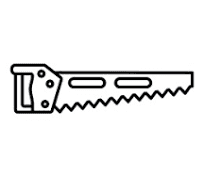
RIP SAW
This is used for sawing along the grain of wood. It has 4-5 points per 25mm and it is 610-710mm long
CROSS-CUT SAW
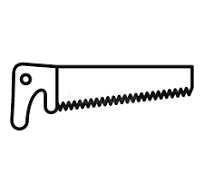
This is used for cutting wood across the grain. It is similar to the rip saw in appearance but it is only 460mm-10mm long. It has 6-9point per 25mm.
PANEL SAW
This is a saw that is capable of doing the work of both the rip saw and the cross-cut saw. It is an all-purpose saw>It is 460-550mm.
BACK SAW
This saw is called a backsaw because it has a steel or brass beck.
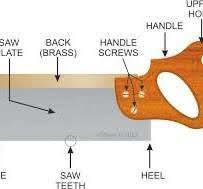
These include
- Tenon saw
- Dovetail saw
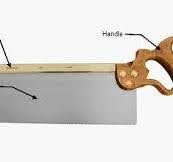
TENON SAW
The tenon saw is used for cutting tenons, joints, and other small jobs on the bench. It has a folded steel or brass back pressed to the blade. This gives it stiffness and weight when cutting. They saw 12 –14 points per 25mm and a length of 200-350mm.
DOVETAIL SAW
The saw is used for dovetailing and other small jobs on the bench. It is a smaller version of the tenon saw, but has an open handle. The length is 200- 260 mm. It has 20 points per 250mm.
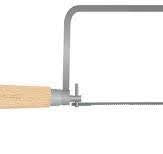
COPING SAW
This is used for cutting accurate curves in thin wood and plywood. The blade can be adjusted to cut in any direction. The blade is about 150 mm long and has about 14 points per 25mm.
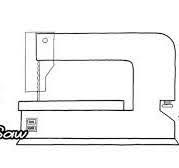
FRET SAW
It is used for complex shapes and curves in plywood and veneers. The blade of this saw is finer than the coping saw blade. It has a high frame, which allows it to be used over a wide area.
EVALUATION QUESTIONS
1. What is a saw?
2. State 7 types of saws
3. Describe the following saw and its uses (a) fret saw (b) panel saw
Third Term Basic Technology Lesson Notes for Other Topics

Health and Hygiene
Explore lesson notes covering all topics.

Simple Machines
Explore lesson notes covering all topics.

Booting
Explore lesson notes covering all topics.

Teeth Brushing
Explore lesson notes covering all topics.

Simple Machines - The Safe Use of Simple Machines
Explore lesson notes covering all topics.

Care of the Nails and Hair
Explore lesson notes covering all topics.

Concept of Technology
Explore lesson notes covering all topics.

Steps of Booting
Explore lesson notes covering all topics.

Cleanliness
Explore lesson notes covering all topics.

Technology in Home - Electric Gadgets
Explore lesson notes covering all topics.

First Aid
Explore lesson notes covering all topics.

Technology in Transportation - Land and Air
Explore lesson notes covering all topics.

First Aid (Continued)
Explore lesson notes covering all topics.

What Is Water Transportation?
Explore lesson notes covering all topics.

My Desktop (Review)
Explore lesson notes covering all topics.


Lesson Notes for Other Classes
Basic 1 Lesson Note
The complete lesson note to guide your studies.

Basic 2 Lesson Note
The complete lesson note to guide your studies.

Basic 3 Lesson Note
The complete lesson note to guide your studies.

Basic 4 Lesson Note
The complete lesson note to guide your studies.

Basic 5 Lesson Note
The complete lesson note to guide your studies.

Basic 6 Lesson Note
The complete lesson note to guide your studies.