
Didárúkọ Ẹyà Ara – Basic 1 Yoruba Lesson Note (Third Term)
Download this term · ₦1,000Lesson note at a glance
- Subject
- Yoruba
- Class
- Basic 1
- Term
- Third Term
- Topic
- Didárúkọ Ẹyà Ara
- Order
- Topic 6 of 6 this term
- Reading time
- 4 min
This Yoruba lesson for Basic 1 covers three topics: naming body parts (Ẹyà Ara), the crowned kings of Yorubaland (Ọba Aládé) with their towns, and birds (Ẹyẹ) in a short story. Students learn the Yoruba names, use them in simple sentences, and practise with songs, drawings and exercises.
Behavioural objectives
By the end of the lesson, students should be able to:
Language (Èdè): body parts
- Name body parts in Yoruba
- Use body part names in simple sentences
- Draw pictures showing body parts
Culture (Àṣà): crowned kings
- Name crowned kings
- Say their towns
- Write their names
Literature (Lítíréṣọ̀): birds
- Name common birds
- Talk about birds
- Draw pictures of birds
Language (Èdè): what are the body parts in Yoruba?
Head area (Agbègbè Orí)
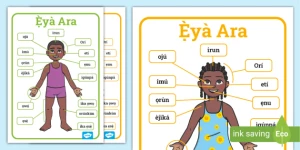
| No. | Yoruba | English |
|---|---|---|
| 1 | Orí | Head |
| 2 | Irun | Hair |
| 3 | Ojú | Eyes |
| 4 | Imú | Nose |
| 5 | Ẹnu | Mouth |
| 6 | Etí | Ears |
| 7 | Ẹ̀rẹ̀kẹ́ | Cheeks |
| 8 | Àgbọ̀n | Chin |
| 9 | Ẹ̀yín | Teeth |
| 10 | Ahọ́n | Tongue |
Upper body (Òkè Ara)
| No. | Yoruba | English |
|---|---|---|
| 11 | Ọrùn | Neck |
| 12 | Èjìká | Shoulder |
| 13 | Àyà | Chest |
| 14 | Apá | Arm |
| 15 | Ikùn | Stomach/Belly |
| 16 | Ẹ̀gbẹ́ | Side/Rib |
| 17 | Ẹ̀yìn | Back |
Lower body (Ìsàlẹ̀ Ara)
| No. | Yoruba | English |
|---|---|---|
| 18 | Ìdí | Buttocks/Bottom |
| 19 | Itan | Thigh |
| 20 | Orúnkún | Knee |
| 21 | Ẹsẹ̀ | Leg/Foot |
Hands (Ọwọ́)
| No. | Yoruba | English |
|---|---|---|
| 22 | Ọwọ́ | Hand |
| 23 | Ìka ọwọ́ | Fingers |
| 24 | Èékánná | Fingernails |
Inside the body (Inú Ara)
| No. | Yoruba | English |
|---|---|---|
| 25 | Ọkàn | Heart |
| 26 | Ẹ̀dọ̀ | Liver |
Simple sentences
- Orí mi dára (My head is fine)
- Mo fi ọwọ́ jẹun (I eat with my hand)
- Mo fi ẹsẹ̀ rìn (I walk with my legs)
- Mo fi ojú ríran (I see with my eyes)
- Mo fi etí gbọ́ (I hear with my ears)
Body parts song
Orí, ojú, imú, ẹnu
Etí àti ọrùn
Apá, ọwọ́, ikùn, ẹsẹ̀
Gbogbo ara wa dára!
Culture (Àṣà): who are the crowned kings of Yorubaland?
Ọba Aládé Ní Ilẹ̀ Yorùbá means “crowned kings in Yorubaland”. Each king belongs to a town and has a title.
Major Yoruba kings
| No. | King | Town | Note |
|---|---|---|---|
| 1 | Ọọ̀ni of Ifẹ̀ | Ilé-Ifẹ̀ | Spiritual leader |
| 2 | Aláàfin of Ọ̀yọ́ | Ọ̀yọ́ | Historical empire |
| 3 | Ọba of Lagos | Èkó/Lagos | Commercial centre |
| 4 | Olúbàdàn of Ìbàdàn | Ìbàdàn | Largest Yoruba city |
| 5 | Aláké of Ẹ̀gbá | Àbẹ́òkúta | Ẹ̀gbá leader |
| 6 | Olúwo of Ìwó | Ìwó | Ancient town |
| 7 | Àtaójà of Ọ̀ṣogbo | Ọ̀ṣogbo | Cultural significance |
How should we show respect to an Ọba?
- Prostrate or kneel when greeting
- Use respectful language
- Obey palace rules
- Honour traditional authority
What does an Ọba wear and carry?
- Adé (Crown)
- Aṣọ ìpele (Royal cloth)
- Ìrùkẹ̀rẹ̀ (Flywhisk)
- Òpá (Staff/Rod)
Literature (Lítíréṣọ̀): what do we know about birds?
Àròsọ Lórí Ẹyẹ means “story about birds”. Students name common birds, read a short story and talk about what makes a bird.
Types of birds (Oríṣiríṣi Ẹyẹ)
| No. | Yoruba | English | Features |
|---|---|---|---|
| 1 | Àkùkọ | Rooster | Male chicken, crows in the morning, has a comb |
| 2 | Adìẹ | Hen/Chicken | Lays eggs, common bird, raised at home |
| 3 | Ẹyẹlé | Pigeon/Dove | Symbol of peace, gentle bird, white or grey |
| 4 | Odídẹ | Parrot | Colourful, can copy speech |
| 5 | Ọ̀kín | Peacock | Beautiful feathers, colourful tail, proud bird |
| 6 | Ẹyẹ Àṣá | Hawk | Strong bird, hunts small animals, sharp eyes |
Story: Ìtàn Ẹyẹ
Ẹyẹ jẹ́ ẹranko tó ní ìyẹ́. Ó lè fò. Ó ń kọ́ ilé nínú igi. Àkùkọ máa ń jí wa ní òwúrọ̀. Ẹyin adìẹ ni à ń jẹ. Ẹyẹlé jẹ́ àmì àlàáfíà. Ẹyẹ ṣe pàtàkì púpọ̀ fún wa. Àwa gbọ́dọ̀ tọ́jú ẹyẹ.
Translation: A bird is an animal with feathers. It can fly. It builds a nest in a tree. The rooster wakes us every morning. We eat the eggs of the hen. The dove is a symbol of peace. Birds are very important to us. We must care for birds.
What are the characteristics of a bird (Àbùdá Ẹyẹ)?
- Has feathers (Ní ìyẹ́)
- Has wings (Ní apá)
- Can fly (Lè fò)
- Lays eggs
- Has a beak
Bird song
Ẹyẹ ń fò lọ sókè
Ẹyẹ ń fò wá sílẹ̀
Ẹyẹ ń kọrin ní òwúrọ̀
Ẹyẹ dára púpọ̀!
Evaluation
Choose the correct answer.
- Orí túmọ̀ sí _____ (a) Hand (b) Head (c) Leg
- Ọba Ifẹ̀ ni _____ (a) Aláàfin (b) Ọọ̀ni (c) Olúbàdàn
- Ojú jẹ́ fún _____ (a) Ríran (b) Gbígbọ́ (c) Rírìn
- Ẹyẹ lè _____ (a) Fò (b) Kàwé (c) Wakọ̀
- Ọwọ́ jẹ́ _____ (a) Hand (b) Head (c) Leg
- Aláàfin wà ní _____ (a) Ifẹ̀ (b) Ọ̀yọ́ (c) Lagos
- Etí jẹ́ fún _____ (a) Ríran (b) Gbígbọ́ (c) Jíjẹ
- Àkùkọ jẹ́ _____ (a) Hen (b) Rooster (c) Dove
- Ẹsẹ̀ jẹ́ fún _____ (a) Ríran (b) Rírìn (c) Gbígbọ́
- Adé jẹ́ fún _____ (a) Ọmọdé (b) Ọba (c) Ọ̀rẹ́
Answer key
1 (b), 2 (b), 3 (a), 4 (a), 5 (a), 6 (b), 7 (b), 8 (b), 9 (b), 10 (b).
Assignment
- Draw a person and label 10 body parts, using the Yoruba names in the lesson.
- Write the town of each king: Ọọ̀ni, Aláké, Olúbàdàn. (Answers: Ilé-Ifẹ̀, Àbẹ́òkúta, Ìbàdàn.)
- Draw 3 birds from the table and write their Yoruba names.
- Write two sentences about the rooster or the hen, using the story.
- Point to body parts at home and say their Yoruba names.
This term's Yoruba topics
Basic 1 Third Term · 6 topics
Get Yoruba as PDF and Word
Every week of Basic 1 Yoruba, Third Term, formatted and ready to print. Ad-free, and the copy lock comes off.
Get this term Card, bank transfer, USSD or OPay
Basic 1 Yoruba Lesson Notes for Other Topics

Sísọ Ọrọ̀ Onílétà Pọ̀
Read the full lesson note.
Ìsọ̀rọ̀-N-Gbé-Sí Láàrin Olùkọ́ Àti Akékọ̀Ọ́
Read the full lesson note.

Oríkà Láti 21-40
Read the full lesson note.
Àpẹ́kó Ní Èdè Yorùbá
Read the full lesson note.
Àkọsílẹ̀
Read the full lesson note.
Ònkà Yorùbá (1-10)
Read the full lesson note.

Alífábẹ́etì (A-E)
Read the full lesson note.
Ìsọ̀rọ̀
Read the full lesson note.
ṢÍṣe Ǹnkan
Read the full lesson note.
Alífábẹ́etì (A-Gb)
Read the full lesson note.
Alífábẹ́etì (H-N)
Read the full lesson note.
Alífábẹ́etì (O-Q)
Read the full lesson note.
Àgbéyẹ̀wò (Revision)
Read the full lesson note.
Káàbọ̀ sí Sáà Kejì
Read the full lesson note.
Àgbéyẹ̀wò Iṣẹ́ Sáà Kínní
Read the full lesson note.
Lesson Notes for Other Classes

Basic 2 Lesson Note
The complete lesson note to guide your studies.

Basic 3 Lesson Note
The complete lesson note to guide your studies.

Basic 4 Lesson Note
The complete lesson note to guide your studies.

Basic 5 Lesson Note
The complete lesson note to guide your studies.

Basic 6 Lesson Note
The complete lesson note to guide your studies.
