
Meaning And Importance Of Agriculture JSS1 Agricultural Science Lesson Note
Download Lesson NoteTopic: Meaning And Importance Of Agriculture
A. What is Agriculture?
Agriculture means all the activities involved in the rearing of animals and the cultivation of crops for man’s and the nation’s benefits. The word agriculture was derived from two Latin words which are ‘agar’ and ‘culture’ meaning ‘land’ and ‘cultivation’. Agriculture is often defined by many people as the cultivation of land. As a science, it deals with the systematic study of plants and animal lives in their environment and seeks to provide natural conditions for them to produce the best quality which are used directly or indirectly by man.
Historical Development Of Agriculture
Agriculture began when man started to exist on earth. The early men lived by gathering wild fruit and hunting wild animals because they were wanderers. The type and quantity available at that time was irregular and uncertain and was subject to the prevailing weather and luck. They continued with this nomadic life until a large population of families and properties necessitated the building of huts, so they changed from their nomadic way of life to a more settled life.
Agriculture and its practices i.e. farming started by accident about 12,000 years ago, when the early men discovered that seed and other propagative parts of remains of their food germinate, grow to maturity, and reproduce their kinds. They also discovered that certain animals were friendly, so they began to domesticate them as crops and animals from different parts spread to other countries by the early missionaries, explorers, and traders.
Agriculture has undergone significant developments since the time of the earliest cultivation. The Fertile Crescent of Western Asia, Egypt, and India were sites of the earliest planned sowing and harvesting of plants that had previously been gathered in the wild. Independent development of agriculture occurred in northern and southern China, Africa’s Sahel, New Guinea, parts of India, and several regions of America. Agricultural techniques such as irrigation, crop rotation, and the application of fertilizers were developed soon after the Neolithic Revolution but have made significant strides in the past 200 years. The Haber-Bosch method for synthesizing ammonium nitrate represented a breakthrough and allowed crop yields to overcome previous constraints.
In the past century, agriculture in the developed nations, and to a lesser extent in the developing world, has been characterized by enhanced productivity, the replacement of human labor by synthetic fertilizers and pesticides, selective breeding, and mechanization. The recent history of agriculture has been closely tied to a range of political issues including water pollution, biofuels, genetically modified organisms, tariffs, and farm subsidies.
First Term Agricultural Science Lesson Notes for Other Topics

Health And Safety
Explore lesson notes covering all topics.

Procedures For Crop Production
Explore lesson notes covering all topics.
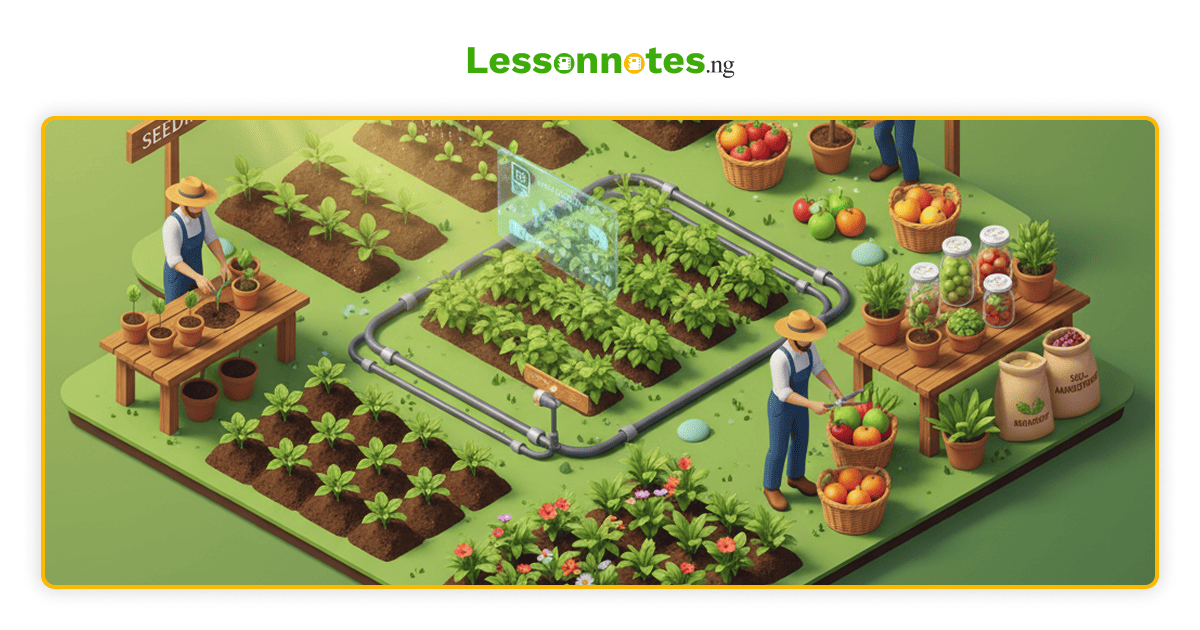
Crop Production
Explore lesson notes covering all topics.

Planting Activities
Explore lesson notes covering all topics.
Post-Planting Activities
Explore lesson notes covering all topics.

Post-Harvesting Activities; Sorting, Grading, And Storage
Explore lesson notes covering all topics.
Harvesting Activities
Explore lesson notes covering all topics.

Preservation Of Harvested Crops; Silo, Crib, Yam Barn, Bagging
Explore lesson notes covering all topics.

Processing Of Harvested Crops: Grinding, Milling
Explore lesson notes covering all topics.

Agriculture as a Source of Employment and Income
Explore lesson notes covering all topics.

Agriculture as a Source of Raw Materials for Industries
Explore lesson notes covering all topics.

Agriculture as a Source of Materials for Clothing
Explore lesson notes covering all topics.

Agriculture as a Means of Foreign Exchange
Explore lesson notes covering all topics.

Branches of Agriculture and People Involved
Explore lesson notes covering all topics.

Crop Production
Explore lesson notes covering all topics.

Lesson Notes for Other Classes

Basic 2 Lesson Note
The complete lesson note to guide your studies.

Basic 3 Lesson Note
The complete lesson note to guide your studies.

Basic 4 Lesson Note
The complete lesson note to guide your studies.

Basic 5 Lesson Note
The complete lesson note to guide your studies.

JSS2 Lesson Note
The complete lesson note to guide your studies.

JSS3 Lesson Note
The complete lesson note to guide your studies.