
Forms Of Agriculture JSS1 Agricultural Science Lesson Note
Download Lesson NoteTopic: Forms Of Agriculture
Forms of Agriculture (Introduction)
Agriculture is defined as the cultivation of the land to produce crops and the rearing of animals for man’s use. Agriculture has many branches. The form of agriculture practiced in an area depends on the size of the farm, purpose, availability of land, the type of soil in the area, topography of the land, and the prevailing climatic conditions.
Crop Farming: A crop is a plant grown for a specific purpose. Farming is the center of activity where land is cultivated for the production of either plants or animals or both. Crop farming therefore involves the cultivation of land for the production of useful crops for the benefit of man. When different types of crops are planted on the same piece of land, it is called Mixed Cropping. Crops that may be planted are maize, cowpea, yam, cocoyam, groundnut, soya bean, tomato, pepper, okra, sorghum, and some perennial crops.
Horticulture: This is the study of how to grow fruits, vegetables, and ornamental plants. It is a special branch of crop science that is not well-developed in Nigeria. Those who specialize in the production of fruits, vegetables, and flowers are called horticulturists. Fruits and Vegetables grown by horticulturists include citrus, pawpaw, mango, guava, cashew, pineapple, plantain, garden egg, tomato, lettuce, cabbage, pumpkin, cucumber, cashew, banana. Ornamental plants grown are hibiscus, croton, rose flowers, zinnia, hyacinth, iris, lily, and Queen of the Night. Ornamental crops are used for beautifying our surroundings.
Livestock farming: This is the system of keeping or rearing different farm animals for different purposes. Animals commonly kept include cattle, poultry, sheep, goats, and pigs. Livestock farming may be settled (ranching) or unsettled (nomadic herding).
Bee Farming: Apiculture or Bee farming is the process of deliberately keeping or culturing bees in wooden boxes or hives for different reasons.
Types of Bees
- Solitary Bees – Most bees in the world are solitary. Mated females live alone in a hole or burrow into well-drained soil or soft brick mortar. They have a short life span. Adults live for about 6 to 8 weeks. They do not sting because they do not store honey. Solitary bees are used for pollinating flowers.
- Bumble Bees – These bees live together in colonies and store honey and pollen in wax as food to be used in times of food shortage. There are two types; Bombus bumble bees and Cuckoo bumble bees.
Bombus bumble bees have three social classes; a female queen, partially developed female workers, and male drones. A colony can contain 1 queen, 300 workers, and a few drones. Cuckoo bees have the males and females living separately except during the period of mating. They have no workers.
- Honey Bees – They live as a large colony in a large cavity or man-made hives. They have three castes, 1 queen, 70,000 workers, and 300 male drones. At the center, the queen bee lays eggs which develop into workers. The drone eggs are laid later. A typical honey bee hive may contain 1 queen, 250 to 300 drones, 20,000 female forages, 40,000 female house bees, 5000 to 7000 eggs, 7000 to 11000 larvae being fed, and 16,000 to 24,000 larvae developing into eggs.
Importance of Bee Farming
- Bees are pollinators of crops and this is important for genetic stability
- Bees are kept for honey, bee wax, pollen, and propolis which are used for food, medicine, or manufacturing other products
- The social life of a honey bee colony provides a strong basis for the study of the structure of societies
- Bees are used for research and education.
Fishery: This is a special area of Agriculture that deals with the production and management of fish and other aquatic animals of agricultural importance. Such animals include lobster, squids, shrimps, crayfish, oysters, prawns, periwinkles and crabs. These animals are rich sources of protein.
Snail Farming or Heliculture: Snails are invertebrates with soft bodies that are covered with hard calcareous shells. They belong to the phylum called mollusca. Heliculture, commonly known as snail farming, is the process of raising land snails specifically for human use, either to use their flesh as edible escargot, or more recently, to obtain snail slime for use in cosmetics, or snail eggs for human consumption as a type of caviar.
Importance of Snail farming.
- Source of Protein – Snail meat has high protein of about 37% – 51%.
- It contains almost all the essential amino acids*.
- Source of Iron – The iron content of snails is 45 -59mg/kg. This high iron content is considered in the treatment of anemia.
- Treatment of different ailments – Snails can be used for the treatment of whooping cough, ulcers, asthma, high blood pressure, constipation, poor eyesight, and piles.
- Preparation of Animal feed – The shell of a snail contains phosphorus and calcium and it can be crushed for the preparation of animal feed.
First Term Agricultural Science Lesson Notes for Other Topics

Preservation of Farm Produce
Explore lesson notes covering all topics.

Factors that may Hinder Preservation
Explore lesson notes covering all topics.
Methods of Preserving the Farm Produce; Sun Drying, Smoking
Explore lesson notes covering all topics.

Preservation of Grains and Cereals Crops
Explore lesson notes covering all topics.

Preservation of Roots and Tubers Crops
Explore lesson notes covering all topics.
Preservation of Fruits: Orange, Banana, Tomatoes, Pawpaw...
Explore lesson notes covering all topics.
Conservation of Oil Crops: Soya Bean, Oil Palm, Groundnut
Explore lesson notes covering all topics.
Preservation of Vegetables
Explore lesson notes covering all topics.

Health And Safety
Explore lesson notes covering all topics.

Procedures For Crop Production
Explore lesson notes covering all topics.
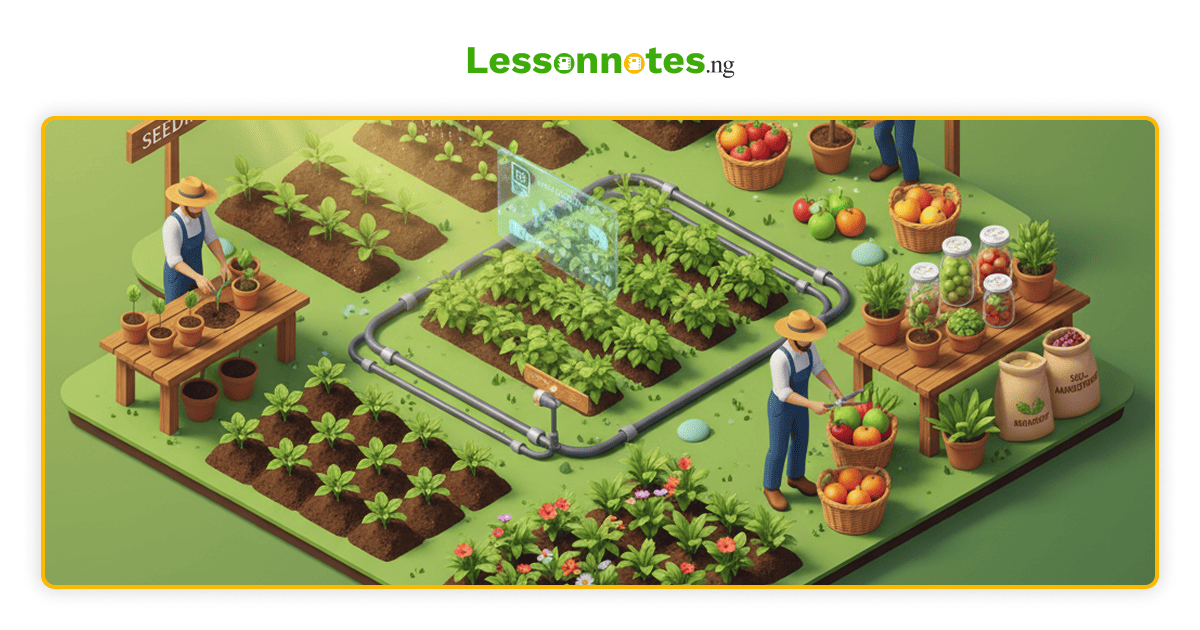
Crop Production
Explore lesson notes covering all topics.

Planting Activities
Explore lesson notes covering all topics.
Post-Planting Activities
Explore lesson notes covering all topics.

Post-Harvesting Activities; Sorting, Grading, And Storage
Explore lesson notes covering all topics.
Harvesting Activities
Explore lesson notes covering all topics.


Lesson Notes for Other Classes

Basic 1 Lesson Note
The complete lesson note to guide your studies.

Basic 2 Lesson Note
The complete lesson note to guide your studies.

Basic 3 Lesson Note
The complete lesson note to guide your studies.

Basic 4 Lesson Note
The complete lesson note to guide your studies.

Basic 5 Lesson Note
The complete lesson note to guide your studies.

Basic 6 Lesson Note
The complete lesson note to guide your studies.