States of Matter – Basic 5 Basic Science Lesson Note (Second Term)
Download Lesson NoteLesson note at a glance
- Subject
- Basic Science
- Class
- Basic 5
- Term
- Second Term
- Topic
- States of Matter
- Order
- Topic 5 of 7 this term
- Reading time
- 4 min
Behavioural Objectives:
At the end of lesson, pupils should be able to:
- state the meaning of matter
- define atom
- identify the states of matter
- describe solids, gases and liquids in terms of how closely packed their particles are
Instructional Materials:
- Wall charts
- Pictures
- Related online Video
- Flash Cards
- Examples of energy conversion (e.g. solar panel, hydroelectric dam, battery) • Chart paper and markers
- Textbooks
- Workbooks
Methods of Teaching:
- Class Discussion • Group Discussion • Asking Questions • Explanation • Role Modelling • Role Delegation
Reference Materials:
- Scheme of Work • Online Information • Textbooks • Workbooks • 9 Year Basic Education Curriculum • Workbooks
Content:
What is matter?
Matter is anything that has weight and occupies space. It takes up space and has mass. If we feel a solid, like a rock or a key, or if can see a liquid like water or juice, matter is a building blocks of all the earth around us.
For example, a pencil is made of matter because it takes up space and has mass. If a solid object. A glass of water is also made of matter because it has mass and takes up space. Even air that we breathe is made of matter because it takes up space and has mass. It is a gas.
Matter can also be described as tiny particles such as density, color, and mass. Liquid, liquid or gas.
States of matter
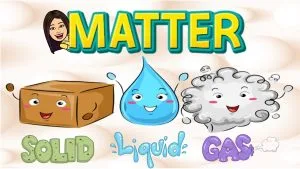
The states of matter are the different forms that matter can take. There are three main states of matter: solid, liquid, and gas.
A solid is a state of matter where the particles are tightly packed together and do not move around much. An example of a solid is a pencil. It keeps its definite shape and is not easy to pour.
1. Solid
- Pencil

Ice cube

Brick

Apple
- Steel
A solid is a state of matter where the particles are closer together than they are in a gas, but not as close as they are in a solid. An example of a liquid is water. It takes the shape of its container and is easy to pour.
2. Liquid

Water
- Juice
- Milk
- Oil
- Alcohol
A gas is a state of matter where the particles are far apart and move around freely. An example of a gas is the air we breathe. It does not have a fixed shape and is easy to compress.
3. Gas
- Air
- Oxygen
- Helium
Carbon dioxide
- Nitrogen
There’s also a fourth state of matter called plasma, which is a gas-like state of matter where the particles are not only far apart but also electrically charged. An example of plasma is lightning in a thunderstorm.
4. Plasma
- Lightning • Fire • Solar wind • Stars • Plasma ball
[the_ad id=”57207″]
How closely packed are liquids, solids and gases
In solids, the particles are pressed out or rearranged closely together. But the way these particles are packed together is different for each state of matter.
- Solids have particles that are very closely packed together, which is why they keep their shape and are not easy to pour. Examples include a pencil, an ice cube, and a brick.
- Liquids have particles that are closer together than gases, but not as close as they are in solids. This is why liquids can flow and take the shape of their container and are easy to pour. Examples include water, juice, and milk.
- Gases have particles that are far apart and move around freely. This is why they do not have a fixed shape and are easy to compress. Examples include air, helium in a balloon, and oxygen we breathe.
- In plasma, the particles are very highly packed and have a fixed shape and volume. Examples. ice cubes, a rock and does not change shape or size on it’s own. The particles in a solid are so close as shape according to the container holding it.
- In a gas, the particles are far apart and move around freely. For example, air in a balloon, when the air particles, the air particles occupy the whole space, so the balloon expands.
Evaluation
- What is the definition of matter? a) Anything that takes up space and has mass b) Anything that can be seen c) Anything that is hard
- What is an example of a solid state of matter? a) Water b) Air c) Ice
- Gas, liquid, and plasma of solid, gas, and plasma
- What is an example of a solid state of matter? a) Air b) Water c) Pencil
- What is an example of a liquid state of matter? a) Brick b) Oxygen c) Water d) Steel
This term's Basic Science topics
Basic 5 Second Term · 7 topics
Second Term Basic Science Lesson Notes for Other Topics
Demonstrating Air in Space
Read the full lesson note.
Air
Read the full lesson note.
Light Energy, Uses of Light and Colour
Read the full lesson note.
Colour Identification 1 - Colours of Objects
Read the full lesson note.
Colour Identification II- Road Traffic Light Signs
Read the full lesson note.
Colour Identification III - Road Markings
Read the full lesson note.
Soil
Read the full lesson note.
Soil II: Importance & Things Found in Soil
Read the full lesson note.
Water - Purifying Water
Read the full lesson note.
Water - Packaged Water
Read the full lesson note.
Soil I - Importance to Plants
Read the full lesson note.
Input Devices
Read the full lesson note.
Air in Motion I - Wind
Read the full lesson note.
Air in Motion II - Harmful Effects of Wind
Read the full lesson note.
Water
Read the full lesson note.
Lesson Notes for Other Classes

Basic 1 Lesson Note
The complete lesson note to guide your studies.

Basic 2 Lesson Note
The complete lesson note to guide your studies.

Basic 3 Lesson Note
The complete lesson note to guide your studies.
Basic 4 Lesson Note
The complete lesson note to guide your studies.
Basic 6 Lesson Note
The complete lesson note to guide your studies.

JSS1 Lesson Note
The complete lesson note to guide your studies.