Imaginative and Creative Drawing – Basic 5 Cultural & Creative Arts Lesson Note (First Term)
Download Lesson NoteLesson note at a glance
- Subject
- Cultural & Creative Arts
- Class
- Basic 5
- Term
- First Term
- Topic
- Imaginative and Creative Drawing
- Order
- Topic 5 of 7 this term
- Reading time
- 2 min
Behavioural Objectives:
By the end of the lesson, pupils should be able to:
- Describe what imaginative drawing is.
- Draw from their imagination.
- Interpret their own and others’ created artwork.
Keywords: Imaginative Drawing, Creativity, Interpretation, Artwork, Visual Expression
Set Induction:
- Display various imaginative drawings from famous artists or students to spark interest. Discuss what makes these drawings unique.
Entry Behaviour:
- Pupils should have basic drawing skills and an understanding of colors and shapes.
Learning Materials:
- Drawing paper, colored pencils, markers, example artworks, and reference images.
Instructional Materials:
- Projector or board for showing examples (if available), drawing materials for each pupil.
Building Background / Connection to Prior Knowledge:
- Discuss previous lessons on basic drawing techniques and how they can be used to express creativity. Connect this to the concept of drawing from imagination.
Embedded Core Skills:
- Creativity, visual interpretation, descriptive skills, and self-expression.
Reference Books:
- Lagos State Scheme of Work for Primary 5 Cultural and Creative Arts.
Content:
- Description of Imaginative Drawing:
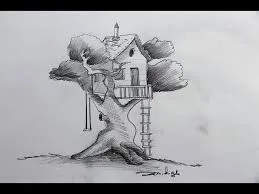
- Definition: Drawing that comes from the artist’s imagination rather than copying from real life.
- Features: Unique, creative, often abstract or surreal, and reflects personal thoughts or fantasies.
- Purpose: To express ideas, emotions, and creative thoughts visually.
- Drawing from Imagination:
- Steps:
- Think of a concept or idea you want to draw.
- Sketch out your idea lightly with a pencil.
- Add details and color to bring your imagination to life.
- Use various drawing tools and techniques to enhance your work.
- Interpreting Created Artwork:
- Interpretation: Understanding what the artwork represents based on its visual elements.
- Discussion: Encourage pupils to describe what they see in their own and others’ drawings and how it makes them feel. • Examples: Look at various artworks and discuss possible meanings or stories behind them.
Evaluation (Fill-in-the-Blank Questions):
- Imaginative drawing involves creating artwork from ________. a) Reality b) Imagination c) Nature d) History
- One feature of imaginative drawing is that it is often ________. a) Simple b) Abstract c) Realistic d) Literal
- To start an imaginative drawing, you should first ________ your idea. a) Erase b) Ignore c) Sketch d) Copy
- When interpreting artwork, you should look at its ________ elements. a) Historical b) Visual c) Written d) Mathematical
- Imaginative drawings can reflect ________ thoughts and emotions. a) Random b) Personal c) Scientific d) Mathematical
- Adding ________ to your drawing helps bring it to life. a) Text b) Details c) Numbers d) Labels
This term's Cultural & Creative Arts topics
Basic 5 First Term · 7 topics
First Term Cultural & Creative Arts (CCA) Lesson Notes for Other Topics
Introduction to Drawing - Objects in Our Environment
Read the full lesson note.

Introduction to Singing
Read the full lesson note.

Singing About Flowery Plants Using Tonic Solfa
Read the full lesson note.
Staging - The Way a Play is Produced and Presented
Read the full lesson note.
Types of Flowers
Read the full lesson note.

Drawing of Staff/Stave, The Grand Staff, and The Clefs
Read the full lesson note.
Use of Lines
Read the full lesson note.
Theatrical Elements and Personnel
Read the full lesson note.
Forms of Dance
Read the full lesson note.
Imaginative and Creative Drawing
Read the full lesson note.

Choral Singing
Read the full lesson note.
Casting and Rehearsal
Read the full lesson note.
Card Making and Decoration
Read the full lesson note.

Introduction to Life Drawing
Read the full lesson note.
Rhythmic Pattern 2
Read the full lesson note.
Lesson Notes for Other Classes

Basic 1 Lesson Note
The complete lesson note to guide your studies.
Basic 2 Lesson Note
The complete lesson note to guide your studies.
Basic 3 Lesson Note
The complete lesson note to guide your studies.

Basic 4 Lesson Note
The complete lesson note to guide your studies.
Basic 6 Lesson Note
The complete lesson note to guide your studies.

JSS1 Lesson Note
The complete lesson note to guide your studies.