
Nigeria’s Federal Capital Territories – Federal Capital II Basic 4 Nigerian History Lesson Note
Download Lesson NoteTopic: Nigeria’s Federal Capital Territories – Federal Capital II
Nigeria’s Federal Capital Territories
Present Federal Capital Territory:
- Name: Federal Capital Territory (FCT) Abuja
- Created: 1976
- Became Capital: 1991
The Correct Answer About Nigeria’s Federal Capitals
Lagos (1960-1991)
- Type: Federal Capital (not Federal Capital Territory)
- Status: Was the seat of federal government
- Current Status: Commercial capital and former federal capital
Abuja (1991-Present)
- Type: Federal Capital Territory (FCT)
- Created as FCT: 1976 (territory carved out)
- Became Active Capital: December 12, 1991
- Created by: General Murtala Mohammed (FCT) and General Ibrahim Babangida (moved capital)
Why Lagos Maintains Special Federal Status
- Historical Importance
- Former seat of federal government (1960-1991)
- First capital of independent Nigeria
- Many federal institutions already established there
- Economic Significance
- Largest economy in Nigeria
- Major seaport for international trade
- Financial center of West Africa
- Commercial hub of Nigeria
- Infrastructure
- Already developed federal facilities
- International airport (Murtala Muhammed)
- Major seaport (Lagos Port Complex)
- Banking and financial institutions
- Strategic Location
- Gateway to Nigeria from the sea
- Connection point for international business
- West African commercial center
- Access to international markets
- Practical Reasons
- Expensive to move all federal institutions
- Some institutions work better in Lagos
- International connections already established
- Expertise and experience concentrated there
Location of Lagos on Map of Nigeria
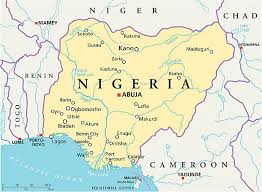
Geographic Location:
- Southwest Nigeria
- Lagos State
- Atlantic Ocean coastline
- Border with Ogun State
- Close to Benin Republic
Important Features:
- Victoria Island – business district
- Lagos Island – old commercial center
- Ikeja – state capital and airport location
- Apapa – major port area
- Lagos Lagoon – water body
Coordinates:
- Latitude: About 6.5°N
- Longitude: About 3.4°E
- Coastal city on the Atlantic Ocean
Federal Institutions Still in Lagos
Major Federal Institutions:
- Central Bank of Nigeria (regional office)
- Federal High Court (Lagos Division)
- Nigerian Ports Authority headquarters
- Federal Ministry regional offices
- Nigerian Custom Service headquarters
- Federal Inland Revenue Service offices
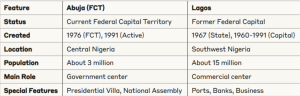
Comparison: Abuja vs Lagos
Exercises
- Fill in the blanks:
- Nigeria currently has _______ Federal Capital Territory
- The FCT is called _______
- Lagos was Nigeria’s capital from _______ to _______
- Abuja became the capital in _______
- True or False:
- Nigeria has two Federal Capital Territories today ( )
- Lagos is still the Federal Capital of Nigeria ( )
- Abuja FCT was created in 1976 ( )
- Lagos maintains some federal institutions ( )
- Why does Lagos maintain special federal status?
- a) It’s the largest city
- b) Historical importance and federal institutions
- c) It has the best weather
- d) It’s close to other countries
- Circle what Lagos still has:
- Presidential Villa
- Federal High Court
- National Assembly
- Nigerian Ports Authority
- Supreme Court
- Central Bank offices
- Match the status with the territory:
- Abuja → Current Federal Capital Territory
- Lagos → Former Federal Capital (special status)
- Where is Lagos located on the map?
- a) Central Nigeria
- b) Northern Nigeria
- c) Southwest Nigeria
- d) Southeast Nigeria
- Complete the timeline:
- Lagos as Federal Capital: _______ to _______
- Abuja FCT created: _______
- Abuja became active capital: _______
- Short Answer:
- What is Nigeria’s current Federal Capital Territory?
- Why does Lagos still have federal institutions?
- Where is Lagos located in Nigeria?
- When did Abuja become Nigeria’s capital?
- Map Exercise: Draw a simple map of Nigeria and mark:
- Location of Abuja (center)
- Location of Lagos (southwest coast)
Answer Key:
- one, Abuja, 1960, 1991, 1991
- False, False, True, True
- b) Historical importance and federal institutions
- Circle: Federal High Court, Nigerian Ports Authority, Central Bank offices
- Matching as shown above
- c) Southwest Nigeria
- 1960, 1991, 1976, 1991
- Abuja / Historical importance and established institutions / Southwest Nigeria on the coast / 1991
- Students should draw basic map showing Abuja in center and Lagos in southwest coastal area
Second Term Nigerian History Lesson Notes for Other Topics

The Earliest Settlers Of The Major Towns In Lagos
Explore lesson notes covering all topics.

The Geography Of Major Towns In Lagos
Explore lesson notes covering all topics.

Major Towns In Lagos State
Explore lesson notes covering all topics.
Heroines In Lagos State : Madam Efunroye Tinubu And Others
Explore lesson notes covering all topics.

Social And Political Development Of The Major Towns In Lagos
Explore lesson notes covering all topics.

Heroes In Lagos State: Ogunfunminire, Kandido, Da Rocha e.t.c
Explore lesson notes covering all topics.
Notable Female Nigerian
Explore lesson notes covering all topics.
Southern Nigerians And Their Nationalist
Explore lesson notes covering all topics.
Some Nigerian Nationalists -Northern Nigeria
Explore lesson notes covering all topics.

Some Nigerian Nationalists- Herbert Macaulay
Explore lesson notes covering all topics.

Nationalist And Nationalism In Nigeria
Explore lesson notes covering all topics.
State Creation in Nigeria 1967
Explore lesson notes covering all topics.

State Creation in Nigeria 1976 Till Date
Explore lesson notes covering all topics.

Federal Capital
Explore lesson notes covering all topics.

Historical Sites In Nigeria-Benin
Explore lesson notes covering all topics.
Lesson Notes for Other Classes

Basic 1 Lesson Note
The complete lesson note to guide your studies.

Basic 2 Lesson Note
The complete lesson note to guide your studies.

Basic 3 Lesson Note
The complete lesson note to guide your studies.
Basic 5 Lesson Note
The complete lesson note to guide your studies.

Basic 6 Lesson Note
The complete lesson note to guide your studies.

JSS1 Lesson Note
The complete lesson note to guide your studies.