
Area Basic 2 Mathematics Lesson Note
Download Lesson NoteTopic: Area
Learning Objectives
By the end of this week, pupils should be able to:
- Count and identify numbers from 1-600 and order numbers 1-600
- Skip count in 2s, 3s, 5s, and 10s
- Write numbers 500-600 in numerals and words
- Use pictorial illustrations to explain area of shapes
- Identify the use of standard measuring units for area
- Calculate the area of different shapes (squares, rectangles, triangles)
- Compare areas of different concrete objects
- Solve real-life problems involving area
- Apply multiplication skills in solving area problems
Lesson Content
Day 1: Number Work (1-600 Complete Range)
Mastering Numbers to 600:
- Count confidently from 1-600
- Order numbers from 1-600
- Write numbers 500-600 in numerals and words
- Examples: 576 = five hundred and seventy-six
Skip Counting Review:
- 2s: 2, 4, 6, 8, 10, 12…
- 3s: 3, 6, 9, 12, 15, 18…
- 5s: 5, 10, 15, 20, 25, 30…
- 10s: 10, 20, 30, 40, 50, 60…
Multiplication Tables Review:
- 2 times table: 2, 4, 6, 8, 10, 12, 14, 16, 18, 20
- 3 times table: 3, 6, 9, 12, 15, 18, 21, 24, 27, 30
Day 2: Introduction to Area
What is Area? Area is the amount of space inside a flat shape. It tells us how much surface a shape covers.
Understanding Area Through Pictures:
- Area is like counting how many squares fit inside a shape
- The bigger the area, the more space inside
- We can compare areas to see which shape covers more space
Everyday Examples of Area:
- The area of your desk top
- The area of a book cover
- The area of a football field
- The area of your bedroom floor
Why is Area Important?
- Helps us know how much paint we need for a wall
- Helps us know how much carpet we need for a floor
- Important for farming (how much land to plant)
- Important for building and construction
Day 3: Measuring Area with Square Units
Standard Units for Area:
- We measure area using square units
- Square centimetres (cm²) for small areas
- Square metres (m²) for larger areas
Counting Square Units:
- Place small squares inside a shape
- Count how many squares fit
- That number is the area
Example: If 6 small squares fit inside a rectangle, the area is 6 square units.
Day 4: Calculating Area of Basic Shapes
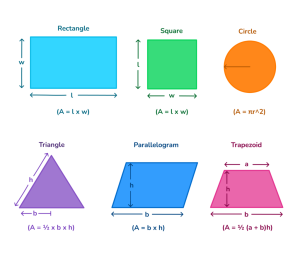
Area of a Square:
- All sides are equal
- Area = side × side
- If one side is 3 units, area = 3 × 3 = 9 square units
Area of a Rectangle:
- Has length and width
- Area = length × width
- If length is 4 and width is 2, area = 4 × 2 = 8 square units
Area of a Triangle:
- Area = (base × height) ÷ 2
- For Primary 2, we can count squares or use simple examples
- A triangle usually has about half the area of a rectangle with the same base and height
Day 5: Comparing Areas and Problem Solving
Comparing Areas:
- Which shape covers more space?
- Which shape has a larger area?
- How much bigger is one area than another?
Real-Life Area Problems:
- Comparing sizes of rooms
- Choosing the right size materials
- Understanding space needed for activities
- Planning gardens or play areas
Examples in Class
Area Calculation Examples:
Square Example:
- A square with each side = 4 units
- Area = 4 × 4 = 16 square units
Rectangle Example:
- A rectangle with length = 5 units, width = 3 units
- Area = 5 × 3 = 15 square units
Visual Examples:
Using Graph Paper:
- Draw a rectangle 4 squares long and 3 squares wide
- Count the squares: 1, 2, 3… 12 squares
- Area = 12 square units
- Check: 4 × 3 = 12 ✓
Real-Life Examples:
Classroom Applications:
- “This book cover has an area of about 300 square centimeters”
- “The classroom floor has a much larger area than your desk”
- “A football field has a huge area compared to our classroom”
Exercises
Exercise 1: Number Work
Write in words:
- 567 = _______________
- 589 = _______________
- 600 = _______________
Skip count: 4. 5s: 5, 10, 15, ___, 25, ___, 35 5. 3s: 3, 6, 9, ___, 15, ___, 21
Exercise 2: Understanding Area
- What is area? _______________
- Name the units we use to measure area: _______
- How do we find the area of a shape? _______________
Exercise 3: Counting Square Units
Count the squares inside these shapes:
[Draw or describe grid squares for students to count]
- Shape A has _____ squares = _____ square units
- Shape B has _____ squares = _____ square units
- Shape C has _____ squares = _____ square units
Exercise 4: Area of Squares
Find the area:
- Square with side 2 units: Area = 2 × 2 = _____ square units
- Square with side 5 units: Area = 5 × 5 = _____ square units
- Square with side 3 units: Area = _____ × _____ = _____ square units
Exercise 5: Area of Rectangles
Find the area:
- Rectangle: length = 4, width = 3 Area = _____ × _____ = _____ square units
- Rectangle: length = 6, width = 2
Area = _____ × _____ = _____ square units - Rectangle: length = 5, width = 4 Area = _____ × _____ = _____ square units
Exercise 6: Comparing Areas
Which shape has a larger area?
- Square with side 3 units OR Rectangle with length 4 and width 2? Square area = _____, Rectangle area = _____ Larger area: _____
- Square with side 4 units OR Rectangle with length 3 and width 5? Square area = _____, Rectangle area = _____
Larger area: _____
Exercise 7: Real-Life Area Problems
- A rectangular garden is 6 metres long and 4 metres wide. What is its area?
- Two square tiles each have sides of 2 units. What is the total area of both tiles?
- A rectangular book cover is 20cm long and 15cm wide. A square book cover has sides of 18cm. Which book cover has a larger area?
- Mary’s rectangular bedroom is 5m long and 3m wide. John’s square bedroom has sides of 4m. Who has the bigger bedroom?
Exercise 8: Mixed Practice
- Find the area of a square with side 6 units.
- Find the area of a rectangle with length 7 and width 3.
- If a shape has an area of 12 square units, give two different rectangles that could have this area.
- Which has more area: a 3×3 square or a 2×6 rectangle?
Fun Activities
- Area Art: Create pictures using squares and rectangles of known areas
- Area Estimation Game: Guess then calculate areas of classroom objects
- Tile Laying: Use square tiles to cover different shapes and count
- Area Comparison Race: Compare areas of different shapes quickly
Teaching Resources/Aids
- Graph paper for drawing and counting squares
- Square tiles or blocks for hands-on area exploration
- Rulers and measuring tools
- Cut-out shapes of different sizes
- Area comparison charts
Practical Activities
- Classroom Area Survey: Measure and calculate areas of different classroom surfaces
- Graph Paper Exploration: Draw shapes and count square units
- Tile Patterns: Use tiles to create shapes and calculate areas
- Area Gallery: Display shapes with their calculated areas
Real-Life Applications
Home Applications:
- Calculating floor space for furniture
- Determining paint needed for walls
- Planning garden layouts
- Choosing carpet or tile amounts
School Applications:
- Comparing sizes of playgrounds
- Planning seating arrangements
- Understanding sports field sizes
- Art project planning
Homework
- Find 3 rectangular objects at home and estimate their areas
- Practice multiplication tables (2s and 3s) for area calculations
- Draw 2 different rectangles with the same area
- Help parents measure a room at home
Assessment
- Can the child explain what area means?
- Do they correctly calculate areas of squares and rectangles?
- Can they compare areas of different shapes?
- Can they solve area problems using multiplication?
- Do they understand the concept of square units?
Extension Activities
- Design a garden layout with calculated areas
- Create area puzzles for classmates
- Investigate why area is measured in square units
- Compare areas of different countries or regions
Mathematical Connections
Links to Multiplication:
- Area calculations use multiplication facts
- Understanding that area = length × width
- Connecting skip counting to area patterns
- Using times tables for quick area calculations
Links to Geometry:
- Understanding 2D shapes and their properties
- Connecting area to shape characteristics
- Comparing different geometric forms
- Building foundation for advanced geometry
Assessment Questions
- “What is the area of a square with sides of 5 units?”
- “How do you find the area of a rectangle?”
- “Which has more area: a 3×4 rectangle or a 6×2 rectangle?”
- “Why do we measure area in square units?”
- “If you know the area is 20 square units, what could the length and width be?”
Third Term Mathematics Lesson Notes for Other Topics
Data Collection
Explore lesson notes covering all topics.
Three-Dimensional Shapes
Explore lesson notes covering all topics.

Money
Explore lesson notes covering all topics.
Capacity
Explore lesson notes covering all topics.
Weight
Explore lesson notes covering all topics.
Length Measurement
Explore lesson notes covering all topics.
Two-Dimensional Shapes
Explore lesson notes covering all topics.
Time - Days, Weeks, And Calendar
Explore lesson notes covering all topics.
Time-Clock Reading
Explore lesson notes covering all topics.
Data Presentation
Explore lesson notes covering all topics.

Binary Number
Explore lesson notes covering all topics.

Measurement
Explore lesson notes covering all topics.
Three-Dimensional Shapes
Explore lesson notes covering all topics.

Angles
Explore lesson notes covering all topics.
Plane Shapes (Properties)
Explore lesson notes covering all topics.
Lesson Notes for Other Classes

Basic 4 Lesson Note
The complete lesson note to guide your studies.
Basic 5 Lesson Note
The complete lesson note to guide your studies.

JSS1 Lesson Note
The complete lesson note to guide your studies.
JSS2 Lesson Note
The complete lesson note to guide your studies.

JSS3 Lesson Note
The complete lesson note to guide your studies.

SS1 Lesson Note
The complete lesson note to guide your studies.