
Sound Energy – JSS3 Basic Science Lesson Note (Second Term)
Download this term · ₦1,000Lesson note at a glance
- Subject
- Basic Science
- Class
- JSS3
- Term
- Second Term
- Topic
- Sound Energy
- Order
- Topic 5 of 8 this term
- Reading time
- 4 min
Sound is a form of energy produced by vibrating objects and carried as waves through a medium to the listener’s ear.
Behavioural objectives
By the end of the lesson, students should be able to:
- define sound and state its S.I. unit;
- distinguish between musical sound and noise;
- explain what an echo is;
- state the characteristics of sound waves;
- explain how sound travels through a medium;
- describe how the human ear hears sound.
What is sound?
Sound is a form of energy that is transferred as a wave through a medium by vibration.
- Source: every sound is made by a vibrating body, such as a drum skin, a guitar string or a tuning fork.
- Medium: the matter through which sound is transmitted, such as air, wire, metal or pipes.
- Hearing: when the waves reach the human ear, they are heard as sound.
- Unit: sound is a form of energy, so its S.I. unit is the joule (J).
- Classes: sound is classified into musical sound and noise.
What are the types of sound?
There are two types of sound: musical sound and noise.
Musical sound
- Meaning: a pleasant sound caused by a body performing regular vibrations.
- Examples: flute, trumpet, drum, guitar, piano and gong.
Noise
- Meaning: an unpleasant sound caused by irregular disturbances.
- Examples: collisions, explosions and the clatter of falling metal.
Difference between musical sound and noise
| Point | Musical sound | Noise |
|---|---|---|
| Vibration | Regular | Irregular |
| Effect on the listener | Pleasant | Unpleasant |
| Examples | Flute, piano, guitar | Explosion, collision |
How does sound travel?
Sound travels as vibrations passing from particle to particle in a medium, so it cannot travel without one.
- Solids: sound travels through metals, wire and pipes, and it is fastest in solids.
- Liquids: sound travels through water, slower than in solids.
- Gases: sound travels through air, slower than in liquids.
- Vacuum: sound cannot travel where there is no matter.
- Long distances: sound may be converted to electrical signals, as in a land telephone.
What is an echo?
An echo is the reflection of sound waves when they are obstructed by a hard object such as a rock.
- Cause: sound waves strike a hard surface such as a wall, rock or concrete structure.
- Behaviour: the waves bounce back in the same way as light waves.
- Result: the listener hears the sound again.
What are the characteristics of sound waves?
Sound waves reflect, refract, diffract and interfere, and they need a medium to travel.
- Reflection: sound bounces off a hard surface, which gives an echo.
- Refraction: sound changes direction when it passes from one medium to another.
- Diffraction: sound bends round obstacles and spreads out through gaps.
- Interference: two sound waves meeting combine to give a louder or softer sound.
- Medium: sound needs a medium to travel, and it is fastest in solids.
What decides how a sound is heard?
Frequency and amplitude of the vibration decide the pitch and loudness of a sound.
| Property | Meaning | What we hear |
|---|---|---|
| Frequency | Number of vibrations per second, measured in hertz (Hz) | Pitch: high or low sound |
| Amplitude | Size of the vibration | Loudness: loud or soft sound |
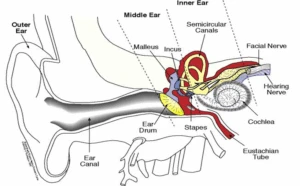
How does the ear hear sound?
The ear changes sound waves into nerve impulses that the brain interprets as sound.
- Sound waves entering the pinnae are directed into the auditory canal, which makes the eardrum vibrate.
- The vibration sets the ossicles into a greater vibration.
- This vibration is greatly amplified in the middle ear, which causes the oval window to vibrate far more than the eardrum because of its smaller size.
- The vibration in the oval window is passed on to the endolymph in the cochlea and causes the membrane-carrying hair cells to vibrate.
- The vibration makes the hair cells set up a nerve impulse.
- This impulse is carried through the auditory nerve to the auditory region of the brain, where it is interpreted as sound.
Evaluation
- Name the two classes of sound.
- Give two examples of musical instruments.
- What is an echo?
- State two things that cause noise.
- Describe how a sound wave entering the ear is changed into a nerve impulse.
Assignment
Answer all the questions below.
- All objects that produce sound have a common characteristic called: A. vibration B. tuning fork C. pieces of metal D. sound
- One of the characteristics of sound energy similar to light energy is: A. incidence B. deviation C. refraction D. reflection
- The part of the ear that is responsible for hearing is: A. semicircular canals B. auditory nerve C. eardrum D. pinna
- The hole through which sound enters the human ear is called: A. tympanic membrane B. auditory meatus C. semi-circular canals
- Echo is produced when sound is: A. incident B. blocked C. refracted D. reflected
- The matter through which sound is transmitted is called: A. medium B. gong C. flute D. microphone
- The bonelike structures found in the middle ear are called: A. blade B. earbone C. ossicles D. pinna
- Optic nerve is to the eye as ____________ nerve is to the ear: A. auditory B. nerve endings C. olfactory D. papillae
- (a) Define sound. (b) State the S.I. unit of sound energy. (c) State four characteristics of sound.
This term's Basic Science topics
JSS3 Second Term · 8 topics
Get Basic Science as PDF and Word
Every week of JSS3 Basic Science, Second Term, formatted and ready to print. Ad-free, and the copy lock comes off.
Get this term Card, bank transfer, USSD or OPay
JSS3 Basic Science Lesson Notes for Other Topics
Resources From Living Things
Read the full lesson note.
Economic Importance Of Resources From Plants And Animals
Read the full lesson note.

Resources From Non-Living Things
Read the full lesson note.
Light Energy
Read the full lesson note.

Magnetism
Read the full lesson note.
Electrical Energy
Read the full lesson note.

Skill Acquisition
Read the full lesson note.

Drug And Substance Abuse – I
Read the full lesson note.
Drug And Substance Abuse II
Read the full lesson note.

Family Traits
Read the full lesson note.
Environmental Hazard – Soil Erosion
Read the full lesson note.
Environmental Hazard – Bush Burning
Read the full lesson note.
Environmental Hazard – Flooding
Read the full lesson note.
Environmental Hazard – Deforestation
Read the full lesson note.
Environmental Hazard – Desertification
Read the full lesson note.
Lesson Notes for Other Classes

JSS1 Lesson Note
The complete lesson note to guide your studies.

JSS2 Lesson Note
The complete lesson note to guide your studies.
