
Abbreviations And Acronyms Basic 5 English Studies Lesson Note
Download Lesson NoteTopic: Abbreviations And Acronyms
PERFORMANCE OBJECTIVES
By the end of the lesson, most of the pupils should have attained the following objectives: –
- Identify the features of abbreviated forms of words.
- Differentiate between abbreviations and acronyms.
- Apply standard English conventions in abbreviations in common words.
- Compose the different forms of letters or texts.
INSTRUCTIONAL MATERIALS
The teacher will teach the lesson with the aid of:
- Cell phone

- Computer projector

- Video
METHOD OF TEACHING
Choose a suitable and appropriate method for the lessons.
REFERENCE MATERIALS
Scheme of work
9-Year Basic Education Curriculum
Course Book
All Relevant Material
Online Information
CONTENT OF THE LESSON
INTRODUCTION
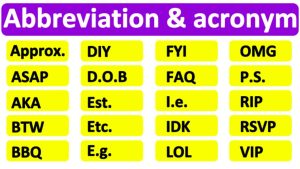
Abbreviations and acronyms are shortened forms of words or names.
ABBREVIATIONS AND ACRONYMS
MEANING OF ABBREVIATIONS
An abbreviation is a shortened form of a word used instead of the full word.
EXAMPLES OF ABBREVIATIONS
- Dr. = Doctor
- Jr. = Junior
- Ms. = Miss
- Mr. = Mister
- Mrs. = Mistress
- Corp. = Corporation
- Prof. = Professor
- Memo = Memorandum
- Math = Mathematics
- Psycho = Psychopath
- Etc.
MEANING OF ACRONYMS
An acronym is a set of initial letters from the first letters of each of the words that form another word.
EXAMPLES OF ACRONYMS
- PC – Personal Computer
- PA- Personal Assistant
- VP – Vice President
- CV – Curriculum Vitae
- MD – Managing Director
- NUT – Nigeria Union Of Teachers
- NTA – Nigeria Television Authority
- HIV – Human Immunodeficiency Virus
- ATM – Automated Teller Machine
- SIM – Subscriber Identification Module
- WHO – World Health Organisation
- NPA – Nigeria Port Authority
- BSC – Bachelor of Science
- NDA – Nigeria Defense Academy
- WWW – World Wide Web
- ASUU – Academic Staff Union Of Universities
- NNPC – Nigeria National Petroleum Corporation
- PHCN -Power Holding Company Of Nigeria
- WAEC – West African Examination Council
- NECO – National Examination Council
- FRSC – Federal Road Safety Commission
- FIFA – Federation of International Football Association
- NAFDAC – National Agency for Drug Administration And Control
- Etc.
PRESENTATION
To deliver the lesson, the teacher adopts the following steps:
- To introduce the lesson, the teacher revises the previous lesson. Based on this, he/she asks
the pupils some questions;
- Displays charts showing examples of abbreviations and acronyms.
- Let the pupils familiarize themselves with the words in groups or pairs.
- Calls attention to the basic features of abbreviations and acronyms.
Pupil’s Activities – Examine the chart to familiarize yourself with the basic features of abbreviations and
acronyms.
- Uses the charts and basic features of abbreviations and acronyms to introduce and explain
The meaning of abbreviations and acronyms with appropriate illustrations.
Pupil’s Activities – Pay attention to the lesson introduction, explain the meaning of abbreviations
and acronyms.
- Asks pupils to differentiate between abbreviations and acronyms.
Pupil’s Activities – With appropriate examples, differentiate between abbreviations and
acronyms.
- Evaluates the lesson.
Pupil’s Activities – Attempted most of the questions correctly.
- Summarizes the lesson on the board.
Pupil’s Activities – Participate actively in the lesson summary and write as instructed.
CONCLUSION
- To conclude the lesson for the week, the teacher revises the entire lesson and links it to the
The following week’s lesson.
LESSON EVALUATION
Asks pupils to:
- Identify the features of the abbreviated forms of words.
- Differentiate between abbreviations and acronyms.
- Apply standard English conventions in abbreviations in common words.
- Compose the different forms of letters or texts.
Second Term English Studies Lesson Notes for Other Topics
Structure: Adverbs
Explore lesson notes covering all topics.
Reading: Observable Study of Butterflies
Explore lesson notes covering all topics.
Dictation for the Week
Explore lesson notes covering all topics.
Writing: Recording Observations
Explore lesson notes covering all topics.
Reading: Newspaper Features
Explore lesson notes covering all topics.
Structure: Simile
Explore lesson notes covering all topics.
Writing: Technical Manuals
Explore lesson notes covering all topics.
Dictation for the week
Explore lesson notes covering all topics.
Writing: Expository Essay
Explore lesson notes covering all topics.
Speech Work: Guided Speech Making
Explore lesson notes covering all topics.
Structure: Similes and Metaphors
Explore lesson notes covering all topics.
Reading: Drug Use and Consequences
Explore lesson notes covering all topics.
Dictation for the Week
Explore lesson notes covering all topics.
Writing: Expository Composition
Explore lesson notes covering all topics.

Supplementary Reading
Explore lesson notes covering all topics.
Lesson Notes for Other Classes
Basic 1 Lesson Note
The complete lesson note to guide your studies.

Basic 2 Lesson Note
The complete lesson note to guide your studies.
Basic 3 Lesson Note
The complete lesson note to guide your studies.

Basic 4 Lesson Note
The complete lesson note to guide your studies.
Basic 6 Lesson Note
The complete lesson note to guide your studies.

JSS1 Lesson Note
The complete lesson note to guide your studies.