Family Relationship and Family Tree – Basic 5 Home Economics Lesson Note (First Term)
Download Lesson NoteLesson note at a glance
- Subject
- Home Economics
- Class
- Basic 5
- Term
- First Term
- Topic
- Family Relationship and Family Tree
- Order
- Topic 3 of 8 this term
- Reading time
- 2 min
Learning objectives
By the end of the lesson, pupils should be able to:
- describe family relationship
- justify the reasons for family bonding
iii. draw their family tree
Previous knowledge
Pupils know their family members and understand family roles.
Lesson content
A. family relationship
Family relationship refers to the connections and bonds between family members. These relationships are based on:
- Blood relations – parents, children, siblings, grandparents
- Marriage relations – husband and wife, in-laws
- Adoption relations – adopted children and parents
B. types of family relationships
- Parent-Child Relationship
- Built on love, care, and respect
- Parents guide and protect children
- Children obey and honor parents
- Sibling Relationship
- Brothers and sisters support each other
- They share experiences and memories
- They help and protect one another
- Husband-Wife Relationship
- Based on love, trust, and partnership
- They work together for family welfare
- They support each other in decisions
C. reasons for family bonding
- Love and Affection
- Family members naturally love each other
- This love creates strong emotional bonds
- It makes family members want to stay close
- Mutual Support
- Family members help each other in times of need
- They share both happy and difficult moments
- They provide emotional and physical support
- Shared Experiences
- Living together creates common memories
- Celebrating festivals and occasions together
- Going through life experiences as a unit
- Security and Protection
- Family provides safety and protection
- Members feel secure within the family unit
- Children especially need this sense of security
D. family tree
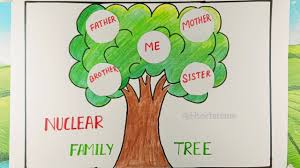
A family tree is a diagram that shows how family members are related to each other. It starts with the oldest generation at the top and goes down to the youngest.
Example of a Simple Family Tree:
PRACTICAL ACTIVITY
Students will draw their own family trees showing:
- Grandparents (if known)
- Parents
- Themselves and siblings
- Any other close relatives
Teaching AIDS
Sample family trees, drawing materials, family photographs, chart paper
Evaluation questions
- What is family relationship?
- List 3 reasons why family bonding is important
- Draw a simple family tree showing 3 generations
- Name 2 types of family relationships
This term's Home Economics topics
Basic 5 First Term · 8 topics
- Family: Meaning and Types of Family
- Roles of Each Family Members and Functions of the Family
- Family Relationship and Family Tree
- Identification of Simple Cooking Tools and Equipment
- Guidelines for Use of Cooking Tools and Equipment
- Simple Sewing Tools and Equipment
- Uses and Care of Simple Sewing, Knitting and Crocheting Tools and Equipment
- Basic Stitches
First Term Home Economics Lesson Notes for Other Topics
Reasons for Cleaning the House, Classroom and the Environment
Read the full lesson note.
How to Make Detergents
Read the full lesson note.

Tools and Agents for Cleaning the Home
Read the full lesson note.
Types and Uses of Stitches
Read the full lesson note.
Effect of Wrong Meal Planning and Eating Habit
Read the full lesson note.
Introduction to Clothing Construction Process(Seam)
Read the full lesson note.
Stitches: (Temporary and Permanent)
Read the full lesson note.

Three Major Meals of the Day
Read the full lesson note.

Meaning of Meal Planning and Importance for Healthy Eating
Read the full lesson note.

Uses And Care Of Simple Sewing, Knitting And Crocheting Tools And Equipment
Read the full lesson note.
Basic Stitches
Read the full lesson note.
Identification Of Simple Cooking Tools And Equipment
Read the full lesson note.
Simple Sewing Tools And Equipment
Read the full lesson note.

Roles Of Each Family Members And Functions Of The Family
Read the full lesson note.

Guidelines For Use Of Cooking Tools And Equipment
Read the full lesson note.
Lesson Notes for Other Classes

Basic 1 Lesson Note
The complete lesson note to guide your studies.
Basic 2 Lesson Note
The complete lesson note to guide your studies.
Basic 3 Lesson Note
The complete lesson note to guide your studies.
Basic 4 Lesson Note
The complete lesson note to guide your studies.
Basic 6 Lesson Note
The complete lesson note to guide your studies.
JSS1 Lesson Note
The complete lesson note to guide your studies.