
Division of Labour Basic 4 Social Studies Lesson Note
Download Lesson NoteTopic: Division of Labour
What is the Division of Labour?
Division of labour means sharing work among different people. Instead of one person doing everything, each person does one part of the job they do best!
Examples in Daily Life
At Home 🏠
- Mother: Cooks food
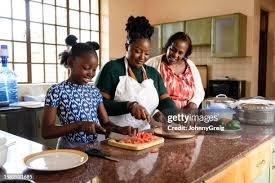
- Father: Repairs things

- Children: Set the table, sweep
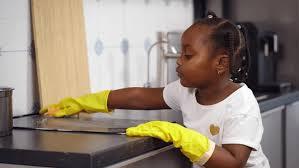
- Everyone: Has a special job!
At School 🏫
- Principal: Manages the school
- Teachers: Teach different subjects

- Cleaner: Keeps school clean

- Security: Protects the school
- Cook: Prepares food

In a Restaurant 🍽️
- Chef: Cooks the food
- Waiter: Serves customers
- Cashier: Collects money
- Cleaner: Washes dishes
Making Bread 🍞
- Farmer: Grows wheat
- Miller: Grinds flour
- Baker: Bakes bread
- Seller: Sells bread
Benefits of Division of Labour
- Work Gets Done Faster ⚡
When everyone does their part, work finishes quickly!
- Better Quality 👍
People become experts at what they do
- Less Stress 😊
No one person has too much work
- More Production 📈
More things can be made or done
- People Learn Special Skills 🎯
Everyone becomes good at something
Problems of Division of Labour
- Boring Work 😴
Doing same thing every day
- Dependence 🔗
If one person is absent, work stops
- No Variety 🔄
Workers only know one job
In Your Classroom
- Class Captain: Leads the class
- Time Keeper: Watches the time
- Board Cleaner: Cleans the board
- Book Monitor: Arranges books
Remember!
Division of labour is like a football team – each player has a position and job to do. When everyone plays their part, the team wins!
EXERCISES
A. Fill in the blanks:
- Division of labour means _______ work among people.
- When people do what they do best, quality _______.
- Division of labour makes work finish _______.
- In a restaurant, the _______ cooks the food.
- Each person becomes an _______ at their job.
B. True or False:
- One person should do all the work. _______
- Division of labour saves time. _______
- Teachers teach all subjects in secondary school. _______
- Division of labour can be boring. _______
- Everyone has the same job in division of labour. _______
C. Match the Person to their Job:
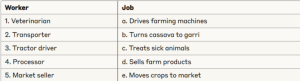
D. Circle examples of division of labour:
- Mother doing all housework alone
- Different teachers for each subject
- Students sharing classroom duties
- One person building a whole house
- Workers in a factory doing different jobs
- Everyone in class being class captain
E. List division of labour in your home:
- Mother: _____________
- Father: _____________
- You: _____________
F. Benefits or Problems? Write B for Benefit, P for Problem:
- Work finishes faster _____
- Job becomes boring _____
- Better quality _____
- Can’t work if someone is absent _____
- People become experts _____
G. Short answers:
- Give two benefits of division of labour.
- What is your job at home?
- Name three different jobs in your school.
H. Think and Draw:
Draw 4 people doing different jobs to make a shirt:
- Cotton farmer
- Thread maker
- Tailor
- Seller
[Drawing space]
Second Term Social Studies Lesson Notes for Other Topics
Common Illnesses In The Community
Explore lesson notes covering all topics.
Symptoms Of Common Illnesses In The Community
Explore lesson notes covering all topics.
Causes Of Common Illness: Dysentery
Explore lesson notes covering all topics.

Prevention Of Common Diseases
Explore lesson notes covering all topics.
Meaning Of Drug Abuse
Explore lesson notes covering all topics.
Ways Of Knowing Someone Who Has Abused Drugs
Explore lesson notes covering all topics.
Effects Of Drug Abuse
Explore lesson notes covering all topics.

Meaning Of Illness
Explore lesson notes covering all topics.

How To Prevent Accidents In The School And At Home
Explore lesson notes covering all topics.
Effects Of Home And School Accidents
Explore lesson notes covering all topics.
Causes of Accidents At Home And In School
Explore lesson notes covering all topics.
Meaning Of Accidents, Causes Of Accidents At Home And School
Explore lesson notes covering all topics.

Importance Of Cleaning In Our Environment
Explore lesson notes covering all topics.
Ways Of Keeping Our Environment Clean
Explore lesson notes covering all topics.
Meaning And The Environment
Explore lesson notes covering all topics.

Lesson Notes for Other Classes

Basic 2 Lesson Note
The complete lesson note to guide your studies.
Basic 3 Lesson Note
The complete lesson note to guide your studies.
Basic 5 Lesson Note
The complete lesson note to guide your studies.
JSS1 Lesson Note
The complete lesson note to guide your studies.
JSS2 Lesson Note
The complete lesson note to guide your studies.

JSS3 Lesson Note
The complete lesson note to guide your studies.