
Knitting JSS3 Cultural & Creative Arts (CCA) Lesson Note
Download Lesson NoteTopic: Knitting
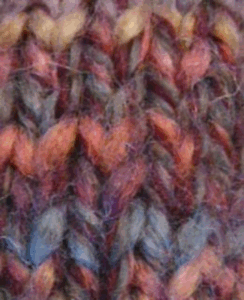

Knitted outfits
Knitting is a method by which yarn is manipulated to create a textile or fabric.
Knitting creates multiple loops of yarn, called stitches, in a line or tube. Knitting has multiple active stitches on the needle at one time. Knitted fabric consists of several consecutive rows of interlocking loops. As each row progresses, a newly created loop is pulled through one or more loops from the prior row, placed on the gaining needle, and the loops from the prior row are then pulled off the other needle.
Knitting may be done by hand or by using a machine.
Different types of yarns (fibre type, texture, and twist), needle sizes, and stitch types may be used to achieve knitted fabrics with different properties (colour, texture, weight, heat retention, look, water resistance, and/or integrity)
Courses and wales
Structure of stockinette, a common knitted fabric. The meandering red path defines one course, the path of the yarn through the fabric. The uppermost white loops are unsecured and “active”, but they secure the red loops suspended from them. In turn, the red loops secure the white loops just below them, which in turn secure the loops below them, and so on.

Alternating wales of red and yellow knit stitches. Each stitch in a wale is suspended from the one above it.

The basic pattern of warp knitting. Parallel yarns zigzag lengthwise along the fabric, each loop securing a loop of an adjacent strand from the previous row.
Weft and warp knitting
There are two major varieties of knitting: weft knitting and warp knitting. In the more common weft knitting, the wales are perpendicular to the course of the yarn. In warp knitting, the wales and courses run roughly parallel. In weft knitting, the entire fabric may be produced from a single yarn, by adding stitches to each wale in turn, moving across the fabric as in a raster scan. By contrast, in warp knitting, one yarn is required for every wale. Since a typical piece of knitted fabric may have hundreds of wales, warp knitting is typically done by machine, whereas weft knitting is done by both hand and machine.Warp-knitted fabrics such as tricot and Milanese are resistant to runs and are commonly used in lingerie.

A modern knitting machine in the process of weft knitting
Weft-knit fabrics may also be knit with multiple yarns, usually to produce interesting color patterns. The two most common approaches are intarsia and stranded colorwork. In intarsia, the yarns are used in well-segregated regions, e.g., a red apple on a field of green; in that case, the yarns are kept on separate spools, and only one is knitted at any time. In the more complex stranded approach, two or more yarns alternate repeatedly within one row and all the yarns must be carried along the row, as seen in Fair Isle sweaters. Double knitting can produce two separate knitted fabrics simultaneously (e.g., two socks). However, the two fabrics are usually integrated into one, giving it great warmth and excellent drape.

In the knit stitch on the left, the next (red) loop passes through the previous (yellow) loop from below, whereas in the purl stitch (right), the next stitch enters from above. Thus, a knit stitch on one side of the fabric appears as a purl stitch on the other, and vice versa.
Knit and purl stitches

Two courses of red yarn illustrating two basic fabric types. The lower red course is knit into the white row below it and is itself knit on the next row; this produces stockinette stitch. The upper red course is purled into the row below and then is knit, consistent with the garter stitch.

A dropped stitch, or missed stitch, is a common error that creates an extra loop to be fixed.
In securing the previous stitch in a wale, the next stitch can pass through the previous loop from either below or above. If the former, the stitch is denoted as a knit stitch or a plain stitch; if the latter, as a purl stitch. The two stitches are related in that a knit stitch seen from one side of the fabric appears as a purl stitch on the other side.
The two types of stitches have different visual effects; the knit stitches look like “V”‘s stacked vertically, whereas the purl stitches look like a wavy horizontal line across the fabric. Patterns and pictures can be created in knitted fabrics by using knit and purl stitches as “pixels”; however, such pixels are usually rectangular, rather than square, depending on the gauge/tension of the knitting. Individual stitches, or rows of stitches, may be made taller by drawing more yarn into the new loop (an elongated stitch), which is the basis for uneven knitting: a row of tall stitches may alternate with one or more rows of short stitches for an interesting visual effect. Short and tall stitches may also alternate within a row, forming a fish-like oval pattern.
Knitting Materials
To start knitting, you only need two things: a pair of needles and a ball of yarn. If you want to finish a project, though, you’ll need a few more items. So what does an experienced knitter keep in a knitting kit?
A tapestry needle – The most basic tool in any knitter’s kit, a tapestry needle is a large sewing needle, with an eye big enough to accommodate bulky yarn. You’ll use the needle to weave in the tails of yarn left after you bind off your project.
Stitch markers – These small rings slip on your needles to mark particular points in your pattern. Some markers can be clipped directly onto a stitch if you need to mark a spot on the project itself to come back to later in the pattern.
Stitch holders – A stitch holder is like a large safety pin. When a pattern calls for you to set some stitches aside to come back to later, you will slip those stitches onto a holder.
Row counters – Many patterns require you to keep track of how many rows you have knit. Some counters slip onto your needle and have a number dial you change after each row. Some have a simple button you click. And, yes, there are smartphone apps for that.
A measuring tape – A lot of patterns call for several inches, rather than several rows. A flexible measuring tape will be indispensable, especially when making pairs of things, like mittens or sleeves. You don’t want to guess that your sleeves are the same length.
Needle caps – When you’re taking a knitting break, you can place them on the end of your needles to ensure no stitches slip off while your project is in your knitting bag. They can also be used to turn a double-point needle into a straight needle.
As for knitting needles, there are three types: the classic straight pair, double-point needles (sold in sets of 4 or 5), and circular needles. Keep knitting and you will eventually use each kind of needle. Some projects require the use of more than one kind.
Straight needles are used for most of your rectangular projects, like scarves and washcloths.
Circular needles are two needle heads connected to a cord. They are necessary for larger projects, like blankets. They are also used for projects that are worked in the round, like hats or the body of a seamless sweater. These needles vary by needle size and cord length, from 9 inches to 60 inches. Frequent knitters might want to invest in a circular needle kit, which offers greater flexibility. Rather than buying a needle for each project, a kit allows you to customize the cord length and the needle size. Plus, if your project calls for changing needle size partway through, all you have to do is scrunch your stitches onto the cord and switch out the needle heads.
Double-point needles are used for smaller projects joined in the round, like mittens or the crown of a hat. Often, you will start a project on circular needles, then switch to double points as you get close to binding off.
Second Term Cultural & Creative Arts (CCA) Lesson Notes for Other Topics

Designing Patterns Using Basic Shapes
Explore lesson notes covering all topics.

Craft Making
Explore lesson notes covering all topics.

Music Staff (Stave)
Explore lesson notes covering all topics.

Colouring Patterns Of Basic Shape
Explore lesson notes covering all topics.

Musical Alphabets & Clefs
Explore lesson notes covering all topics.
Paper Craft Making
Explore lesson notes covering all topics.
Acting
Explore lesson notes covering all topics.
Developing Character In A Play
Explore lesson notes covering all topics.

Impersonation
Explore lesson notes covering all topics.
Mosaic
Explore lesson notes covering all topics.

Creating Music Solfa Notation
Explore lesson notes covering all topics.

Music Notes And Their Values
Explore lesson notes covering all topics.

Creating A Play With The Theme Of Honesty/ Integrity/ Right Attitude To Work
Explore lesson notes covering all topics.

Introduction To Weaving Using Paper
Explore lesson notes covering all topics.
Dance Motif
Explore lesson notes covering all topics.

Lesson Notes for Other Classes

Basic 2 Lesson Note
The complete lesson note to guide your studies.
Basic 3 Lesson Note
The complete lesson note to guide your studies.

Basic 4 Lesson Note
The complete lesson note to guide your studies.
Basic 5 Lesson Note
The complete lesson note to guide your studies.

JSS1 Lesson Note
The complete lesson note to guide your studies.

JSS2 Lesson Note
The complete lesson note to guide your studies.