
Athletics (II) – Sprint Race Basic 4 Physical & Health Education Lesson Note
Download Lesson NoteTopic: Athletics (II) – Sprint Race
LEARNING AREA
- Introductory Activities
- Understanding Sprint Racing
- Types of Sprint Races
- Stages of Sprint Racing
- Starting Techniques and Commands
- Take-off and Acceleration
- Running Technique and Arm Action
- Finishing Techniques
PERFORMANCE OBJECTIVES
By the end of the lesson, most of the pupils should have attained the following objectives –
- explain the meaning of sprint race and its characteristics.
- identify different types of sprint races.
- demonstrate correct starting position and techniques.
- perform proper take-off and acceleration techniques.
- show correct running form and arm action.
- demonstrate proper finishing techniques.
- understand and follow starting commands.
INSTRUCTIONAL MATERIALS
The teacher will teach the lesson with the aid of:
- Athletic track/field or playground
- Starting blocks (if available) or marked starting lines
- Measuring tape
- Stopwatch
- Whistle
- Cones or markers
- Charts showing sprint techniques
- Video clips of sprint races (if available)
- Flags for finishing line
METHOD OF TEACHING
Choose a suitable and appropriate methods for the lessons.
Note – Irrespective of choosing methods of teaching, always introduce an activities that will arouse pupil’s interest or lead them to the lessons.
REFERENCE MATERIALS
- Scheme of Work
- 9 – Years Basic Education Curriculum
- Physical Education Curriculum
- Athletics Handbook
- Track and Field Manual
- All Relevant Material
- Online Information
CONTENT OF THE LESSON
LESSON 1 – MEANING OF SPRINT RACE
WHAT IS A SPRINT RACE?

A sprint race is a short-distance running event where athletes run as fast as possible over a relatively short distance. Sprint races require maximum speed, power, and explosive energy.
CHARACTERISTICS OF SPRINT RACES:
- Short distances (50m to 400m)
- Maximum speed throughout the race
- Explosive start and powerful acceleration
- High intensity effort
- Anaerobic energy system (without oxygen)
- Requires speed, power, and coordination
LESSON 2 – TYPES OF SPRINT RACES
COMMON SPRINT DISTANCES:
- 50 METERS
- Very short sprint
- Mainly for beginners and youth
- Focuses on acceleration and speed
- 100 METERS
- The classic sprint distance
- Known as the “fastest human” race
- Requires perfect technique throughout
- 200 METERS
- Includes a curve in the track
- Combines speed and speed endurance
- Requires strategic pacing
- 400 METERS
- Longest sprint distance
- One complete lap of the track
- Requires speed endurance and tactical awareness
RELAY SPRINTS:
- 4 x 100m relay
- 4 x 200m relay
- 4 x 400m relay
LESSON 3 – STAGES OF SPRINT RACING
Sprint racing is divided into FIVE MAIN STAGES:
STAGE 1: STARTING
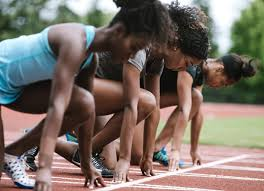
- Getting into the proper starting position
- Responding to starting commands
- First explosive movement
STAGE 2: TAKE-OFF (ACCELERATION)

- First 10-30 meters of the race
- Building up speed from stationary position
- Gradual body position changes
STAGE 3: RUNNING (MAXIMUM SPEED)
- Maintaining top speed
- Efficient running technique
- Optimal stride length and frequency
STAGE 4: ARM ACTION
- Coordinated arm movement throughout
- Helps with balance and speed
- Synchronized with leg action
STAGE 5: FINISHING
- Maintaining speed to the finish line
- Proper finishing technique
- Legal finish according to rules
LESSON 4 – STARTING TECHNIQUES
STARTING POSITIONS:
STANDING START
- Used for beginners and shorter distances
- Feet placed shoulder-width apart
- One foot slightly ahead of the other
- Body leaning forward slightly
CROUCH START (STARTING BLOCKS)
- Used in competitive sprinting
- More explosive and faster start
- Requires starting blocks
CROUCH START TECHNIQUE:
- “ON YOUR MARKS” POSITION:
- Place hands behind the starting line
- Fingers spread for support
- Strong leg in back block, weak leg in front
- Body weight forward on hands
- Eyes looking down
- “SET” POSITION:
- Raise hips higher than shoulders
- Weight shifts to hands and front foot
- Body forms a coiled spring position
- Hold position until gun sounds
- Focus and prepare for explosive start
- “GO” (GUN SOUND):
- Drive powerfully with both legs
- Pump arms vigorously
- Stay low for first few steps
- Gradually rise to upright position
LESSON 5 – TAKE-OFF AND ACCELERATION
TAKE-OFF PHASE (First 2-3 steps):
- Explosive Drive: Push hard against the starting blocks or ground
- Low Body Position: Stay low with body angled forward
- Powerful Arm Action: Drive arms back and forth aggressively
- Short, Quick Steps: Take rapid, driving steps
ACCELERATION PHASE (10-30 meters):
- Gradual Rise: Slowly bring body to upright position
- Increasing Stride Length: Steps get longer as speed builds
- Maintain Power: Continue powerful arm and leg action
- Build Speed: Progressively increase running speed
KEY POINTS:
- Don’t stand up too quickly
- Drive with the arms
- Push off balls of feet
- Lean forward initially
LESSON 6 – RUNNING TECHNIQUE
PROPER RUNNING FORM:
BODY POSITION:
- Upright posture with slight forward lean
- Relaxed shoulders
- Head up, eyes looking ahead
- Core muscles engaged
LEG ACTION:
- High knee lift
- Quick leg turnover
- Land on balls of feet
- Drive leg back and down
- Full extension of driving leg
FOOT STRIKE:
- Land on forefoot/balls of feet
- Minimal ground contact time
- Push off with toes
- Avoid heel striking
STRIDE CHARACTERISTICS:
- Optimal stride length (not too long or short)
- High stride frequency
- Efficient energy transfer
- Smooth, rhythmic movement
LESSON 7 – ARM ACTION
CORRECT ARM TECHNIQUE:
ARM POSITION:
- Bent at approximately 90-degree angle
- Relaxed shoulders
- Hands loosely cupped (not clenched fists)
- Elbows close to body
ARM MOVEMENT:
- Drive arms straight back and forth
- Don’t cross arms across the body
- Opposite arm to opposite leg coordination
- Powerful backward drive
- Quick forward recovery
HAND POSITION:
- Relaxed, loosely cupped
- Thumbs on top
- No tension in hands
- Natural finger position
BENEFITS OF PROPER ARM ACTION:
- Helps maintain balance
- Increases running speed
- Provides rhythm and timing
- Assists with body coordination
LESSON 8 – FINISHING TECHNIQUES
APPROACHING THE FINISH:
MAINTAIN SPEED:
- Don’t slow down before the line
- Keep driving through the finish
- Maintain proper form
- Focus on the finish line
FINISHING METHODS:
- RUN THROUGH:
- Most common and safest method
- Maintain normal running form
- Run past the finish line
- Don’t slow down at the line
- LEAN FINISH:
- Lean torso forward at the line
- Keep legs driving
- Only use when very close race
- Requires good timing
IMPORTANT FINISHING RULES:
- Race is finished when torso crosses the line
- Don’t throw hands or head forward
- Arms and legs don’t count for finishing
- Stay in your lane throughout
LESSON 9 – STARTING COMMANDS
OFFICIAL STARTING COMMANDS:
“RUNNERS TO YOUR MARKS”
- Athletes approach starting line
- Get into starting position
- Prepare for the race
“ON YOUR MARKS”
- Take proper starting position
- Be still and ready
- Focus on the start
“SET”
- Move to “set” position
- Hold position motionless
- Wait for starting signal
STARTING SIGNAL (GUN/WHISTLE)
- Begin the race immediately
- React as quickly as possible
- Start explosive movement
FALSE START:
- Moving before the starting signal
- Results in disqualification
- Stay completely still in “set” position
PRESENTATION
To deliver the lesson, the teacher adopts the following steps:
- To introduce the lesson, the teacher revises the previous lesson on basic running. Based on this, he/she asks the pupils about running fast;
- Explains what sprint racing is and demonstrates the difference between sprinting and jogging;
Pupil’s Activities – Practice the difference between slow jogging and fast sprinting over short distances.
- Demonstrates proper starting techniques and starting commands;
Pupil’s Activities – Practice starting positions and responding to starting commands.
- Shows correct take-off and acceleration techniques;
Pupil’s Activities – Practice explosive starts and acceleration over 20-30 meters.
- Demonstrates proper running form and arm action;
Pupil’s Activities – Practice correct running technique focusing on arm action and body position.
- Shows finishing techniques and explains finishing rules;
Pupil’s Activities – Practice running through the finish line and proper finishing form.
- Organizes short sprint races with proper technique focus;
Pupil’s Activities – Participate in 50m or 60m sprint races applying learned techniques.
CONCLUSION
To conclude the lesson for the week, the teacher revises the entire lesson and links it to the following week’s lesson on sprint training and improvement.
NEXT LESSON
Sprint Training Methods and Techniques for Improvement – Physical Education Primary
LESSON EVALUATION
Asks pupils to:
- Demonstrate correct starting position and response to commands
- Show proper take-off and acceleration technique
- Display correct running form with proper arm action
- Finish a sprint race correctly
- Explain the stages of sprint racing
WORKBOOK
WEEKLY ASSESSMENT (TEST)
- A sprint race is a _______ distance running event. A. Long B. Short
- The shortest sprint distance is usually _______ meters. A. 50 B. 100
- How many stages are there in sprint racing? A. Four B. Five
- The longest sprint distance is _______ meters. A. 200 B. 400
- In starting position, athletes respond to _______ commands. A. Two B. Three
- The take-off phase occurs in the first _______ meters. A. 10-30 B. 50-60
- Arms should be bent at approximately _______ degrees. A. 90 B. 180
- The race is finished when the _______ crosses the line. A. Hand B. Torso
- Moving before the starting signal is called _______. A. False start B. Good start
- List the five stages of sprint racing: a. _________________ b. _________________ c. _________________ d. _________________ e. _________________
First Term Physical & Health Education Lesson Notes for Other Topics

Sports and Games (Athletics)
Explore lesson notes covering all topics.

Safety
Explore lesson notes covering all topics.

Movement (Catching)
Explore lesson notes covering all topics.
Movement (Throwing)
Explore lesson notes covering all topics.

Moving our Body Parts
Explore lesson notes covering all topics.

Movement
Explore lesson notes covering all topics.

Revision of First Term : PHE
Explore lesson notes covering all topics.
Athletics (Jumping)
Explore lesson notes covering all topics.

Sports and Games (Athletics)
Explore lesson notes covering all topics.

Safety Rules In Football Games
Explore lesson notes covering all topics.

Football Game
Explore lesson notes covering all topics.

Football Game
Explore lesson notes covering all topics.
Basketball Game
Explore lesson notes covering all topics.
Personal Healthcare
Explore lesson notes covering all topics.

Volleyball Game
Explore lesson notes covering all topics.
Lesson Notes for Other Classes

Basic 1 Lesson Note
The complete lesson note to guide your studies.

Basic 2 Lesson Note
The complete lesson note to guide your studies.

Basic 3 Lesson Note
The complete lesson note to guide your studies.

Basic 5 Lesson Note
The complete lesson note to guide your studies.

Basic 6 Lesson Note
The complete lesson note to guide your studies.

JSS1 Lesson Note
The complete lesson note to guide your studies.