
Machines SS2 Physics Lesson Note
Download Lesson NoteTopic: Machines
Machines make our work simpler. It is a force-producing device by which a large force called load can be overcome by a small applied force called effort.
TERMINOLOGIES USED IN MACHINES
- Force Ratio (Mechanical Advantage )
- Velocity Ratio
- Efficiency
- Mechanical Advantage
We define effort as the force applied to a machine and load as the resistance overcome by the machine. The ability of a machine to overcome a large load through a small effort is known as its mechanical advantage. It is given by M.A = Load/ Effort
The mechanical advantage of a machine is influenced by friction in parts.
- Velocity Ratio (V.R)
The velocity ratio is the ratio of the distance moved by the effort and load in the same interval
V.R = Distance moved by effort
Distance moved by the load
The velocity ratio depends on the geometry of the machine
- Efficiency (E)
The efficiency of a machine is defined as:
Ef =Useful work done by the machine. × 100
Work put into the machine
Work = force x distance
Ef = load x distance moved by load
Effort x distance moved by effort × 100
Then V.R =M.A
TYPES OF MACHINES
- LEVER
This is the simplest form of machine. It consists of a rigid rod pivoted about a point called the fulcrum F with a small effort applied at one end of the lever to overcome a large load L at the other end. There are various types of levers depending on the relative positions of the load, effort and fulcrum.

Taking a moment about F
E x a = L x b which is given
L = a =M.A
E b
a/b = V.R
Examples of first-class levers are the crowbar, pair of scissors or pincers, claw hammer, see-saw, pliers etc
In the second order lever, the load is between the fulcrum and effort Examples are a wheelbarrow, nutcracker tarp door, an oar etc.
In the third-order lever, the effort is between the fulcrum and the load. Human forearm, laboratory tong etc.
- Wheel And Axle

It consists of a large wheel to which a rope or string is attached and an axle or small wheel with the rope or string wound around it in the opposite direction. The load to be lifted is hung at the free end of the rope on the axle while the effort is applied at the end of the rope on the wheel. For each complete rotation, the load and the effort move through a distance equal to the circumference of the wheel and axle respectively.
V.R = R/r
The principle of wheel and axle is used in brace screwdrivers but spanner windlass and gear-boxes
- Gear Wheels
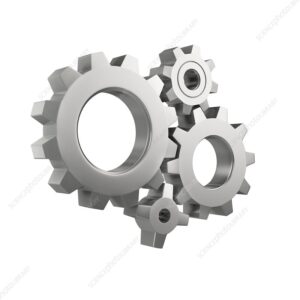
In gearboxes, there are toothed wheels of different diameters interlocked to give turning force at low speeds depending on which gear is the driver and which is the driven
V.R = No of teeth on the driven wheel
There are no teeth on the driving wheel
- The Hydraulic Press
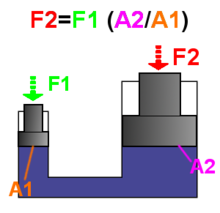
The machine is widely used for compressing waste paper and cotton into compact bales forging different alloys into desirable shapes etc. Its work is based on Pascal’s principle which states that pressure is transmitted equally in fluid Oil is the liquid normally used in hydraulic press
V.R = R2/r2
- The Wedge
The wedge is a combination of two inclined planes. It is used to separate bodies which are held together by a large force. Examples of wedge-type machines are axes, chisels, knives etc.
- Pulley

A simple pulley is a fixed wheel hung on a suitable support with a rope passing around its groove.
i. Block And Tackle (Pulley)
This is the more practical system of pulleys in which one or more pulleys are mounted on the same axle with one continuous rope passing all-round the pulleys
EFFECTS OF FRICTION ON MACHINE
- Work is always wasted in machines to overcome the frictional forces present between the moving parts and also to lift to part of the machine. The greater the friction, the greater the effort required and the smaller the M.A. M.A. depends on friction but depends on the geometry of moving parts.
- The efficiency of nearly all the machines varies with the load and the load and effort are related by: E = al + b ( a and b are constant ). This is called linear law for a machine. It follows that E is proportional to L
- The value to give us the effort required to operate the machine moving part only if no load is present while A gives us the measure of the friction present
= M.A x 100
V.R
In practical machines, the efficiency is usually less than 100% because of friction in the moving parts of the machine.
CLASSWORK
1(a) What is a machine? (b) Explain why a machine can never be 100% efficient.
- Define the following terms as applicable to the machine (a) velocity ratio (ii) mechanical advantage (iii) efficiency
- A pulley with a velocity ratio of 5 is used to lift a load of 400N through a vertical height of 8m by exerting an effort of 100N. Calculate the: (a) work done by the effort and (b) efficiency of the pulley system
First Term Physics Lesson Notes for Other Topics

Simple Harmonic Motion
Explore lesson notes covering all topics.
Equilibrium Of Forces
Explore lesson notes covering all topics.

Newton's Law Of Motion
Explore lesson notes covering all topics.
Projectile And Its Implications
Explore lesson notes covering all topics.
Derivation of Equations of Linear Motions
Explore lesson notes covering all topics.

Scalar And Vector Quantities
Explore lesson notes covering all topics.

Concept Of Position, Distance, And Displacement In Relation To X-Y Plane
Explore lesson notes covering all topics.
Scalars And Vectors
Explore lesson notes covering all topics.
Rectilinear Acceleration
Explore lesson notes covering all topics.
Speed And Velocity
Explore lesson notes covering all topics.
Motion
Explore lesson notes covering all topics.
Time
Explore lesson notes covering all topics.
Position, Distance, Displacement
Explore lesson notes covering all topics.
Fundamentals And Derived Quantities And Units
Explore lesson notes covering all topics.
Magnet and Magnetic Field
Explore lesson notes covering all topics.

Lesson Notes for Other Classes

Basic 2 Lesson Note
The complete lesson note to guide your studies.
Basic 3 Lesson Note
The complete lesson note to guide your studies.

Basic 4 Lesson Note
The complete lesson note to guide your studies.
Basic 5 Lesson Note
The complete lesson note to guide your studies.

JSS1 Lesson Note
The complete lesson note to guide your studies.

JSS2 Lesson Note
The complete lesson note to guide your studies.