
Derivation of Equations of Linear Motions SS2 Physics Lesson Note
Download Lesson NoteTopic: Derivation of Equations of Linear Motions
BASIC DEFINITIONS
- Displacement: This is the distance travelled in a specified direction. It is a vector quantity. Its unit is meters
- Distance: This is the space or separation between two points. It is a scalar quantity. Its unit is meters
- Speed: this is the rate of change of distance with time. It is a scalar quantity. Its unit is a meter per second (m/s)
Speed= distance
Time
- Velocity: this is the rate of change of distance with displacement with time. It is a vector quantity. Its unit is a meter per second (m/s)
Velocity= displacement
Time
- Acceleration: this is the increasing rate of change of distance with time. It is a vector quantity. Its unit is meter per seconds-square (m/s2). Retardation or deceleration is a negative acceleration.
Acceleration= velocity
Time
DERIVATION OF EQUATIONS OF LINEAR MOTION
v= final velocity
u = initial velocity
a = acceleration
t = time
s = distance
Average speed = total distance
Time
Total distance= average speed x time
s= (u + v) x t ————– (1)
2
From the definition of acceleration
a = (v-u) ————– (2)
t
From equation (2) substitute for ‘t’ into equation (1)
v2 = u2 + 2as ————– (3)
From equation (2) substitute for ‘v’ into equation (1)
s = ut + ½(at2) ————– (4)
Calculations Using the Equation of Motion
- A car moves from rest with an acceleration of 0.2 m/s2. Find its velocity when it has covered a distance of 50m
u= 0m/s; a= 0.2m/s2; s= 50m; v =?
v2 =u2 + 2as
v2 = (0)2 + 2 (0.2 x 50)
v2 = 20
v = √20
v = 2√5m/s
- A car travels with a uniform velocity of 108 km/hr . How far does it travel in ½ a minute?
Solution
v=108 km/hr; t= ½ minutes; Distance =?
v = 108 km/hr = 108 x1000
3600
v= 30 m/s
t= ½ 60 = 30secs
Speed = distance
time
Distance = speed x time
s = 30 x 30
s = 900 m
MOTION UNDER GRAVITY
A body moving with a uniform acceleration in space does so under the influence of gravity with a constant acceleration. (g = 10 m/s2). In dealing with vertical motion under gravity, it must be noted that:
a= g is positive for a downward motion
a= -g for an upward motion
the velocity v= 0 at maximum height for a vertically projected object
The initial velocity u=0 for a body dropped from rest above the ground
For a re-bouncing body, the height above the ground is zero
The time of fall of two objects of different masses has nothing to do with their masses but is dependent on the distance and acceleration due to gravity as shown below
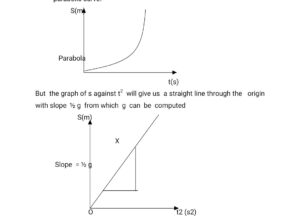
s = ut + ½ gt2
s = ½ gt2 (u=0; initial velocity of an object dropping from a height)
t = √ [(2s)/g]
The above relationship can also be used to determine the value of acceleration due to gravity. If we plot s against t, it will give us a parabolic curve.
Example:
A ball is thrown vertically into the air with an initial velocity, u. What is the greatest height reached?
Solution
v² = u² + 2as
u = u; a = -g; v = 0
02 = u² + 2(-g) s
2gs = u²
s = u² /2g
- A ball is released from a height of 20m. Calculate:
(i) the time it takes to fall
(ii) the velocity with which it hits the ground
a= +g
u=0
s =20m
t =?
t = √2s/g
t = √ (2 x 20 /10)
t = 2secs
v = u + gt
v= gt
v = 10 x2
v = 20 m/s
ASSIGNMENT
- A ball thrown vertically upwards from the ground level hits the ground after 4s. Calculate the maximum height reached during its journey
- A particle starts from rest and moves with a constant acceleration of 0.5m/s2. Calculate the time taken by the particle to cover a distance of 25m.
- A car takes off from rest and covers a distance of 80m on a straight road in 10 seconds. Calculate its acceleration
- A particle accelerates uniformly from rest at 6m/s2 for 8 secs and then decelerates uniformly to rest in the next 7 secs. Determine the magnitude of the deceleration.
First Term Physics Lesson Notes for Other Topics

Machines
Explore lesson notes covering all topics.

Simple Harmonic Motion
Explore lesson notes covering all topics.

Equilibrium Of Forces
Explore lesson notes covering all topics.

Newton's Law Of Motion
Explore lesson notes covering all topics.
Projectile And Its Implications
Explore lesson notes covering all topics.

Scalar And Vector Quantities
Explore lesson notes covering all topics.

Concept Of Position, Distance, And Displacement In Relation To X-Y Plane
Explore lesson notes covering all topics.
Scalars And Vectors
Explore lesson notes covering all topics.
Rectilinear Acceleration
Explore lesson notes covering all topics.
Speed And Velocity
Explore lesson notes covering all topics.
Motion
Explore lesson notes covering all topics.

Time
Explore lesson notes covering all topics.
Position, Distance, Displacement
Explore lesson notes covering all topics.

Fundamentals And Derived Quantities And Units
Explore lesson notes covering all topics.
Magnet and Magnetic Field
Explore lesson notes covering all topics.


Lesson Notes for Other Classes

Basic 1 Lesson Note
The complete lesson note to guide your studies.

Basic 2 Lesson Note
The complete lesson note to guide your studies.

Basic 3 Lesson Note
The complete lesson note to guide your studies.

Basic 4 Lesson Note
The complete lesson note to guide your studies.

Basic 5 Lesson Note
The complete lesson note to guide your studies.

Basic 6 Lesson Note
The complete lesson note to guide your studies.