
Simple Harmonic Motion SS2 Physics Lesson Note
Download Lesson NoteTopic: Simple Harmonic Motion
DEFINITION
This is the periodic motion of a body or particle along a straight line such that the acceleration of the body is directed towards a fixed point.
A particle undergoing simple harmonic motion will move to and fro in a straight line under the influence of a force. This influential force is called a restoring force as it always directs the particle back to its equilibrium position.
Examples of simple harmonic motions are:
- loaded test tube in a liquid
- Mass on a string
- The simple pendulum

As the particle P moves around the circle once, it sweeps through an angle θ = 360 (or 2π radians) in the time T the period of motion. The rate of change of the angle θ with time (t) is known as the angular velocity ω
Angular velocity (ω) is defined by
ω = angle turned through by the body
Time taken
ω = θ /t (rad /sec)
θ = ωt
This is similar to the relation distance = uniform velocity x time (s= =vt ) for motion in a straight line
As the angle changes with time so is the arc length
S = z p
Changing with time. By definition θ in radians = s/r and hence
S= rθ
A = r = radius of the circle
s/t = rθ /t = s/r /t
s/t = s/t x 1/r = r θ /t
v =r ω
The linear velocity v at any point, Q whose distance from C the central point is x is given by
V = ω √ A2 – X2
The minimum velocity, Vm, corresponds to the point at X = 0 which is the velocity at the central point or centre of motion.
Hence, Vm =ω A
Thus, the maximum velocity of the SHM occurs at the centre of the motion (X=0) while the minimum velocity occurs at the extreme position of motion (x=A ).
RELATIONSHIP BETWEEN LINEAR ACCELERATION AND ANGULAR VELOCITY
X = A COS θ
θ = ωt
X = A cos ω t
dx = -ωA sin ω t
dt
dv =-ω2 A cos ω t
dt
=-ω2X
The negative sign indicates that the acceleration is always inwards towards C while the displacement is measured outwards from C.
The energy of simple harmonic motion
Forced vibration and resonance
ENERGY OF SIMPLE HARMONIC MOTION
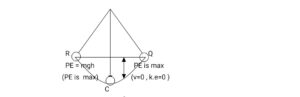
h=0, PE =0; KE = ½ MV2; KE is max
Since force and displacement are involved, it follows that work and energy are involved in simple harmonic motion.
At any instant of the motion, the system may contain some energy as kinetic energy (KE ) or potential energy(PE). The total energy (KE + PE ) for a body performing SHM is always conserved although it may change form between PE and KE.
When a mass is suspended from the end of a spring stretched vertically downwards and released, it oscillates in a simple harmonic motion. During this motion, the force tending to restore the spring to its elastic restoring force is simply the elastic restoring force which is given by
F= – ky
K is the force constant of the spring
EXAMPLE
A body of mass 20g is suspended from the end of a spiral spring whose force constant is 0.4Nm-1. The body is set into a simple harmonic motion with an amplitude of 0.2m. Calculate:
- The period of the motion
- The frequency of the motion
- The angular speed
- The total energy
- The maximum velocity of the motion
- The maximum acceleration
SOLUTION
T = 2π √m/k = 2π √ 0.02/0.4 = 0.447 π sec = 1.41 sec
f=1/T = 1/1.41 = 0.71Hz
ω =2πf = 2π x 0.71= 4.46 rad. S-1
Total energy = ½ KA2 = ½ (0.4) (0.2)2 = 0.008 J
½ mv2 = /12 KA2
Vm2 = 0.008 x 2
0.02
= 0.8
Vm= 0.89 m/s
Or V= ω A
= 4.462 x 0.2
= 3.98m/s2
FORCED VIBRATION AND RESONANCE
Vibrations resulting from the action of an external periodic force on an oscillating body are called forced vibrations. Every vibrating object possesses a natural frequency (fo) of vibration. This is the frequency with which the object will oscillate when it is left undisturbed after being set into vibration. The principle of the sounding board of a piano or the diaphragm of a loudspeaker is based on the phenomenon of forced vibrations.
Whenever the frequency of the vibrating body acting on a system coincides with the natural frequency of the system, then the system is set into vibration with a relatively large amplitude. This phenomenon is called resonance.
First Term Physics Lesson Notes for Other Topics

Machines
Explore lesson notes covering all topics.
Equilibrium Of Forces
Explore lesson notes covering all topics.

Newton's Law Of Motion
Explore lesson notes covering all topics.
Projectile And Its Implications
Explore lesson notes covering all topics.
Derivation of Equations of Linear Motions
Explore lesson notes covering all topics.

Scalar And Vector Quantities
Explore lesson notes covering all topics.

Concept Of Position, Distance, And Displacement In Relation To X-Y Plane
Explore lesson notes covering all topics.
Scalars And Vectors
Explore lesson notes covering all topics.
Rectilinear Acceleration
Explore lesson notes covering all topics.

Speed And Velocity
Explore lesson notes covering all topics.
Motion
Explore lesson notes covering all topics.
Time
Explore lesson notes covering all topics.
Position, Distance, Displacement
Explore lesson notes covering all topics.

Fundamentals And Derived Quantities And Units
Explore lesson notes covering all topics.
Magnet and Magnetic Field
Explore lesson notes covering all topics.


Lesson Notes for Other Classes

Basic 2 Lesson Note
The complete lesson note to guide your studies.

Basic 3 Lesson Note
The complete lesson note to guide your studies.

Basic 4 Lesson Note
The complete lesson note to guide your studies.

Basic 5 Lesson Note
The complete lesson note to guide your studies.

JSS1 Lesson Note
The complete lesson note to guide your studies.

JSS2 Lesson Note
The complete lesson note to guide your studies.