
Equilibrium Of Forces SS2 Physics Lesson Note
Download Lesson NoteTopic: Equilibrium Of Forces
CONDITIONS FOR EQUILIBRIUM
A body is said to be in equilibrium if, under the action of several forces, it does accelerate or rotate.
- The sum of the upward forces must be equal to the sum of the downward forces.
- The sum of the clockwise moment above a point must be equal to the sum of the anticlockwise moment about the same point
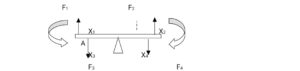
F1 + F2 = F3 + F4
(F1+F2) – (F3+F4) = 0
Clockwise moment = F2X2 + F4X4
Anticlockwise moment = F1X1+ F3X3
(F1X1+ F3X3) – (F2X2 + F4X4) = 0
The sum of clockwise moment = sum of anticlockwise moment
MOMENT OF A FORCE
The moment of a force is the product of the force and the perpendicular distance
M = F x distance
Unit =Nm
COUPLE
A couple is a system of two parallel, equal and opposite forces acting along the same line
The moment of a couple is the product of one of the forces and the perpendicular distance between the lines of action of the two forces
M = f x 2r
M = f x d
The distance between the two equal forces is called the arm of the couple
The moment of a couple is also called a torque
APPLICATION OF THE EFFECT OF COUPLES
- It is easier to turn a tap on or off by applying a couple
- It is easier to turn the steering wheel of a vehicle by applying a couple with our two hands instead of a single force with one arm.
EXAMPLES
- A light beam AB sits on two pivots C and D. A load of 10N hangs at 0; 2m from the support at C. Find the value of the reaction forces P and Q at C and D respectively.

10N
P + Q = 10N
X 2 = Q (2 + 6)
20 = 8Q
Q = 20/8 =2.5 N
OR
Taking a moment about D
P x8 = 10 x6
P = 60/8
P =7.5N
Q = 10 -7.5
Q = 2.5 N
CENTER OF GRAVITY
The centre of gravity of a body is the point through which the line of action of the weight of the body always passes irrespective of the position of the body. It is also the point at which the entire weight of the body appears to be concentrated.
The centre of mass of a body is the point at which the total mass of the body appears to be concentrated. Sometimes, the centre of mass may coincide with the centre of gravity for small objects.
STABILITY OF OBJECTS
There are three types of equilibrium- stable equilibrium, unstable equilibrium, and neutral equilibrium.
- Stable Equilibrium: a body is said to be in stable equilibrium if it tends to return to its original position when slightly displaced. A low centre of gravity and wide base will put objects in stable equilibrium e.g. a cone resting on its base; a racing car with a low C.G and wide base; a ball or a sphere in the middle of a bowl.
- Unstable Equilibrium: a body is said to be in an unstable equilibrium if when slightly displaced it tends to move further away from its original position e.g. a cone or an egg resting on its apex. High C.G. and a narrow base usually cause unstable equilibrium.
- Neutral Equilibrium: A body is said to be in neutral equilibrium if when slightly displaced, it tends to come to rest in its new position e.g. a cone or cylinder or an egg resting on its side.
ASSIGNMENT
- Two forces A and B act at a point at right angles. If their resultant is 50N and their sum is 70N, their magnitudes are: (a) 50N and 20N (b) 20N and 40N (c) 40N and 30N (d) 60N and 10N
- A uniform meter rule of mass 100g balances at the 40cm mark when a mass X is placed at the 10cm mark. What is the value of X? (a) 33.33g (b) 43.33g (c) 53.33g (d) 63.33g
- The equilibrant of a system of forces is (a) equal and opposite to the resultant of the forces (b) the force which has the same effect as the system (c) equal to the resultant of the system (d) the force that makes the system unstable
- Two forces forming a couple are separated by a distance of 25cm, if one of the forces equals 40N, what is the moment of the couple? (a) 1000 Nm (b) 500 Nm (c) 10Nm (d) 5Nm
- Two forces each of magnitude 10N act in opposite directions at the end of a table. If the length of the table is 50cm. Find the moment of the couple on the table (a) 0.5Nm (b) 5Nm (c) 50Nm
- A pole AB of length 5M and weight 300N has its centre of gravity 2.0M from the end A and lies on horizontal ground. Calculate the force required to begin to lift this end.(a) 60N (b) 120N (c) 240N
First Term Physics Lesson Notes for Other Topics

Machines
Explore lesson notes covering all topics.

Simple Harmonic Motion
Explore lesson notes covering all topics.

Newton's Law Of Motion
Explore lesson notes covering all topics.
Projectile And Its Implications
Explore lesson notes covering all topics.
Derivation of Equations of Linear Motions
Explore lesson notes covering all topics.

Scalar And Vector Quantities
Explore lesson notes covering all topics.

Concept Of Position, Distance, And Displacement In Relation To X-Y Plane
Explore lesson notes covering all topics.
Scalars And Vectors
Explore lesson notes covering all topics.
Rectilinear Acceleration
Explore lesson notes covering all topics.

Speed And Velocity
Explore lesson notes covering all topics.
Motion
Explore lesson notes covering all topics.
Time
Explore lesson notes covering all topics.
Position, Distance, Displacement
Explore lesson notes covering all topics.

Fundamentals And Derived Quantities And Units
Explore lesson notes covering all topics.
Magnet and Magnetic Field
Explore lesson notes covering all topics.


Lesson Notes for Other Classes
Basic 1 Lesson Note
The complete lesson note to guide your studies.

Basic 2 Lesson Note
The complete lesson note to guide your studies.

Basic 3 Lesson Note
The complete lesson note to guide your studies.

Basic 4 Lesson Note
The complete lesson note to guide your studies.

Basic 5 Lesson Note
The complete lesson note to guide your studies.

Basic 6 Lesson Note
The complete lesson note to guide your studies.