
Marketing Concepts SS1 Marketing Lesson Note
Download Lesson NoteTopic: Marketing Concepts
The marketing concept is a business philosophy which holds that a company must determine the needs and wants of a specific target market by delivering the desired satisfaction more effectively and efficiently than competitors.
The marketing concept also holds that achieving organizational goals depends on knowing the needs and wants of the target market and delivering the desired satisfaction better than competitors do.
The marketing concept can also be defined as a management orientation which sees the consumer as the central focus of all the activities of the organization.
In other words, the marketing concept is a marketing philosophy which sees the consumer or client as the central focus of all the activities of an organization because no organization can survive without the continued patronage of its consumers. This philosophy regards a genuine concern for consumer welfare (consumer orientation) and the adequate fulfilment of needs (consumer satisfaction) as the most dependent paths to the realization of an organization’s short and long-term goals. The act of marketing has undergone a metamorphosis over time.
It has evolved from the production to the selling stage and the consumer orientation stage and, indeed, it is evolving in some organizations to the consumerism and social responsibility stage.
There are sharp contrasts between the two stages. At the selling state, the emphasis is placed on the product, the company first makes the product and then figures out how to sell it profitably, the orientation of the company is internal and the emphasis of the company is on the sellers’ needs.
Conversely, at the marketing stage, the emphasis is on the continuous wants of the consumer. But first, the company figures out how to profitably make and deliver a product to satisfy these wants. The orientation of the company is external market orientation and the company emphasizes buyer’s needs.
CONCEPTS WHICH ORGANIZATIONS USE IN CONDUCTING MARKETING
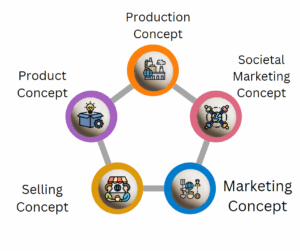
- Production Concept: This concept assumes that consumers would buy products that are available and at lower prices; thus, companies concern themselves with mass production.
The production concept is the idea that a firm should focus on, those products that it could produce most efficiently and that the creation of a supply of low-cost products would in and of itself create the demand for the products. The key questions that a firm would ask before producing a product are:
- Can we produce the product?
- Can we produce enough of it?
The concept focuses more on solving the problem of production and little concern for public (customer) satisfaction. In this concept, customers are seen as people who exist to buy a company’s products rather than a company existing to serve the customers. It is the concept in management orientation that assumes that customers will favour those products that are available and affordable; therefore, the major task of management is to pursue improved production and distribution effectively.
- The Product Concept: This is an orientation that assumes that the customer will favour products that are of high quality. Thus, companies concern themselves with quality, performance and innovative product features.
This concept assumes that customers will favour those products that offer the most quality for the price and therefore, companies need to produce quality products. It explains that customers are primarily interested in the product’s quality and they know the quality and feature differences of competing brands.
Customers make their choices from many brands available based on getting the best quality for their money. So, organizations need to produce quality products to attract customers to them.
- The Selling Concept: The selling concept is based on the assumption that even when products are of high quality, available and affordable, consumers would still not buy unless they are persuaded to buy.
Thus, companies engage in promotional efforts to break consumers’ resistance. Production of goods does not mean assured sales most time. Under the selling concept, companies would not only produce the products, but they would also try to convince customers to buy them through advertising and personal selling.
Before producing a product, the key questions asked are:
- Can we sell the product?
- Can we charge enough for it?
The sales concept paid little attention to whether the product was needed; the goal simply was to beat the competition in the sale with little regard for customer satisfaction. Marketing was a function that was performed after the product was developed and produced, and many people came to associate marketing with hard selling. Even today, many people use the word “marketing” when they mean sales.
- The Marketing Concept: This concept emphasizes marketing management with the twin goals of customer orientation and profitable sales volume. Attention is to be on marketing rather than selling. The key questions became:
i. What do customers want?
ii. Can we develop it while they still want it?
iii. How can we keep our customers satisfied?
In response to these discerning questions, firms began to adopt the marketing concept, which involves:
i. Focusing on customer needs before developing the product.
ii. Aligning all functions of the company to focus on those needs.
iii. Realizing a profit by successfully satisfying customer needs over the long term.
When firms first began to adopt the marketing concept, they typically set up separate marketing departments whose objective was to satisfy customers’ needs. Often, these departments were sales departments with expanded responsibilities.
While this expanded sales department structure can be found in some of the companies today, many firms have structured themselves into marketing organizations having a company-wide customer focus. Since the entire organization exists to satisfy customers’ needs, nobody can neglect a customer issue by declaring it a “marketing problem” as everybody must be concerned with customer satisfaction.
The marketing concept relies upon marketing research to define market segments, their size, and their needs. To satisfy those needs, the marketing team makes decisions about the controllable parameters of the marketing mix.

First Term Marketing Lesson Notes for Other Topics

Classification Of Products II - Industrial Goods
Explore lesson notes covering all topics.

Classification Of Products
Explore lesson notes covering all topics.
Marketing Concepts II - Difference Between Sales & Marketing Concept
Explore lesson notes covering all topics.

Post Independence Era in The History of Marketing in Nigeria
Explore lesson notes covering all topics.

Introduction To Marketing II - Functions of Marketing
Explore lesson notes covering all topics.

Introduction To Marketing
Explore lesson notes covering all topics.

Market Decision and Reasons Wider Market Escape from Competition
Explore lesson notes covering all topics.

Features of the International Market
Explore lesson notes covering all topics.

Legal, Social, Cultural and Demographic Features of International Market
Explore lesson notes covering all topics.

Approaches to the International Market
Explore lesson notes covering all topics.

Regulations Guiding International Marketing
Explore lesson notes covering all topics.
Information and Communication Technology in International Marketing
Explore lesson notes covering all topics.

Importance of International Marketing
Explore lesson notes covering all topics.

International Marketing
Explore lesson notes covering all topics.


Lesson Notes for Other Classes

JSS1 Lesson Note
The complete lesson note to guide your studies.

JSS2 Lesson Note
The complete lesson note to guide your studies.

SS2 Lesson Note
The complete lesson note to guide your studies.

SS3 Lesson Note
The complete lesson note to guide your studies.