
Classification Of Computers SS1 Data Processing Lesson Note
Download Lesson NoteTopic: Classification Of Computers
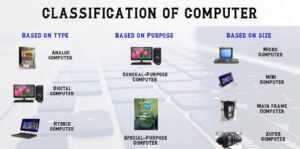 CLASSIFICATION OF COMPUTER BY TYPES
Computers can be classified by types into THREE major types. They are:
- Digital Computer
- Analogue Computer
- Hybrid Computer
- Digital Computer
This is the most common type of computer today. It measures physical quantities by counting. Examples are calculators, digital wristwatches, digital fuel dispensers etc.
2. Analogue Computer
This type of computer is used to measure and process continuous data such as speed, temperature, heartbeat etc. Examples are speedometers, thermometers etc.
3. Hybrid Computer
This type of computer combines the features of digital and analogue computers. It is a combination of digital and analogue computers.
CLASSIFICATION OF COMPUTER BY FUNCTIONALITY
Classification of computers according to purpose can be grouped into two (2), namely:
- General-purpose computers
- Special-purpose computers
- Special Purpose Computers
These are computers designed solely to solve a restricted class of problems e.g. computers for medical diagnosis, weapon guidance, traffic control, weather study and forecast etc.
2. General Purpose Computers
These are computers designed solely to solve a vast variety of problems e.g. they can be used for Word processing and at the same time for graphics, databases, spreadsheets etc.
CLASSIFICATION OF COMPUTERS BY SIZE
Computers can be generally categorized into four, namely:
- Supercomputers
- Mainframe computers
- Mini computers
- Microcomputers
- Super Computer
These are the largest, fastest and most expensive computers. The cost is several millions of dollars and the speed is between 600 million to 900 million instructions per second (MIP).
Another name for a supercomputer is MONSTER. Scientists in weather forecasting, and exploration make use of supercomputers. It can also be used for complex calculations e.g. CRAY, X-MP etc.
2. Mainframe Computers
A mainframe computer is a large computer in terms of price, size of internal memory and speed. It has a variety of peripheral devices such as printers, plotters etc more than those found with small computers, except small computers with large amounts of external storage.
Mainframe computers usually need a specialized environment to operate, with dust, temperature and humidity carefully controlled. They are used in large establishments e.g. banks, airports etc. Examples of Mainframe computers are IBM 360/370, NCR-V 8800.
3. Mini Computers
Mini computers were developed in the 1970s for specialized tasks (i.e. they are special purpose computers). They are smaller less powerful and less expensive than mainframes.
Mini computers, as they are called, are easier to install and operate e.g. PDP II, VAX 750/6000, NCR 9300, DEC, HP 3000 etc.
4. Micro Computers
A microcomputer is a computer whose central processing unit (CPU) is based on a microprocessor.
Microcomputers are at present the most popular computers. They are very small. The capability is generally not as many and not as complex as mini computers or Mainframe computers. They are easy to use. Another name for microcomputers is Personal Computer (PC).
REASONS WHY MICRO COMPUTERS ARE WIDELY USED
- They are cheap.
- They have small sizes.
- They do not require a special environment for their operations.
- They can be used anywhere.

First Term Data Processing Lesson Notes for Other Topics
History Of Computer
Explore lesson notes covering all topics.
Data And Information
Explore lesson notes covering all topics.
Digitalization Of Data
Explore lesson notes covering all topics.
History Of Computing
Explore lesson notes covering all topics.
Introduction to Computer Networking
Explore lesson notes covering all topics.
Internet I - Electronic Mail/ E-Mail Accounts
Explore lesson notes covering all topics.
Internet II - Internet & Search Engines
Explore lesson notes covering all topics.
Computer Virus
Explore lesson notes covering all topics.
Maintenance of Computer I
Explore lesson notes covering all topics.
Maintenance of Computer II
Explore lesson notes covering all topics.
Career Opportunities in Data Processing
Explore lesson notes covering all topics.
Types of Network Devices
Explore lesson notes covering all topics.
Computer Networking
Explore lesson notes covering all topics.


Lesson Notes for Other Classes

JSS1 Lesson Note
The complete lesson note to guide your studies.

JSS2 Lesson Note
The complete lesson note to guide your studies.

SS2 Lesson Note
The complete lesson note to guide your studies.

SS3 Lesson Note
The complete lesson note to guide your studies.