
Classification Of Products SS1 Marketing Lesson Note
Download Lesson NoteTopic: Classification Of Products
MEANING OF PRODUCTS
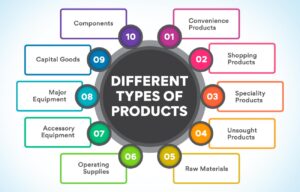
A product is anything that can be offered to a market to satisfy a want or need. Products that are marketed include physical goods, services, ideas, events, experiences, persons, places, properties, organizations and so on.
A product can also refer to anything that can be offered to the market for attention, acquisition, use or consumption that will satisfy consumer’s wants or needs.
It can also be defined as something capable of satisfying consumer needs or wants.
MEANING OF PRODUCTION PROCESS
The product concept focuses on quality superior performance or innovative features, while the production concept focuses on mass production, mass distribution and low price.
When a product is bought, the buyer is not only buying the product but also buying the benefits and the satisfaction that the product will provide.
CLASSIFICATION OF PRODUCTS
The competitive nature of the marketplace has therefore become a significant factor that producers can only ignore to their peril. The purchasing power of the consumers is also affected by the economy of the Nation. It is as a result of those factors that manufacturers must of necessity know the product category to which their products belong.
Producers will do well to ensure that such products retain the quality the consumers want. Since the prices of the items are secondary to the consumers, producers can afford to jack up the prices to obtain some level of margin of profit. are the various classifications of products:
- Industrial Goods: These are goods that need to undergo processing. They are raw materials that would be converted into semi-finished or finished goods. Examples are cotton wool, timber, fresh tomatoes, etc.
- Primary Products: These are all farm produce that have not undergone processing. Examples include cotton wool, yam tuber, cassava tuber, fresh fish, fruits, fresh tomatoes, etc.
- Secondary Products: These are all farm produce that have undergone processing. Examples include garlic, yam flour, smoked fish, corn flour, tomato paste, dry fish, etc.
- Consumer Goods: Consumer goods are goods that are bought from retail stores for personal, family, or household use. Examples are tin tomatoes, smoked fish, fruit juice, garlic, etc. They are grouped into three subcategories based on consumer buying habits: convenience goods, shopping goods, and speciality goods.
i. Convenience Products: These refer to items that the consumer buys with minimum shopping effort. Essentially, these are goods that are habitual with the consumers. They are bought frequently but not in larger quantities because they are non-durable goods. In other words, they are ‘used up”.
Under this category are biscuits, newspapers, toilet soap, cigarettes, etc. In an attempt to buy convenience goods, consumers purchase such goods at a convenient location or retail outlets situated very close to their residences.
ii. Staple Products: These are products that are bought often in a routine manner without much thought regularly. A typical example is with paste or milk for breakfast. Staple products are usually sold in convenient locations like food stores and supermarkets. Branding is important with staple products.
iii. Impulse Products: These are products that are purchased without any planning or search effort. They are usually purchased because of a strongly felt need. They are products that consumers had not planned to buy but decided to buy on the spot.
An example is an ice cream seller who rings a bell. If the children do not buy the ice cream as the seller is sighted, the need goes away and the purchase will not be later. This implies that if the buyer does not see an impulse product on time, the sale may be lost. This explains why retailers display impulse products conspicuously where they will be seen and bought.
i. Emergency products: These are products that are circumstantially purchased when the need is great. For example, the price of ambulance service will not matter if an accident occurs. So also is the price of an umbrella during a rainstorm. Different types of marketing mix are required to meet customers’ emergency needs.
ii. Shopping Products: These are products consumers purchase and consume on a less frequent schedule compared to convenience products. Consumers are willing to spend more time locating these products since they are relatively more expensive than convenience products.
Examples are clothing products, personal services, electronic products, and household furnishings.
iii. Specialty Products: Bo products tend to carry a high price tag relative to convenience and shopping non-products.
Consumption may occur at about the same rate as shopping for products but consumers are much more selective. In fact, in many cases, consumers know in advance which products they prefer and will not shop above to compare products. But they may shop at retailers that provide the best value.
Examples include high-end luxury automobiles, expensive champagne, and celebrity hair care experts. The target markets are generally very small, and outlets selling the products are very limited to the point of being exclusive.
WHY NEW PRODUCTS MAY FAIL IN THE MARKET
- Inadequate market analysis through poor estimation of potential sales of the new product can lead to product failure.
- A new product will also fail if the product does not offer any significant advantage over what competitors are offering.
- Failure to provide sufficient follow-up after the new product has been introduced can also result in new product failure.
- A higher cost of production than anticipated can lead to a higher price of new products which can eventually lead to product failure
- Competitive strength and the reaction of rival firms such as increased promotional activities to protect their market share will lead to new product failure.
- Poor timing of product introduction such as launching the new product during the off-season or off-peak periods will affect the anticipated demand, leading to product failure.
- Technical or production problems such as technical deficient products will lead to new product failure.
- Poor corporate image of the company can lead to customers becoming hesitant in patronizing the company’s product, hence leading to the failure of the new product.
- Too long a test marketing period will make it possible for competitors to capitalize and introduce similar products to the market hence leading to failure of the new product.
- Problems of distribution such as inadequate channels or distribution strategy will affect the product’s availability to customers, hence causing the new product to fail.

First Term Marketing Lesson Notes for Other Topics
Classification Of Products II - Industrial Goods
Explore lesson notes covering all topics.

Marketing Concepts II - Difference Between Sales & Marketing Concept
Explore lesson notes covering all topics.

Marketing Concepts
Explore lesson notes covering all topics.

Post Independence Era in The History of Marketing in Nigeria
Explore lesson notes covering all topics.

Introduction To Marketing II - Functions of Marketing
Explore lesson notes covering all topics.

Introduction To Marketing
Explore lesson notes covering all topics.

Market Decision and Reasons Wider Market Escape from Competition
Explore lesson notes covering all topics.

Features of the International Market
Explore lesson notes covering all topics.

Legal, Social, Cultural and Demographic Features of International Market
Explore lesson notes covering all topics.

Approaches to the International Market
Explore lesson notes covering all topics.

Regulations Guiding International Marketing
Explore lesson notes covering all topics.

Information and Communication Technology in International Marketing
Explore lesson notes covering all topics.

Importance of International Marketing
Explore lesson notes covering all topics.

International Marketing
Explore lesson notes covering all topics.


Lesson Notes for Other Classes

JSS1 Lesson Note
The complete lesson note to guide your studies.

JSS2 Lesson Note
The complete lesson note to guide your studies.
SS2 Lesson Note
The complete lesson note to guide your studies.

SS3 Lesson Note
The complete lesson note to guide your studies.