
Digitalization Of Data SS1 Data Processing Lesson Note
Download Lesson NoteTopic: Digitalization Of Data
Digitalization is the process of converting information into digital format. This information may represent an object, image, sound, document or signal (usually an analogue signal) organized into a discrete set of points or samples. This is the binary data that computers and many devices with computing capacity (such as digital cameras and digital hearing aids) can process.
Digitalization can also be defined as the integration of digital technologies into everyday life. The digital system uses a binary numeric system in which electronic pulses are represented by either 0 for a Low pulse or 1 for a High pulse. Digital can more easily represent symbols such as alphanumeric characters that represent real-world data than the analogue system.
BENEFITS OF DIGITALIZATION
- Long-term preservation of documents
- Orderly archiving of documents
- Easy and customized access to information
- Easy information dissemination through images and text, CD-ROM, Internet, 5. Intranet and extranets.
TYPES OF DIGITAL COMPUTER
- Microcomputers
- Mini computers
- Mainframe computers
- Supercomputers
TECHNOLOGY OF DIFFERENT INFORMATION AGE
The ages are:
- Stone age
- Iron age
- Middle age
- Industrial age
- Electronic age
| Information Age | Tools Used | Purpose | Time | Examples of tools in that age |
| Stone Age | Stone | Sewing, Counting, Defense, Transaction, Storage | Below 12th Century | Basalt, Sandstone, Flint, etc |
| Iron Age | Iron | Defence, Agriculture | 12th Century | Hoes and cutlass |
| Middle Age | Writing Materials | Knowledge transfer, Education | 12th and 13th Century | Pen, Feather, etc |
| Industrial Age | Coals | Power, Development, faster movement | Late 18th and Early 19th Century | Cars, Ships, etc |
| Electronic Age | Writing Materials | Storage, accuracy, timelines | Late 19th Century and above | Circuit, Processor |
EARLY COUNTING DEVICES
- Fingers and Toes
- Stone
- Sticks
- Pebbles
- Cowries
In the early days of man’s existence on earth, counting and simple arithmetic were performed using different parts of the body and some other counting aids. The following are devices used by people of ancient times.
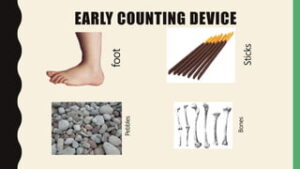
Some early counting devices
- Fingers And Toes
In ancient times, calculations were done by the use of fingers and toes. Fingers were used for simple addition and toes were used together with fingers to count up to twenty. The following problems were faced when using fingers and toes to count:
- They could not be used conveniently to count numbers more than twenty.
- The result obtained from counting with fingers could not be easily remembered.
- Stones And Pebbles
Stones were introduced for counting because of the limitations of counting with fingers and toes. Counting with stones involves building a pile of stones where each represents a quantity. The following were problems faced using stones as counting devices:
- Large numbers of stones were too heavy to carry from one place to another.
- It was cumbersome to count if the counting process involved large numbers.
- Grains
The use of grains was introduced because of the heaviness of stones. Grains can be kernel, beans, rice, corn etc. Grains were used the same way as stones.
- Sticks
These are small pieces of wood that are used for counting in place of stones and grains. Children in nursery and primary schools use match sticks for counting.
- Marks On The Wall
This involves the use of sharp objects in drawing lines on the wall for counting.
Continuous marks on walls will make a wall dirty.
DISADVANTAGES OF EARLY COUNTING DEVICES
- They are difficult to carry about.
- Counting and calculation takes a lot of time.
- They are prone to mistakes.
- They cannot be used to count or calculate large numbers.
- Their results cannot be easily remembered.
- They have no storage facilities.
COMPONENTS OF A COMPUTER SYSTEM
A computer system consists of three main parts otherwise called components. They are :
- Hardware
- Software
- People ware
- Hardware Component
The computer hardware could be defined as the physical parts of the computer that we see, feel and handle. It consists of a device for input, processing, storage, output and communications.
Hardware can be divided into two sections:
- System Unit(CPU)
- The peripherals
i. Cpu/system Unit
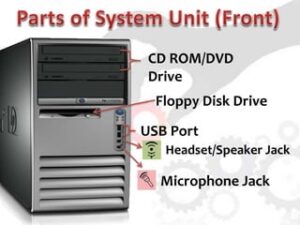
The CPU is the brain of the computer system and it can subdivided into:
a) Control Unit
b) Arithmetic and Logic Unit
c) Memory Unit
a) Control Unit
This is the unit of the computer system that fetches instructions from the main storage, interprets them and issues all the necessary signals to the components making up the system.
b) Arithmetic And Logic Unit
This part of the CPU is where all arithmetic operations are carried out in the computer. This unit is also involved in decision-making. Logic functions such as less than (<), equal (=), greater than (>) etc which are operations of comparisons are used for decision-making.
c) Memory Unit
The memory or primary storage unit is the place in the computer where the program and the data are stored. The computer memory is divided into two namely:
– Random Access Memory (RAM)
– Read Only Memory (ROM)
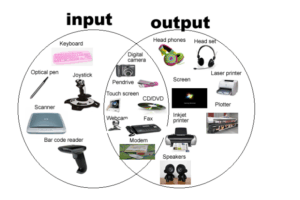
Peripherals
The peripherals are devices outside the CPU but function under the control of the CPU e.g. mouse, keyboard, printer etc.
Software Component
Software is the set of instructions that is used to direct the computer hardware to perform its tasks. That is, it is a set of instructions that makes the users do work and allow the computer to operate.
Software programs i.e. another name for the software is program. A program is a sequence of instructions given to a computer to solve a given problem or accomplish a given task. There are two main classes of software which are:
- System software
- Application software
i. System Software
These are programs written by the manufacturer to control the smooth running of the computer.
ii. Application Software
These are programs written by programmers to instruct the computer to perform a particular task.
iii. PeopleWare
These are people who make and use the computer. They range from professional users to operational users. A user could also be anyone who makes use of a computer. Without people, the computer cannot work. There are two main classes of people:
- Computer professionals.
- Computer users.
PERIPHERALS
Peripherals are in three categories:
- Input Devices
- Output Devices
- Auxiliary Storage Devices
First Term Data Processing Lesson Notes for Other Topics

Database Management System II - How to Create Database
Explore lesson notes covering all topics.
Database Management System I
Explore lesson notes covering all topics.
Data Model
Explore lesson notes covering all topics.
Data Modeling
Explore lesson notes covering all topics.
Data Modeling II - Standard Data Model & Examples
Explore lesson notes covering all topics.
Normalization
Explore lesson notes covering all topics.
Data Model II - Types of Data Modelling
Explore lesson notes covering all topics.

Entity-Relationship Models
Explore lesson notes covering all topics.
Classification Of Computers
Explore lesson notes covering all topics.
History Of Computer
Explore lesson notes covering all topics.
Data And Information
Explore lesson notes covering all topics.
History Of Computing
Explore lesson notes covering all topics.
Introduction to Computer Networking
Explore lesson notes covering all topics.
Internet I - Electronic Mail/ E-Mail Accounts
Explore lesson notes covering all topics.
Internet II - Internet & Search Engines
Explore lesson notes covering all topics.


Lesson Notes for Other Classes
Basic 1 Lesson Note
The complete lesson note to guide your studies.

Basic 2 Lesson Note
The complete lesson note to guide your studies.

Basic 3 Lesson Note
The complete lesson note to guide your studies.

Basic 4 Lesson Note
The complete lesson note to guide your studies.

Basic 5 Lesson Note
The complete lesson note to guide your studies.

Basic 6 Lesson Note
The complete lesson note to guide your studies.