
Importance of Personal Security Basic 5 Security Education Lesson Note
Download Lesson NoteTopic: Importance of Personal Security
Behavioural Objectives
By the end of the lesson, pupils should be able to:
- Mention precaution tips on personal security
- State the importance of personal security, including keeping yourself safe, protecting your home, feeling safe in your community, and quick medical assistance.
Keywords
Precaution, Personal Security, Safety, Protection, Community
Set Induction
Begin the lesson by asking pupils to discuss what makes them feel safe at home, in school, or in their community. Use their responses to introduce the topic of personal security.
Entry Behavior
Pupils have basic knowledge of personal security and different types of security.
Learning Resources and Materials
- Illustrative charts showing different security measures
- Flashcards with precaution tips
Building Background Connection to Prior Knowledge
Pupils have learned about the types of personal security in the previous lesson.
Embedded Core Skills
Critical Thinking, Communication, Safety Awareness
Learning Materials
- Lagos State Scheme of Work for Primary 5
- Security Education textbooks
Instructional Materials
- Whiteboard and markers
- Flashcards
- Illustrative charts
Content
1. Precaution Tips on Personal Security
- Be Aware of Your Surroundings: Always pay attention to what is happening around you, whether you are at home, school, or outside.
- Lock Doors and Windows: Ensure that all entry points to your home are secure, especially at night or when you are alone.
- Avoid Talking to Strangers: Be cautious when approached by people you do not know, especially if you are alone.
- Keep Emergency Contacts Handy: Have a list of important phone numbers like those of your parents, guardians, or the police.
2. Importance of Personal Security
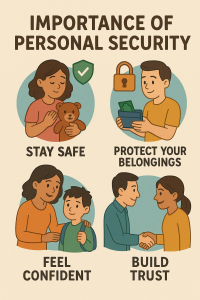
- Keeping Yourself Safe: Personal security helps protect you from harm or danger. By following safety tips, you avoid getting hurt.
- Personal Protection Defense: Knowing how to protect yourself in different situations is crucial for your safety. This could include using simple self-defense techniques or knowing when to seek help.
- Keeping Your Home Safe: Personal security extends to your home. By securing your home, you protect yourself and your family from intrusion or accidents.
- Feeling Safe in Your Community: Personal security contributes to a sense of safety and well-being within your community. When everyone follows security measures, the whole community benefits.
- Quick Medical Assistance: Personal security includes being prepared for emergencies, such as knowing who to call and where to go if someone needs medical help quickly.
Fill-in-the-Blank Questions with Options
- Personal security helps in keeping _____ safe. a) toys b) yourself c) games d) pets
- One precaution tip is to always be aware of your _____ a) toys b) surroundings c) books d) games
- _____ doors and windows is important for home security. a) Opening b) Locking c) Painting d) Repairing
- Avoid talking to _____ to stay safe. a) friends b) teachers c) strangers d) family
- Keeping emergency contacts handy is a _____ tip. a) personal security b) fun c) play d) game
- Personal security helps protect you from _____ a) joy b) harm c) fun d) celebrations
- Personal protection includes knowing simple _____ techniques. a) drawing b) cooking c) self-defense d) music
- Securing your home helps protect your _____ a) belongings b) fun c) games d) toys
- Feeling safe in your _____ is part of personal security. a) toy room b) kitchen c) community d) bedroom
- Quick medical assistance is an important aspect of personal _____ a) fun b) games c) security d) music
First Term Security Education Lesson Notes for Other Topics

Elements Of Security
Explore lesson notes covering all topics.

Elements Of Security - Integrity
Explore lesson notes covering all topics.
Elements Of Security - Confidentiality
Explore lesson notes covering all topics.

Elements Of Security - Authenticity
Explore lesson notes covering all topics.

Elements Of Security - Availability
Explore lesson notes covering all topics.

Empathy
Explore lesson notes covering all topics.
Elements Of Security - Creativity In Sharing Information
Explore lesson notes covering all topics.

Audio Awareness - Materials In Security
Explore lesson notes covering all topics.

Partnering With Key Security Departments
Explore lesson notes covering all topics.

Sources Of Danger And Insecurity - Bombing I
Explore lesson notes covering all topics.

Sources Of Danger And Insecurity - Suicide Bombing
Explore lesson notes covering all topics.

Sources Of Danger And Insecurity
Explore lesson notes covering all topics.

Sources Of Danger And Insecurity - Riot
Explore lesson notes covering all topics.

Sources Of Danger - Dangerous Chemicals
Explore lesson notes covering all topics.

Sources Of Insecurity - Food Poisoning
Explore lesson notes covering all topics.

Lesson Notes for Other Classes

Basic 2 Lesson Note
The complete lesson note to guide your studies.
Basic 3 Lesson Note
The complete lesson note to guide your studies.

Basic 4 Lesson Note
The complete lesson note to guide your studies.

JSS1 Lesson Note
The complete lesson note to guide your studies.
JSS2 Lesson Note
The complete lesson note to guide your studies.

JSS3 Lesson Note
The complete lesson note to guide your studies.