
Ratios Basic 5 Mathematics Lesson Note
Download Lesson NoteTopic: Ratios
Behavioural Objectives:
By the end of the lesson, pupils should be able to:
- Explain the meaning of a ratio
- Express ratios as fractions
- Solve real life problems involving ratios
- Apply quantitative aptitude to problems related to ratios
Keywords:
- Ratio
- Fraction
- Relationship
- Real life problems
- Quantitative aptitude
Set Induction:
The teacher will start by discussing everyday situations where ratios are used, such as in recipes or sharing items among friends. This will introduce the concept of ratios and their practical uses in daily life.
Entry Behaviour:
Pupils are already familiar with basic fractions and simple arithmetic operations.
Learning Resources and Materials:
- Ratio and fraction charts
- Worksheets for practice
- Real-life problem scenarios
- Whiteboard and markers
Building Background/Connection to Prior Knowledge:
The teacher will review fractions and discuss how ratios can be expressed as fractions.
Embedded Core Skills:
- Analytical thinking
- Problem solving
- Application of mathematical concepts
Learning Materials:
- Ratio and fraction charts
- Practice worksheets
- Real-life problem scenarios
Reference Books:
Lagos State Scheme of Work, Primary 5 Mathematics Textbook
Instructional Materials:
- Ratio and fraction charts
- Worksheets
- Whiteboard and markers
Content:
1. Relationship Between Ratio and Fractions
- Explanation of what a ratio is
- How ratios can be expressed as fractions
- Examples and practice problems
2. Solving Real Life Problems Involving Ratios
- Application of ratios in everyday situations
- Practice problems involving proportion
3. Quantitative Aptitude
- Using ratios in quantitative aptitude problems
- Practice problems and examples
Relationship Between Ratio and Fractions
Explanation of What a Ratio Is:
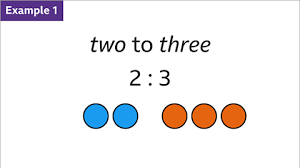
A ratio compares two or more quantities, showing how many times one quantity is compared to another. It is written as a:b.
Example: If there are 3 boys and 2 girls in a class, the ratio of boys to girls is 3:2.
How Ratios Can be Expressed as Fractions:
A ratio can be converted to a fraction by expressing it as “a/b” where “a” is the first quantity and “b” is the second quantity.
Examples and Practice Problems:
Example 1:
- Ratio: 3:5
- Fraction: 3/5
Example 2:
- Ratio: 7:3
- Fraction: 7/3
Example 3:
- Ratio: 2:8
- Fraction: 2/8 = 1/4
Example 4:
- Ratio: 6:4
- Fraction: 6/4 = 3/2
Example 5:
- Ratio: 5:2
- Fraction: 5/2
Class Work:
- Convert the ratio 4:3 to a fraction.
- Express the ratio 15:5 as a fraction in simplest form.
- Write the ratio 8:12 as a fraction and simplify.
- Convert the ratio 7:14 to a fraction and simplify.
- Change the ratio 14:21 to a fraction and simplify.
Solving Real-Life Problems Involving Ratios
Application of Ratios in Everyday Situations:
Ratios help in comparing quantities, mixing ingredients, or dividing resources in various real-life situations.
Examples and Practice Problems:
Example 1:
- Problem: A recipe uses a ratio of 2 cups of flour to 3 cups of sugar. If you want to use 6 cups of flour, how many cups of sugar do you need?
- Solution: Use the ratio 2:3. For 6 cups of sugar, the amount of flour needed is (2/3) × 6 = 4 cups.
Example 2:
- Problem: In a classroom, the ratio of boys to girls is 4:3. If there are 20 boys, how many girls are there?
- Solution: Set up the proportion 4:3 = 20:x. Cross multiply: 4x = 3 × 20 = 60, so x = 15 girls.
Example 3:
- Problem: The ratio of red marbles to blue marbles is 5:7. If there are 35 red marbles, how many blue marbles are there?
- Solution: The ratio is 5:7 means in 5 hours, about the ratio of ones needed to have it.
Example 4:
- Problem: A paint mixture uses a ratio of 3 parts red to 5 parts white. If you use 6 litres of blue paint, how much white paint is needed?
- Solution: Set up the proportion 3:5 = 6:x. Cross multiply: 3x = 5 × 6 = 30, so x = 10 litres of white paint needed is (3/5) × 6 = 2 hours.
Example 5:
- Problem: The ratio of apples to oranges in a basket is 3:2. If there are 15 apples, how many oranges are there?
- Solution: The ratio of apples to oranges is 3:2. For 15 apples, the number of oranges is (2/3) × 15 = 10 oranges.
Class Work:
- A bag of marbles has red and blue marbles in the ratio 3:5. If there are 15 red marbles, how many blue marbles are there?
- In a group of 150 students, the ratio of boys to girls is 2:3. How many boys are there?
- A recipe calls for flour and sugar in the ratio 4:3. If you use 12 cups of flour, how much sugar do you need?
- The ratio of cats to dogs in a pet store is 2:7. If there are 14 cats, how many dogs are there?
- If the ratio of girls to boys in a pet store is 3:4 and there are 24 dogs, how many cats are there?
First Term Mathematics Lesson Notes for Other Topics
Subtraction Of Numbers
Explore lesson notes covering all topics.

Addition Of Numbers
Explore lesson notes covering all topics.

Addition Of Whole Numbers
Explore lesson notes covering all topics.

Equivalent Fractions
Explore lesson notes covering all topics.

Fractions
Explore lesson notes covering all topics.

Ordering Of Whole Numbers
Explore lesson notes covering all topics.

Place Value Of Numbers
Explore lesson notes covering all topics.

Counting Of Whole Numbers
Explore lesson notes covering all topics.
Whole Numbers (270-300) And Number Writing
Explore lesson notes covering all topics.

Fractions (3/4)
Explore lesson notes covering all topics.

Mixed Operations (Addition And Subtraction)
Explore lesson notes covering all topics.

Subtraction Of Two 2-Digit Numbers (Without Renaming)
Explore lesson notes covering all topics.

Addition Of Two 2-Digit Numbers
Explore lesson notes covering all topics.

Fractions (1/2 And 1/4)
Explore lesson notes covering all topics.

Place Value
Explore lesson notes covering all topics.

Lesson Notes for Other Classes

Basic 2 Lesson Note
The complete lesson note to guide your studies.
Basic 3 Lesson Note
The complete lesson note to guide your studies.

Basic 4 Lesson Note
The complete lesson note to guide your studies.

JSS1 Lesson Note
The complete lesson note to guide your studies.

JSS2 Lesson Note
The complete lesson note to guide your studies.

JSS3 Lesson Note
The complete lesson note to guide your studies.