Electrolysis III: Faraday’s Laws of Electrolysis – SS2 Chemistry Lesson Note (First Term)
Download this term · ₦1,000Lesson note at a glance
- Subject
- Chemistry
- Class
- SS2
- Term
- First Term
- Topic
- Electrolysis III: Faraday’s Laws of Electrolysis
- Order
- Topic 7 of 8 this term
- Reading time
- 5 min
Faraday’s laws of electrolysis describe how much substance is discharged during electrolysis. The first law says the mass of an element discharged is directly proportional to the quantity of electricity passed. The second law says when the same quantity of electricity passes through different electrolytes, the relative moles discharged are inversely proportional to the charges on the ions.
Behavioural objectives
By the end of the lesson, students should be able to:
- state Faraday’s first and second laws of electrolysis;
- write the mathematical expression for the first law and give the units of each quantity;
- describe experiments that verify both laws;
- solve simple calculations on the electrochemical equivalent;
- list the industrial applications of electrolysis and state the objectives of electroplating.
What is Faraday’s first law of electrolysis?
Faraday’s first law states that the mass (m) of an element discharged during the electrolysis of an electrolyte is directly proportional to the quantity of electricity (Q) passing through it.
The law can be expressed mathematically as follows:
- m is directly proportional to Q
- Since Q = It, m is directly proportional to It
- m = EIt, or m = EQ
E is the constant of proportionality, known as the electrochemical equivalent of a substance.
Units of the quantities
- m is measured in grams (g)
- I is measured in amperes (A)
- t is measured in seconds (s)
- Q is measured in coulombs (C)
- E is measured in g A-1 s-1 or g C-1
For a particular electrolytic process carried out at different times, the law can also be expressed as:
m1/Q1 = m2/Q2, or m1/(I1t1) = m2/(I2t2)
How is the first law verified?
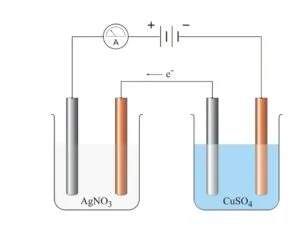
The experimental setup is shown below.

The electrolytic cell above can be used to verify Faraday’s first law.
The copper cathode is weighed at the beginning of the experiment. A steady current of 1 A is passed for 10 minutes and the current supply is switched off. The copper cathode is then weighed again to find the gain in mass. This procedure is repeated using different time intervals. A graph of gain in mass against time gives a straight line passing through the origin.
When the experiment is repeated using different currents for a fixed period, a graph of gain in mass against the magnitude of the current also gives a straight line passing through the origin.
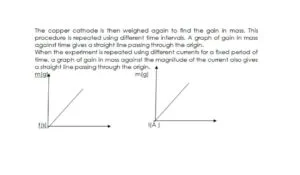
The two graphs show that the mass of copper deposited is directly proportional to the current and to the time, i.e. m is directly proportional to It.
What is Faraday’s second law of electrolysis?
Faraday’s second law of electrolysis states that when the same quantity of electricity Q is passed through different electrolytes, the relative number of moles of the elements discharged is inversely proportional to the charges on the ions of the elements.
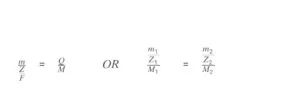
What is the Faraday?
The minimum quantity of electricity required to liberate one mole of a univalent ion is 96500 C. This quantity of electricity is called the Faraday (F). One Faraday (1 F) is one mole of electrons, which contains Avogadro’s number (6.02 × 10²³) of electrons.
It follows that two Faradays (2 F) are required to discharge 1 mole of ions of a divalent element or radical such as Pb2+ or SO42-, i.e. M2+ + 2e– → M.
How is the second law verified?
To verify the second law, set up two electrolytic cells:
- One with copper electrodes immersed in CuSO4 solution.
- The other with silver electrodes immersed in AgNO3 solution.
- Weigh the copper and silver cathodes before the experiment begins.
A steady current of 1 A is passed into the solutions for, say, 15 minutes and the current supply is switched off. The mass of each cathode is then weighed again to find the gain in mass.
The number of moles of silver deposited at the silver cathode is double the number of moles of copper deposited at the copper cathode, although the same quantity of electricity was passed through the two electrolytes. That is, if Y moles of copper are deposited, 2Y moles of silver are deposited.
The charge on Cu2+ is +2 and that on Ag+ is +1. Hence the number of moles of copper and silver deposited is inversely proportional to the charge on their ions.
How do we calculate with Faraday’s laws?
Example: Calculate the electrochemical equivalent of a metal M if a current of 5 A is passed for 1 hr and 2 g of M is deposited.
Solution:
m = 2 g, I = 5 A, t = 1 hr = 60 × 60 s
m = EIt
2 = E × 5 × 60 × 60
E = 2 / 18000 = 1.11 × 10⁻⁴ g A-1 s-1
What are the applications of electrolysis?
Electrolysis is applied in industry in the following areas:
- Extraction of elements: Na, K, Mg, Ca, Al, Zn and non-metals such as H2, F2 and Cl2 are obtained either by electrolysis of their ores or by electrolysis of their fused compounds or their aqueous solutions.
- Purification of metals, e.g. Cu, Hg, Ag, Au.
- Electroplating of one metal by another.
- Preparation of certain important compounds such as sodium hydroxide and sodium trioxochlorate (V).
What is electroplating?
Electroplating is a method of coating the surface of one metal with another metal, usually copper, silver, chromium, nickel or gold, using electrolysis. The main objectives of electroplating are:
- Decoration.
- Protection against corrosion.
Articles which are usually plated include cutlery, jewellery and iron or steel objects such as the metallic parts of motor cars.

Evaluation
- State Faraday’s first law of electrolysis and write its mathematical expression.
- What is one Faraday? How many Faradays are needed to discharge 1 mole of Pb2+ ions?
- Describe how you would verify Faraday’s first law using a copper cathode.
- State the two main objectives of electroplating.
- Name two compounds prepared by electrolysis.
Assignment
- State Faraday’s second law of electrolysis.
- Explain why, for the same quantity of electricity, the number of moles of silver deposited is double the number of moles of copper deposited.
- List four industrial applications of electrolysis.
This term's Chemistry topics
SS2 First Term · 8 topics
Get Chemistry as PDF and Word
Every week of SS2 Chemistry, First Term, formatted and ready to print. Ad-free, and the copy lock comes off.
Get this term Card, bank transfer, USSD or OPay
First Term Chemistry Lesson Notes for Other Topics

Periodic Table
Read the full lesson note.

Families Of Elements
Read the full lesson note.

Families Of Elements II - Transition & Rare Earth Elements
Read the full lesson note.

Oxidation And Reduction Reaction
Read the full lesson note.

Electrolysis
Read the full lesson note.

Electrolysis II - Factors Affecting Preferential Discharge of Ions
Read the full lesson note.

Electrochemical Cells
Read the full lesson note.

Symbols, Formula And Equations II
Read the full lesson note.

Chemical Combinations
Read the full lesson note.

Symbols, Formula And Equations
Read the full lesson note.

Particulate Nature Of Matter
Read the full lesson note.

Introduction To Chemistry I
Read the full lesson note.

Alloys
Read the full lesson note.

Alkanoic Acids/Carboxylic Acid
Read the full lesson note.

Fats And Oils
Read the full lesson note.
Lesson Notes for Other Classes

Basic 1 Lesson Note
The complete lesson note to guide your studies.
Basic 2 Lesson Note
The complete lesson note to guide your studies.

Basic 3 Lesson Note
The complete lesson note to guide your studies.

Basic 4 Lesson Note
The complete lesson note to guide your studies.

Basic 5 Lesson Note
The complete lesson note to guide your studies.

Basic 6 Lesson Note
The complete lesson note to guide your studies.