Electrochemical Cells – SS2 Chemistry Lesson Note (First Term)
Download this term · ₦1,000Lesson note at a glance
- Subject
- Chemistry
- Class
- SS2
- Term
- First Term
- Topic
- Electrochemical Cells
- Order
- Topic 8 of 8 this term
- Reading time
- 5 min
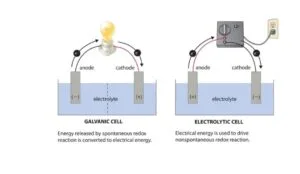
An electrochemical cell is a device that converts chemical energy to electrical energy. An electrolytic cell does the opposite: it converts electrical energy to chemical energy. Each cell has two electrodes, an anode and a cathode, dipped in electrolytes. In an electrochemical cell, a salt bridge or porous partition links the two half-cells.
Behavioural objectives
By the end of the lesson, students should be able to:
- state the difference between an electrolytic cell and an electrochemical cell;
- write a cell diagram using conventional notation;
- state the functions of a salt bridge;
- explain electrode potential and standard electrode potential;
- calculate the e.m.f. of a cell from standard electrode potentials.
What are electrolytic and electrochemical cells?
An electrolytic cell is a device in which electrical energy is converted to chemical energy. An electrochemical cell is a device in which chemical energy is converted to electrical energy.
Note: An electrochemical cell is also known as a galvanic cell. It consists of two half-cells:
- an oxidation half-cell
- a complementary reduction half-cell
What are the differences between an electrolytic cell and an electrochemical cell?
| SN | Electrolytic cell | Electrochemical cell |
|---|---|---|
| 1 | Electrical energy is converted to chemical energy. | Chemical energy is converted to electrical energy. |
| 2 | The cathode is the negative electrode while the anode is the positive electrode. | The cathode is the positive electrode while the anode is the negative electrode. |
| 3 | No salt bridge is required. | A salt bridge or porous partition is required. |
| 4 | The electrolyte may not contain ions of the metal electrode used. | The electrolyte must contain ions of the metal electrode used. |
| 5 | Electrons are pushed by an external source, such as a battery. | Electrons are generated by oxidation at the anode. |
How do you draw and write cell diagrams?
A typical electrochemical cell consists of two electrodes (cathode and anode) and their electrolytes. The electrodes are connected using a salt bridge. A typical electrode or half-cell is a device in which an element (metal) is in contact with its ions. A typical metallic electrode is symbolically represented as:
M(s)/Mn+(aq) or Mn+(aq)/M(s) for metals dipped into solutions of their ions.
Conventional notation is used to describe an electrochemical cell without drawing. Example:
X/X+//Y+/Y
The single vertical lines (/) represent the metal and metal ion interphase, while the double lines (//) represent the salt bridge or a porous partition.
In a simple electrochemical cell, electrons flow from the anode (negative electrode) to the cathode (positive electrode). For an electrochemical cell to produce electricity, the anode element must be more reactive than the cathode element. That is, the anode element must be higher in the electrochemical series than the cathode.
What is a salt bridge?
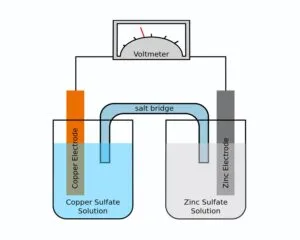
In an electrochemical cell, the half-cells can be linked by a salt bridge instead of a porous partition to maintain the electrical neutrality of the half-cell electrolytes. A salt bridge is a filter paper soaked in sodium chloride solution, KCl or NH4NO3.
Functions of a salt bridge
- It helps to complete the electric circuit.
- It enables ions to migrate from one half-cell to the other, to maintain electrical neutrality in the solutions when current flows in the setup.
What is electrode potential?
Electrode potential is the potential difference that is set up between a metallic electrode and its electrolyte.
Copper ion/copper system
If a copper plate is dipped into a CuSO4 solution, the net reaction is:
Cu2+(aq) + 2e– ⇌ Cu(s)
That is: Cu2+(aq)/Cu(s)
Zinc ion/zinc system
If a zinc plate is dipped into a ZnSO4 solution, the net reaction is:
Zn2+(aq) + 2e– ⇌ Zn(s)
That is: Zn2+(aq)/Zn(s)
What is standard electrode potential?
The electrode potential of a given system depends on:
- the overall energy change
- the concentration of ions in the solution
- the temperature
Standard electrode potential (E°) is used to compare the electrode potential values of different metal ion/metal systems.
To measure the standard electrode potential of a metal ion/metal system, we find the difference (in volts) between the metallic electrode and the standard hydrogen electrode. The standard hydrogen electrode potential is considered to have an arbitrary value of zero.
How is the e.m.f. of a cell calculated?
When two half-cells are joined together through a salt bridge, the e.m.f. of the cell formed is the algebraic difference between the two electrode potentials.
The e.m.f. of the cell formed by the system Zn(s)/Zn2+(aq) & Cu2+(aq)/Cu(s) is defined as the standard electrode potential of the right-hand electrode minus the standard electrode potential of the left-hand electrode.
Etotal = E°R – E°L = +0.34 – (-0.76) = +1.10 V
When this convention is used, a positive e.m.f. indicates that the reaction is thermodynamically feasible as written, from left to right. A negative e.m.f. implies that the reaction is thermodynamically impossible as written.
Evaluation
- Define an electrolytic cell and an electrochemical cell.
- State two differences between an electrolytic cell and an electrochemical cell.
- State two functions of a salt bridge.
- What do the single line (/) and the double line (//) represent in a cell diagram?
- State the three factors on which the electrode potential of a system depends.
Assignment
- Explain why the anode element must be more reactive than the cathode element for an electrochemical cell to produce electricity.
- A cell is formed from the system Zn(s)/Zn2+(aq) & Cu2+(aq)/Cu(s). Given that E° of the copper electrode is +0.34 V and E° of the zinc electrode is -0.76 V, calculate the e.m.f. of the cell.
- State what a positive e.m.f. and a negative e.m.f. indicate about a cell reaction.
This term's Chemistry topics
SS2 First Term · 8 topics
Get Chemistry as PDF and Word
Every week of SS2 Chemistry, First Term, formatted and ready to print. Ad-free, and the copy lock comes off.
Get this term Card, bank transfer, USSD or OPay
First Term Chemistry Lesson Notes for Other Topics

Periodic Table
Read the full lesson note.

Families Of Elements
Read the full lesson note.

Families Of Elements II - Transition & Rare Earth Elements
Read the full lesson note.

Oxidation And Reduction Reaction
Read the full lesson note.

Electrolysis
Read the full lesson note.

Electrolysis III - Faraday's Laws of Electrolysis
Read the full lesson note.

Electrolysis II - Factors Affecting Preferential Discharge of Ions
Read the full lesson note.

Symbols, Formula And Equations II
Read the full lesson note.

Chemical Combinations
Read the full lesson note.

Symbols, Formula And Equations
Read the full lesson note.

Particulate Nature Of Matter
Read the full lesson note.

Introduction To Chemistry I
Read the full lesson note.

Alloys
Read the full lesson note.

Alkanoic Acids/Carboxylic Acid
Read the full lesson note.

Fats And Oils
Read the full lesson note.
Lesson Notes for Other Classes

Basic 1 Lesson Note
The complete lesson note to guide your studies.

Basic 2 Lesson Note
The complete lesson note to guide your studies.

Basic 3 Lesson Note
The complete lesson note to guide your studies.

Basic 4 Lesson Note
The complete lesson note to guide your studies.

Basic 5 Lesson Note
The complete lesson note to guide your studies.

Basic 6 Lesson Note
The complete lesson note to guide your studies.