
Table Tennis Game Basic 6 Basic Technology Lesson Note
Download Lesson NoteTopic: Table Tennis Game
Learning Objectives
By the end of the lesson, pupils should be able to:
- Discuss brief history of table tennis
- Categorize types of facilities and equipment
- Design a table tennis board
- Demonstrate basic skills and techniques
Content
History of Table Tennis
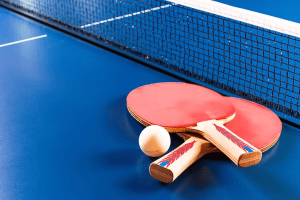
- Origin: England, 1880s
- Original names: “Whiff-whaff,” “Ping-pong”
- Development: Parlor game among upper class
- Name: “Ping-pong” from sound of ball
- Modern game: Early 1900s
- International Federation: ITTF founded 1926
- Olympic sport: 1988 (Seoul)
- Dominant countries: China, Japan, South Korea
Facilities and Equipment
The Table:
- Length: 2.74 meters (9 feet)
- Width: 1.525 meters (5 feet)
- Height: 76 cm from floor
- Surface: Dark colored (usually blue or green)
- Net height: 15.25 cm
- White lines: Mark edges and centerline
Equipment:
- Ball:
- Material: Celluloid or plastic
- Diameter: 40mm
- Weight: 2.7 grams
- Color: White or orange
- Quality: Star rating (1-3 stars)
- Racket/Paddle/Bat:
- Blade: Wooden (85% minimum)
- Rubber: Red on one side, black on other
- Types:
- Penhold grip style
- Shakehand grip style
- Properties:
- Speed
- Spin
- Control
- Net and Posts:
- Divides table in half
- Height: 15.25 cm
- Extends 15.25 cm beyond table edge
- Playing Area:
- Minimum: 14m × 7m
- Good lighting
- Non-slip floor
- Adequate space around table
Comparison with Other Racket Sports:
| Feature | Table Tennis | Tennis | Badminton |
| Court Size | 2.74m × 1.525m | 23.77m × 10.97m | 13.4m × 6.1m |
| Net Height | 15.25 cm | 91.4 cm | 1.55 m |
| Ball | Hard plastic 40mm | Felt-covered 6.7cm | Shuttlecock |
| Points to Win | 11 | Variable | 21 |
| Indoor/Outdoor | Indoor | Both | Both |
Basic Skills and Techniques
- Grip:
Shakehand Grip (Most common):
- Hold like shaking hands
- Index finger on backhand rubber
- Thumb on forehand side
- Other fingers wrap around handle
Penhold Grip:
- Hold like holding pen
- Popular in Asia
- Good for forehand attacks
- Stance:
- Feet shoulder-width apart
- Knees slightly bent
- Weight on balls of feet
- Body slightly forward
- Ready to move any direction
- Basic Strokes:
Forehand Drive:
- Start position: Racket low, near hip
- Swing: Forward and upward
- Contact: In front of body
- Follow through: End near opposite shoulder
Backhand Drive:
- Position: Racket near opposite hip
- Swing: Across body, forward and up
- Contact: In front of body
- Follow through: Complete arc
Push (Defensive):
- Racket angle: Slightly open
- Movement: Short, pushing motion
- Use: Return short balls
- Control: Keep ball low
- Serves:
Forehand Serve:
- Toss ball 16cm minimum
- Strike on descent
- Ball must bounce on server’s side first
- Then opponent’s side
Backhand Serve:
- Similar rules
- Different angle and spin
Types of Spin:
- Topspin: Forward rotation
- Backspin: Backward rotation
- Sidespin: Lateral rotation
- No spin: Flat hit
- Footwork:
- Quick small steps
- Always return to ready position
- Move to ball, don’t reach
- Stay balanced
- Ball Placement:
- Aim for corners
- Vary depth (short/long)
- Change direction
- Keep opponent moving
Basic Rules:
- Scoring:
- Games to 11 points
- Must win by 2 points
- Match: Best of 5 or 7 games
- Service:
- Serve from behind end line
- Ball must bounce once each side
- Alternate service every 2 points
- Service changes at 10-10 (deuce)
- Legal Play:
- Ball must bounce before hitting
- Can’t touch table with free hand
- Ball must go over net
- Let (replay) if ball touches net on service
Benefits of Table Tennis:
- Improves hand-eye coordination
- Enhances reflexes
- Develops concentration
- Good aerobic exercise
- Improves mental acuity
- Social activity
- All ages can play
Second Term Basic Technology Lesson Notes for Other Topics
Games - Basic Skills in Ball Games
Explore lesson notes covering all topics.
Starting Up a Computer
Explore lesson notes covering all topics.

Demonstrating Air in Space
Explore lesson notes covering all topics.
Games (Local Games)
Explore lesson notes covering all topics.

Parts of a Computer (Peripherals)
Explore lesson notes covering all topics.
Air
Explore lesson notes covering all topics.

Starting Up a Computer
Explore lesson notes covering all topics.

Basic Safety for Computers
Explore lesson notes covering all topics.
Safety Rules in Football Games
Explore lesson notes covering all topics.

Light Energy, Uses of Light and Colour
Explore lesson notes covering all topics.

Computer Room
Explore lesson notes covering all topics.
Swimming (Aquatic)
Explore lesson notes covering all topics.
Colour Identification 1 - Colours of Objects
Explore lesson notes covering all topics.

Computer Room
Explore lesson notes covering all topics.

Colour Identification II- Road Traffic Light Signs
Explore lesson notes covering all topics.
Lesson Notes for Other Classes

Basic 1 Lesson Note
The complete lesson note to guide your studies.

Basic 2 Lesson Note
The complete lesson note to guide your studies.
Basic 3 Lesson Note
The complete lesson note to guide your studies.

Basic 4 Lesson Note
The complete lesson note to guide your studies.
Basic 5 Lesson Note
The complete lesson note to guide your studies.

JSS1 Lesson Note
The complete lesson note to guide your studies.