Volume and Capacity – Basic 5 Mathematics Lesson Note (Second Term)
Download Lesson NoteLesson note at a glance
- Subject
- Mathematics
- Class
- Basic 5
- Term
- Second Term
- Topic
- Volume and Capacity
- Order
- Topic 6 of 8 this term
- Reading time
- 6 min
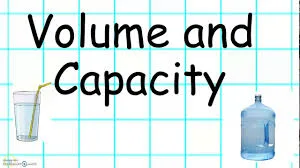
Behavioural Objectives: By the end of this lesson, learners should be able to:
- Define volume and capacity
- Understand the difference between volume and capacity and state their relationship
- Convert between the concept of capacity and apply it to real-life problems
- Learn about cubic metre, cubic centimetre, litre, millilitre and gallon
- Solve word problems
Volume and Capacity
Volume: Volume is the amount of space occupied by a three-dimensional object. It is measured in cubic units (like cubic metres, cubic centimetres) and it is about how much space a three-dimensional object takes up.
Capacity: Capacity is the maximum amount a container can hold. It is measured in litres (L) and millilitres (mL).
Units of Volume:
The standard units of volume of a shape, solids for length, with, and height (given: length × width × height = volume in cubic units)
Capacity: To find the capacity of a container (cup or water and measure how much it holds, Capacity can be measured in millilitres and litres as follows:
- 1 litre = 1000 millilitres
- 1000 litres = 1 cubic metre
- 1 cubic centimetre = 1 millilitre
- 1 gallon = 4.55 litres (gallon = gallon)
Volume Examples:
- Cube: Volume = side³ = s³ where s is the length of the side
- Cuboid: Volume = length × width × height
- Cylinder: Volume = πr²h = 3.14 × radius² × height
Remember volume is about how much space an object takes up, while capacity is about how much a container can hold.
Learning Examples:
Solving Problems:
Remember to follow the volume of cuboid is L × W × H where L is the length of the cuboid, W is the width of the cuboid and H is the height of the cuboid. The volume is usually given in cubic centimetres (cm³) or cubic metres (m³).
The formula for finding the volume of a cuboid is V = L × W × H where the volume is in the metric system. For example, if the length is 10 metres, the width is 8 metres and the height is 6 metres, then the volume will be 10 × 8 × 6 = 480 cubic metres.
The length unit are a dimensional concept. For example, a volume that measures 2 litres of volume can be equal to 2000 millilitres or 2000 cubic centimetres. This is because 1 litre = 1000 millilitres = 1000 cubic centimetres.
Volume Formula:
- Volume of a cube = side³ = s³ (where s is the length of the side of the cube)
Examples:
Volume Examples:
(1) Calculate the volume of a cuboid that has dimensions 10 cm by 30 cm:
What we know: length = 10 cm, width = 8 cm, height = 3 cm Volume = length × width × height = 10 × 8 × 3 = 240 cm³
(2) Calculate the volume of a cuboid that has dimensions 40 cm by 3 m by 70 cm:
First we must make all the measurements in the same units. Let’s convert 3 m to cm: 3 m = 300 cm Volume = length × width × height = 40 × 300 × 70 = 840,000 cm³
(3) What are the dimensions of a cuboid which has a volume of 4 m³ (cubic metres) and has a base area of 1 m² and what is the height:
Volume = base area × height = 1 × height = 4 Therefore, height = 4 m
(4) What is the volume of a cube with each side of 50 cm²?:
Volume = side³ = 50³ = 125,000 cm³
(5) A rectangular room has a width of 8m and length of 10m and the height is 3m. Calculate the volume:
Volume = length × width × height = 10 × 8 × 3 = 240 m³
(6) A cylinder has a radius of 10 cm and a height of 50cm and the capacity is 5m litres which the cylinder is 5m wide at the bottom and 10 cm wide at the top:
Volume = πr²h = 3.14 × 10² × 50 = 3.14 × 100 × 50 = 15,700 cm³
(7) A triangular prism has a base area of 40m² and height of 5 cm after the volume is 15m³:
Since area of base = 40 m² and height = 5 cm = 0.05 m Volume = base area × height = 40 × 0.05 = 2 m³
Volume and Capacity
Examples of Typical Cubic Units and Liquid Capacity:
- Volume of liquid from glass bottle and cubic meter: 1 cubic meter = 1000 litres of liquid 1 litre = 1000 millilitres (ml) of liquid
- Capacity is also equal to measure on its: 1 cubic centimetre = 1 millilitre 1000 cubic metres = 1000 litres 1 litre = 1000 millilitres and hold 1000 cubic centimetres of water capacity
- A soap can be filled with water up to volume of 20 cm³. How much water can it hold? Since 1 cm³ = 1 mL Therefore 20 cm³ = 20 mL
- A container has volume of 2 litres. Its capacity is also 2 litres. How much water it can hold in millilitres? 2 litres = 2 × 1000 = 2000 mL
- If you can be the equal: We have lots many cylindrical in terms the amount of litres: 50 50ml of solution for every litre equal to amount of water. If 20 such solution litres, how many millilitres are equal in total? 20 litres = 20 × 1000 = 20,000 mL
- If we have one different units and we approximately consider the amount of water to: 1800 L of 50 mL water for equals. That is the amount of water for 1000 ml water equals in the amount of litres of 4.5 litres: How many 1800 L = 1800 × 1000 = 1,800,000 mL
- 300L to 100m litre: consider in cubic centimetre of 10 Litre = 300L of the volume of Cubic centimetre is at litres which equal to amount in the of litres = 5000 cm³ of How many = 5000 litres 300L = 300 × 1000 = 300,000 mL = 300,000 cm³
- A plastic bottle has a capacity of litre. How many cubic centimetres it has the amount equal in the litres = 1 litre = 1000 cm³
- An aluminum water bottle of 5 Litres, how many cubic centimetres it has quantity equal in 200ml = 5 litres = 5 × 1000 = 5000 cm³
- A milk container has a volume of 4 litres, how many cubic centimetres it has the amount in ml into the litres it can hold = 4 litres = 4 × 1000 = 4000 cm³ = 4000 mL
- The formula for finding the volume of a cuboid is: Volume = length × width × height
- The formula for finding the volume of a cube is: Volume = side³
- The formula for finding the volume of a triangular prism is: Volume = ½ × base × height × length
- The formula for finding the capacity (or volume) of a cylinder is: Volume = πr²h where π = 3.14, r = radius, h = height
- Conversions:
- 1 centimetre³ = _____ litres → 0.001 litres
- 1 litre = _____ millilitres → 1000 millilitres
- 1 cubic metre = _____ litres → 1000 litres
Objective Questions:
- The volume of a cube measuring 5 litres dimensional sides of 5 sides = a) 25 cm³ b) 125 cm³ c) 75 cm³ d) 100 cm³
- Which of the following is the capacity unit? a) cm³ b) Litre c) m³ d) kg
- 4 cm³ equals: a) 4 mL b) 4 L c) 400 mL d) 0.4 mL
- 5 Litres equals: a) 500 mL b) 50 mL c) 5000 mL d) 50000 mL
- A cube measures: a) Has 3 dimensions b) Has 2 dimensions c) Has 1 dimension d) Has no dimensions
- Volume is measured in: a) Litres b) Grams c) cubic units d) metres
- Capacity is measured in: a) cm³ b) Litres c) kg d) metres
- The volume of a cuboid having length 8cm, breadth 5cm, width = ________ cm³ a) 13 b) 18 c) 40
- The volume of a shape not including triangular, square unit = ________ volume a) 1 b) Cubic c) Litres d) cm³
- 1 Litre equals: a) 100 mL b) 10 mL c) 1000 mL d) 10000 mL
This term's Mathematics topics
Basic 5 Second Term · 8 topics
Second Term Mathematics Lesson Notes for Other Topics

Whole Numbers 121-130 & Number Skills
Read the full lesson note.
Numbers 110-120 & Subtraction Facts
Read the full lesson note.

Numbers 101-110 & Addition Facts
Read the full lesson note.
Identification & Counting Numbers 1-100
Read the full lesson note.
Subtraction & Numbers 81-100
Read the full lesson note.
Math Facts & Numbers 71-80
Read the full lesson note.

Numbers 1-250
Read the full lesson note.

Data Collection
Read the full lesson note.
Numbers 241-250
Read the full lesson note.

Numbers 231-240
Read the full lesson note.
3D Shapes
Read the full lesson note.
Capacity
Read the full lesson note.
Revision of First Term’s Work
Read the full lesson note.
Length and Pythagoras Rule
Read the full lesson note.
Revision of First Term's Topic
Read the full lesson note.
Lesson Notes for Other Classes
Basic 1 Lesson Note
The complete lesson note to guide your studies.
Basic 2 Lesson Note
The complete lesson note to guide your studies.
Basic 3 Lesson Note
The complete lesson note to guide your studies.

Basic 4 Lesson Note
The complete lesson note to guide your studies.
Basic 6 Lesson Note
The complete lesson note to guide your studies.
JSS1 Lesson Note
The complete lesson note to guide your studies.