
Element of Design Basic 6 Cultural & Creative Arts (CCA) Lesson Note
Download Lesson NoteTopic: Element of Design
Learning Objectives
By the end of the lesson, pupils should be able to:
- Examine the elements of design
- List the elements of design
- Create an element of design
Content
What are Elements of Design?
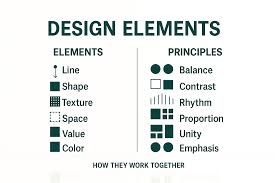
Elements of design are the basic building blocks that artists use to create visual art. They are like the alphabet of art – the fundamental components that combine to make beautiful and meaningful artwork.
The Seven Elements of Design:
- LINE
- Definition: A mark made by a moving point
- Types of Lines:
- Straight lines (horizontal, vertical, diagonal)
- Curved lines (circles, waves, spirals)
- Broken lines (dashed, dotted)
- Thick and thin lines
- Emotional Effects:
- Horizontal lines: calm, peaceful, stability
- Vertical lines: strength, power, growth
- Diagonal lines: movement, energy, action
- Curved lines: grace, softness, nature
- SHAPE
- Definition: A closed area with defined boundaries
- Types of Shapes:
- Geometric shapes (circle, square, triangle, rectangle)
- Organic shapes (irregular, natural forms like leaves, clouds)
- Abstract shapes (simplified or stylized forms)
- Uses: Create focal points, organize composition, represent objects
- FORM
- Definition: Three-dimensional shapes with height, width, and depth
- Types of Forms:
- Geometric forms (cube, sphere, cylinder, pyramid)
- Organic forms (rocks, trees, human body)
- How to Show Form: Shading, highlights, shadows, perspective
- COLOR
- Definition: Light reflected from objects to our eyes
- Color Wheel Components:
- Primary colors (red, blue, yellow)
- Secondary colors (green, orange, purple)
- Tertiary colors (mixtures of primary and secondary)
- Color Properties:
- Hue (the color itself)
- Intensity (brightness or dullness)
- Value (lightness or darkness)
- TEXTURE
- Definition: How something feels or appears to feel
- Types of Texture:
- Actual texture (real surface you can touch)
- Visual texture (appears textured but is flat)
- Examples: Rough, smooth, bumpy, soft, hard, fuzzy, prickly
- SPACE
- Definition: The area around, between, or within objects
- Types of Space:
- Positive space (the object itself)
- Negative space (empty area around objects)
- Shallow space (appears flat)
- Deep space (appears to go far back)
- VALUE
- Definition: The lightness or darkness of colors and tones
- Value Scale: Ranges from white (lightest) to black (darkest)
- Uses: Creates mood, shows form, adds drama, guides the eye
How Elements Work Together:
- Harmony: Elements work together pleasantly
- Contrast: Elements create interesting differences
- Emphasis: Some elements stand out more than others
- Balance: Elements are distributed evenly
- Movement: Elements guide the eye through the artwork
Elements in Nigerian Art:
- Traditional Patterns: Geometric shapes and lines in Adire, Ankara
- Cultural Colors: Significance of colors in different Nigerian cultures
- Natural Forms: Animals and plants in traditional sculptures
- Textural Crafts: Woven baskets, carved wood, beaded jewelry
Practical Applications:
- Logo Design: Using simple shapes and colors effectively
- Fashion: Combining patterns, colors, and textures
- Architecture: Lines, forms, and space in building design
- Graphic Design: Typography, layout, and visual hierarchy
Activities
- Readiness Test: Quick assessment of prior knowledge about art basics
- Create a line study showing different types and emotions
- Design shapes using geometric and organic forms
- Make a texture collection using rubbings and drawings
- Create a color wheel using available materials
- Practice showing form through shading exercises
Multiple Choice Questions
- How many main elements of design are there? a) Five b) Six c) Seven d) Eight
- Which element refers to the lightness or darkness of colors? a) Texture b) Value c) Form d) Space
- Primary colors include: a) Red, green, blue b) Red, blue, yellow c) Yellow, orange, purple d) Blue, green, orange
- Horizontal lines typically create a feeling of: a) Energy and movement b) Calm and stability c) Strength and power d) Confusion and chaos
- The area around and between objects is called: a) Positive space b) Form c) Negative space d) Texture
Homework
Choose one element of design and create three different examples of it. For instance, if you choose “line,” draw three different artworks showing straight lines, curved lines, and broken lines. Write one sentence explaining how each example makes you feel or what it reminds you of. Practice identifying all seven elements in one piece of artwork you see at home or in your community.
Third Term Cultural & Creative Arts (CCA) Lesson Notes for Other Topics

Creating a Drama Sketch from a Story
Explore lesson notes covering all topics.

Types of Lines and Uses of Lines
Explore lesson notes covering all topics.

Musical Notes
Explore lesson notes covering all topics.
Musical Notes - Values and Rest Signs
Explore lesson notes covering all topics.
Drawing
Explore lesson notes covering all topics.

Methods of Moulding Objects
Explore lesson notes covering all topics.
Introduction to Recorder Playing
Explore lesson notes covering all topics.

Fashion Accessories - Singing Songs About Wearing Clothes
Explore lesson notes covering all topics.
Definition of Music
Explore lesson notes covering all topics.

Mode of Greeting
Explore lesson notes covering all topics.

Definition of Drama and Theatre
Explore lesson notes covering all topics.

Definition of Dance
Explore lesson notes covering all topics.

Impersonation
Explore lesson notes covering all topics.

Melodic Patterns Of Traditional Song
Explore lesson notes covering all topics.

The Bass Staff
Explore lesson notes covering all topics.
Lesson Notes for Other Classes

Basic 1 Lesson Note
The complete lesson note to guide your studies.

Basic 2 Lesson Note
The complete lesson note to guide your studies.
Basic 3 Lesson Note
The complete lesson note to guide your studies.

Basic 4 Lesson Note
The complete lesson note to guide your studies.

Basic 5 Lesson Note
The complete lesson note to guide your studies.

JSS1 Lesson Note
The complete lesson note to guide your studies.