
Theory Of Consumer Behaviour SS2 Economics Lesson Note
Download Lesson NoteTopic: Theory Of Consumer Behaviour
The theory of consumer behaviour is also known as the theory of household behaviour. It is primarily concerned with how the consumer or household tries to satisfy his/her wants by dividing his/her limited amount of income between the various commodities that give him an equal amount of satisfaction.
WHAT IS UTILITY?
Utility can be defined as the satisfaction derived from the consumption of a given commodity. Hence, when a consumer derives satisfaction from the consumption of a commodity, it can be said that the commodity or service possesses utility.
Utility, therefore, is relative to a consumer, depending on the time, place, form, etc.
A commodity that can satisfy a consumer’s wants at a particular point in time and place may not satisfy others’ wants.
There are two schools of thought in the analysis of utility and they are as follows:
- Cardinal school of thought
- Ordinal school of thought.
- CARDINAL SCHOOL OF THOUGHT: This approach emphasizes that utility is measurable. That is, after consuming a given quantity of a commodity the consumer can simply evaluate his satisfaction through the use of figures which range from zero to infinity.
Assumptions Of Cardinal Approach
- Utility is measurable.
- The consumer is rational.
- There is diminishing marginal utility.
- Total utility (TU) depends on the quantity consumed.
- Money income of the consumer is held constant.
CONCEPT OF TOTAL, AVERAGE AND MARGINAL UTILITY
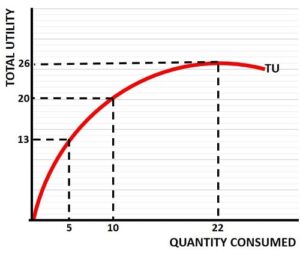
- Total Utility: This is the total amount of satisfaction a consumer derives from the consumption of a particular commodity at a point in time. Consumers’ utility increases as the quantity consumed increases but not at an equal rate because consumers have a saturation point in the consumption of a particular commodity at a given time.

- Average Utility: This is derived by dividing total utility by the units of the commodity consumed. That is, it is the satisfaction that a consumer derives per unit of a commodity consumed.
AU = TU/Q
- Marginal Utility: This means the additional satisfaction a consumer derives from the consumption of additional units of a particular commodity. It is then the change in the total utility as a result of the consumption of additional units of a commodity. MU = ∆TU/∆Q

UTILITY SCHEDULE
| Qty of Goods Consumed | Total Utility | Average Utility | Marginal Utility |
| 1 | 4 | 4 | – |
| 2 | 7 | 3.5 | 3 |
| 3 | 9 | 3 | 2 |
| 4 | 10 | 2.5 | 1 |
RELATIONSHIP BETWEEN TOTAL UTILITY AND MARGINAL UTILITY
The MU begins to fall right after the first unit of the commodity has been consumed and continues to diminish until it reaches zero level on the x-axis and below.
At the point where the MU reaches zero level on the x-axis, TU reaches its maximum point.
When the MU cuts the x-axis, TU begins to fall from its peak.
When the MU descends below the x-axis and becomes negative, the TU curve begins to slope downward
THE LAW OF DIMINISHING MARGINAL UTILITY
The law of diminishing marginal utility states that other things being equal, the marginal utility of a commodity to an individual decreases with the extra unit of that commodity he consumes. In other words, the law states that if a consumer goes on consuming successive equal increments in the quantity of a commodity, then the increase in total utility resulting will become smaller and smaller, that is, satisfaction per extra unit will start falling. For instance, a beer drinker may derive maximum satisfaction in the first three bottles, after which a decrease in satisfaction may set in as more and more bottles of beer are consumed until he may be unable to consume anymore.
UTILITY MAXIMIZATION
Utility maximization is also known as the equilibrium of the consumer. A point where a consumer derives maximum satisfaction when his marginal utility equates to the price of the commodity consumed. That is, the additional utility derived from the consumption of additional commodities is equal to the price of the commodity.
In the case of one commodity, a consumer will maximize his satisfaction in the consumption of a particular commodity when the MU of that commodity equals the price of that commodity, eg MUx = Px
In the case of two or more commodities, a consumer is said to be in equilibrium or maximize his utility when the ratio of MU of the last unit of the commodities consumed should be equal to the ratio of the price. Alternatively, a consumer’s utility is maximized when the MU per amount spent on a product is equal to the MU per amount spent on any other product, as stated below:
MUx MUy MUz
Px = Py = Pz.
where MUx = MU of commodity X
Px = Price of commodity X
MUy = MU of commodity Y
Py = Price of commodity Y
MUz = MU of commodity Z
Pz = Price of commodity Z
CONSUMER SURPLUS
Consumer surplus is defined as the difference between the amount a consumer budgeted to pay for a commodity based on the anticipated level of satisfaction, and the amount he paid to have it. When he consumed the first unit, he was willing to pay as much as #50, but the commodity price was #30. Thus, he saved #20. Therefore any amount above the market price of #30 represents the consumer’s surplus.
ASSIGNMENT
- Which one of these assumptions do economists always make about consumers? (a) That they are all wage earners (b) That they make rational decisions in the market (c) That they cannot spend more than their incomes (d) That they can measure utility derived from consumption
- The aim of the consumer in allocating his income is (a) to maximize his marginal utility and (b) to buy the goods he wants most whatever the price. (c) to maximize his total utility (d) to buy those goods which have fallen in price.
- ……………………takes place when the ratio MU of a commodity consumed is equal to the ratio of its price (a) consumer surplus (b) law of diminishing marginal utility (c) consumer behaviour (d) utility maximization
- Total utility (TU) attains its peak when the Marginal utility (MU) is ….. (a) zero on x- axis (b) above x- axis (c) close to x axis (d) under x- axis
- The difference between the amount of money a consumer planned to pay for a commodity and the actual amount of money he paid is………. (a) commodity price (b) consumer surplus (c) marginal cost (d) producer surplus
First Term Economics Lesson Notes for Other Topics

Price Control
Explore lesson notes covering all topics.

Rationing And Hoarding
Explore lesson notes covering all topics.

Basic Tools For Economic Analysis
Explore lesson notes covering all topics.

Measures Of Dispersion
Explore lesson notes covering all topics.

Demand And Supply
Explore lesson notes covering all topics.

Elasticity Of Demand
Explore lesson notes covering all topics.

Income Elasticity Of Demand
Explore lesson notes covering all topics.

Cross Elasticity Of Demand
Explore lesson notes covering all topics.
Scale Of Production
Explore lesson notes covering all topics.

Division Of Labour And Specialization
Explore lesson notes covering all topics.
Theory Of Production II
Explore lesson notes covering all topics.
Theory of Production
Explore lesson notes covering all topics.
Concept Of Demand And Supply II
Explore lesson notes covering all topics.
Concept Of Demand And Supply
Explore lesson notes covering all topics.
Basic Tools Of Economic Analysis II
Explore lesson notes covering all topics.

Lesson Notes for Other Classes

Basic 2 Lesson Note
The complete lesson note to guide your studies.

Basic 3 Lesson Note
The complete lesson note to guide your studies.

Basic 4 Lesson Note
The complete lesson note to guide your studies.

Basic 5 Lesson Note
The complete lesson note to guide your studies.

JSS1 Lesson Note
The complete lesson note to guide your studies.

JSS2 Lesson Note
The complete lesson note to guide your studies.