
Elasticity Of Demand SS2 Economics Lesson Note
Download Lesson NoteTopic: Elasticity Of Demand
The elasticity of demand may be defined as the degree of responsiveness of demand to changes in price, income, prices of other commodities etc.
TYPES OF ELASTICITY OF DEMAND
- Price elasticity of demand
- Income elasticity of demand
- Cross elasticity of demand
- PRICE ELASTICITY OF DEMAND Price elasticity of demand is the degree of responsiveness of demand for a particular commodity to changes in its price. It is the rate at which the quantity demanded changes as its price changes.
To measure the price elasticity of demand we use the formula:
% change in Quantity Demanded
% change in price
This formula can be broken down or simplified as:
Old Quantity – New Quantity X 100
Old quantity
E= Old Price – New Price X 100
Old Price
Illustration
When the price of a given product is reduced from N90 to N80, the quantity demanded increases from 50 to 60 units.
Deduce the coefficient of elasticity of demand.
Solution
Old price = N90, New price = N80
Change in price = 80 – 90 = -10
= 10 x 100
90 1
= 11.1%
Old quantity = 50, New quantity = 60
Change in quantity = 60 – 50 = 10
= 10 x 100
50 1 = 20%
PE = 20
11.1 = 1.8%
TYPES OF PRICE ELASTICITY OF DEMAND
The types of elasticity of demand and their graphical representation can be shown as follows:
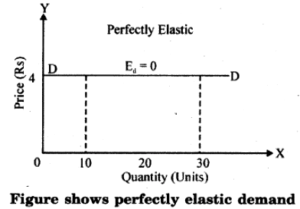
Perfectly Elastic (or Infinitely Elastic) Demand.
Consumers react sharply to changes in price. They are willing to buy all the goods available at a particular price and none at all at a slightly higher price. The coefficient of elasticity tends to infinity.
Perfectly Inelastic (or Zero Elasticity) Demand
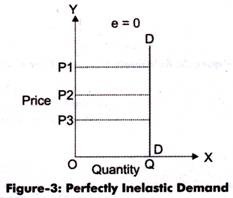
When the quantity demanded remains the same regardless of the price change. The demand is said to be perfectly inelastic. The coefficient of elasticity is zero
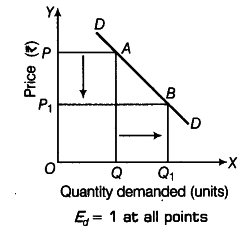
- Unitary (or Unity) Elasticity of Demand
This is the situation where a change in price or income brings about the same percentage change in the quantity demanded. The coefficient of elasticity of demand is equal to 1
- Fairly Elastic Demand
In this case, a small percentage change in price gives rise to more than proportionate change in the quantity demanded. For example, where a 20% fall in price leads to a 50% rise in demand, the coefficient of elasticity is greater than 1 but less than infinity.
- Inelastic Demand (Fairly Inelastic Demand)
When a change in the price of a commodity leads to a less than proportionate change in the quantity demanded then demand is inelastic e and a 15% increase in price brings about a 10% decrease ithe n the quantity demanded.
The coefficient of elasticity is less than 1 but greater than zero.
FACTORS AFFECTING (OR DETERMINING) ELASTICITY OF DEMAND
- Availability of Close Substitutes: A commodity that has close substitutes is likely to have an elastic demand.
- Degree of Necessity of the Goods: If a commodity is a necessity or a near-necessity, increase or
decrease in its price is not likely to affect its demand
- Proportion of consumer income that Is Spent on that Commodity: Generally the higher a person’s income, the more inelastic is demand for commodities
- Habit: If a consumer has become addicted to a commodity, his demand for the good will tend to be monastic. An increase in the price of the commodity may therefore not affect (reduce) the quantity demanded.
- The Level of Consumer Income: The larger the income of the consumer the more inelastic his demand for commodities. On the other hand, the demand of consumers with low income tends to be elastic.
- Cheap Commodities: The cost of some commodities is relatively insignificant and as such consumers’ demand for them will be inelastic.
ASSIGNMENT
- If the elasticity of supply is greater than 1 supply is (a) Unitary elastic (B) Inelastic (c) Elastic (d) Infinitely elastic
- When the demand curve is a straight line parallel to the x-axis, demand is (a) fairly elastic (b) fairly inelastic (c) Perfectly elastic (d) Perfectly inelastic
- If the elasticity of demand for a commodity is less than 1, demand is (a) Unitary elastic (b) Inelastic (c) Infinitely elastic (d) Zero elastic
- If the price of a commodity rises from N2 to N4 and its demand decreases from 125 to 100 then the coefficient of elastic demand is (a) 0.02 (b) 0.20 (c) 0.25 (d) 5
- For a good having close substitutes the price elasticity of demand is likely to be (a) Zero (b) negative (c) more than (d) less than
First Term Economics Lesson Notes for Other Topics

Price Control
Explore lesson notes covering all topics.

Rationing And Hoarding
Explore lesson notes covering all topics.

Basic Tools For Economic Analysis
Explore lesson notes covering all topics.

Measures Of Dispersion
Explore lesson notes covering all topics.

Theory Of Consumer Behaviour
Explore lesson notes covering all topics.

Demand And Supply
Explore lesson notes covering all topics.

Income Elasticity Of Demand
Explore lesson notes covering all topics.

Cross Elasticity Of Demand
Explore lesson notes covering all topics.

Scale Of Production
Explore lesson notes covering all topics.

Division Of Labour And Specialization
Explore lesson notes covering all topics.

Theory Of Production II
Explore lesson notes covering all topics.

Theory of Production
Explore lesson notes covering all topics.

Concept Of Demand And Supply II
Explore lesson notes covering all topics.

Concept Of Demand And Supply
Explore lesson notes covering all topics.

Basic Tools Of Economic Analysis II
Explore lesson notes covering all topics.


Lesson Notes for Other Classes

Basic 1 Lesson Note
The complete lesson note to guide your studies.

Basic 2 Lesson Note
The complete lesson note to guide your studies.

Basic 3 Lesson Note
The complete lesson note to guide your studies.

Basic 4 Lesson Note
The complete lesson note to guide your studies.

Basic 5 Lesson Note
The complete lesson note to guide your studies.

Basic 6 Lesson Note
The complete lesson note to guide your studies.