
Introduction To Visual Arts SS1 Visual Arts Lesson Note
Download Lesson NoteTopic: Introduction To Visual Arts
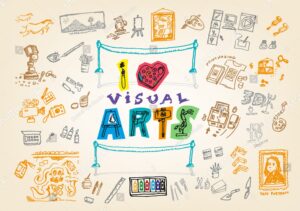
Visual art is the art of making things. It is also the art form that creates works that are primarily visual such as Ceramics, drawing, painting, sculpture and craft. This art appeals to our sense of vision and our sense of touch. It is an art that can be seen and touched.
Visual art has the power to inspire, educate, and challenge our perceptions, and it plays a significant role in shaping our culture, history, and personal experiences.
CLASSIFICATION OF VISUAL ARTS
There are two classes of visual arts and they are:
- Fine Arts: This includes:
- Architecture/drawing: It focuses on house design.
- Painting: It focuses on drawing and painting of pictorial composition.
- Sculpture: It focuses on modelling and carving objects.
- Applied Arts: Also known as industrial art. It includes:
- Ceramics: These focus on moulding things like cups, plates, pots, glassware, etc.
- Textile: focus on designing various patterns of clothes and fabrics with prints and dye.
- Metalworks: this is the production of jewellery such as necklaces, earrings, bracelets and pendants.
- Graphics: this deals with designing various printed documents such as posters, banners, flyers, etc.
- Photography
- Fashion design
- Industrial design
- Interior design
SOME VISUAL ART MATERIALS AND THEIR USES
- Pencil: It is often used in drawing and shading. It is made of graphite and lead and it has different forms and grades such as soft pencil and hard pencil.
- Water Color: it is light in texture and it is used on cardboard. They are produced in different forms and are packaged as paste in tubes and as tables in cases.
- Poster Color: it is darker than watercolour. They are parked in assorted colours. They are used on cardboard.
- Crayons: it is mostly used by children. It is produced in the form of a pencil or wax.
- Palette: It is a mixing board that is very important in drawing. It is used to mix colours.

FUNCTIONS OF VISUAL ART:
Visual art serves various functions, including:
- Aesthetic Pleasure: Creating beauty, harmony, and balance.
- Self-expression: Communicating emotions, thoughts, and experiences.
- Storytelling: Conveying narratives, myths, and histories.
- Social Commentary: Critiquing societal norms, politics, and culture.
- Emotional Resonance: Evoking feelings, empathy, and connection.
- Intellectual Stimulation: Encouraging thought, analysis, and interpretation.
- Therapeutic Benefits: Providing comfort, solace, and healing.
- Cultural Preservation: Preserving heritage, traditions, and values.
- Personal Identity: Exploring individuality, identity, and belonging.
- Spiritual Or Religious Expression: Connecting with the divine, sacred, or transcendent.
Visual art plays a significant role in human society, contributing to our emotional, intellectual, and cultural well-being.

First Term Visual Arts Lesson Notes for Other Topics
Visual Sense
Explore lesson notes covering all topics.

Professions And Job Opportunities
Explore lesson notes covering all topics.
Drawing Lines
Explore lesson notes covering all topics.
Drawing Nature And Man-Made Objects
Explore lesson notes covering all topics.
Drawing And Shading
Explore lesson notes covering all topics.
Drawing Still-Life Objects
Explore lesson notes covering all topics.
Drawing Human Figures
Explore lesson notes covering all topics.
Introduction To Art Appreciation
Explore lesson notes covering all topics.


Lesson Notes for Other Classes
JSS1 Lesson Note
The complete lesson note to guide your studies.

JSS2 Lesson Note
The complete lesson note to guide your studies.

SS2 Lesson Note
The complete lesson note to guide your studies.

SS3 Lesson Note
The complete lesson note to guide your studies.