
Drawing Human Figures SS1 Visual Arts Lesson Note
Download Lesson NoteTopic: Drawing Human Figures
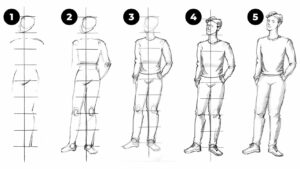
Life drawing is a form of artistic study. It is the art of observing and translating on paper, cardboard or canvas representation of the undertaken study of the human form. It entails the study and drawing of the human form, and anatomy in a variety of shapes, postures, countenance, and moods through the participation of a live model.
The study of life drawing exposes the artist to different approaches to rendering what they have observed in the live model.
- It allows the artist to define a drawing technique that will give him adequate results in interpreting the shapes and forms created on the model by the interplay of light and dark shades.
- Understanding how to illustrate the skeletal framework of the model which defines the structure and shape of the human figure.
- The elegant, outstanding and defined masculine or feminine frame, cut edge lines of a nude model.
- Understanding of the cloth drippier over the body shapes and frame.
- Rendering the live study from the perspective of geometric shapes and gradually modifying it to resemble the human form.
Live drawing can be used by the artist to compose a range of figure studies in preparation for more finished work. It has also inspired the art of portraiture, gesture illustrations, medical illustrations, sculpture and photography.
The study of a live model in life drawing is made as a whole and in part. As a whole, the entire study of the framework of the human figure is put to observatory study with height and body size. In part, it will consist of the body part of the live human model, head, (face, eyes, nose skin, texture and complexion), hand (shoulder, muscle, ankle, finger and nails), chest (breast, hair features, chest muscle), stomach and pelvic region (diameter of stomach, male and female reproductive organs), leg (framework of the laps, thighs, foot and foot nails).
In life drawing, the study of the human anatomy is the first level concern followed by developing a relationship between the figure in a study with a harmonious background. Compositional balance is required of the artist or student when rendering an advanced finished life drawing study.
THE PROPORTION IN HUMAN FIGURE DRAWING
In the study and drawing of the human figure, it is important to render a representation of the human figure in accurate proportion. The standard proportion technique for rendering human figure drawings has to do with the head as the basic unit of measurement. The distance from the top of the head to the chin represents the measurement of the head.
An average figure or person is measured seven and a half head marking, head inclusive. An ideal figure or person when depicting an impression of nobility or grace is measured at eight. A heroic figure or person in the depiction of a god and superheroic is measured at eight and a half head.
It is good to note that these proportions are basic standard figures and changes in poses will affect the height.
MEASURING THE HUMAN FIGURE
With a standard basic unit measurement of the human figure in mind, measure the length of the figure’s head and apply it in division across the entire length of the human figure or model. This can be achieved by simply stretching out your arm with pencil-top in hand, straight towards the figure or model.
The pencil top might look like a rough measure but it gives a reasonable help in getting down the proportion of a figure. It is important to note this each time when measuring that you are expected to stand in the same place, keep your head as still as possible and ensure that your arms extend fully with elbows straight. Avoid staying so close to the model.
TRANSFERRING MEASUREMENT ON PAPER
To transfer these measurements on your drawing paper, simply make seven equally spaced horizontal lines down the paper. You then seal the observed information to fit the page. Starting with the head as your top division, draw the rest of the figure noting the placement of key points or organs against head measurements.
THE STRUCTURE OF MALE AND FEMALE FIGURES
- The male figure has broad shoulders and narrow hips.
- The female figure has narrow shoulders and wide hips.
- The male figure commonly has a flat chest or pair of pumped-up chests or breasts.
- The male figure commonly has flat buttocks.
- The female figure commonly has raised buttocks.

First Term Visual Arts Lesson Notes for Other Topics

Introduction To Visual Arts
Explore lesson notes covering all topics.

Visual Sense
Explore lesson notes covering all topics.

Professions And Job Opportunities
Explore lesson notes covering all topics.

Drawing Lines
Explore lesson notes covering all topics.

Drawing Nature And Man-Made Objects
Explore lesson notes covering all topics.

Drawing And Shading
Explore lesson notes covering all topics.

Drawing Still-Life Objects
Explore lesson notes covering all topics.

Introduction To Art Appreciation
Explore lesson notes covering all topics.


Lesson Notes for Other Classes

JSS1 Lesson Note
The complete lesson note to guide your studies.

JSS2 Lesson Note
The complete lesson note to guide your studies.

SS2 Lesson Note
The complete lesson note to guide your studies.

SS3 Lesson Note
The complete lesson note to guide your studies.