
The Cell SS1 Biology Lesson Note
Download Lesson NoteTopic: The Cell
DEFINITION AND FORMS OF CELLULAR EXISTENCE
The cell is the simplest, smallest, basic, structural and functional unit of life. The cell can carry out all life activities such as growth, respiration e. t. c.
Cells can exist in various forms which include
- As a single cell (unicellular forms) e. g. Amoeba, Chlamydomonas, Chlorella, Euglena
a. Chlamydomonas(Chlamydomonas rivalries)
Chlamydomonas is a unicellular plant-like protist, motile using its flagellum and has a cup-shaped chloroplast. It is sensitive to light using its eye spot. In the presence of light, starch grains appear in the cytoplasm. These disappear in a dark environment.
Chlamydomonas cells through their flagella (whip-like) respond to changes in the surroundings such as moving from a dark region to a region of light. This organism disposes of its excess water using its contractile vacuoles. It reproduces asexually and sexually when it reaches its maximum size.
b. Amoeba (Amoeba proteus)
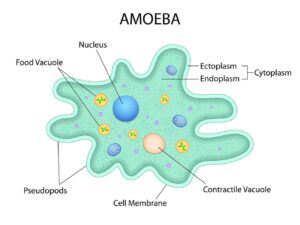
Amoeba a unicellular animals like protists and the simplest organisms with the heterotrophic mode of feeding. It is shapeless. It digests its complex food with its food vacuole. The undigested food materials are got rid of with excess water through its contractile vacuole. Amoeba moves about and captures its food with the aid of its pseudopodia (‘’false feet’’). At maximum growth, amoeba reproduce asexually by dividing into two daughter cells (binary fission)
Diagram of an amoeba
The cell is the simplest, smallest, basic, structural and functional unit of life. The cell can carry out all life activities such as growth, respiration e. t. c.
c. Paramecium
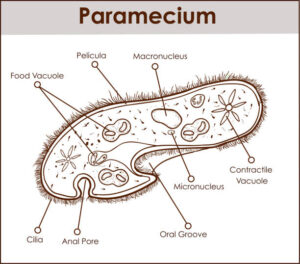
Paramecium is a more complex unicellular organism compared to Amoeba. It is slipper-shaped and moves with the aid of its cilia, which also directs food into its gullet. The undigested food material is removed through the anal pore. Excess water is got rid of through the anterior and posterior contractile vacuoles. Two types of nuclei are visible in this organism, the micronucleus and mega-nucleus
d. Euglena (Euglena viridis)
Euglena Viridis is a protist who has both plant and animal features. As a plant, it has chloroplasts (star-shaped) for photosynthesis, pyrenoids for starch storage and paramylum granules (form in which starch is stored).
As an animal, it has no cellulose cell wall, but a plasma membrane called a pellicle, a gullet, an eye spot, a contractile vacuole and a flagellum for movement.
In colonial forms e. g. Volvox, Sponges, Pandora.
i. Volvox: Volvox is made up of several chlamydomonas-like cells which are arranged in an angular layer to form a hollow ball-like structure. The cells are connected by cytoplasm strands.
The cell of Volvox moves about through the beating of the flagella. Most cells of Volvox lose their ability to reproduce. Only a few of them can reproduce to form two daughter cells . In filamentous forms e. g. Spirogyra, Oscillateria, Oedogonium
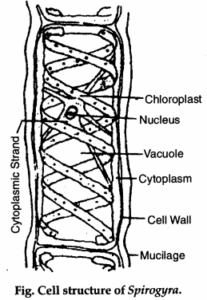
ii. Spirogyra: Spirogyra is a filament of identical cells which are joined end to end without branching. Each cell of spirogyra carries out its function independently of another cell. Spirogyra has a spirally arranged chloroplast for photosynthesis.
The filament grows indefinitely. The break-off cells from the filament can reproduce asexually to form a new filament. Spirogyra also can reproduce sexually.
- As A Part Of Multicellular Organisms
A multicellular organism is made up of interdependent cells carrying out several special functions. The cells of multicellular organisms are arranged to perform similar functions and then form tissues. A group of specialized tissues performing similar functions forms an organ. Organs are further organized to carry out special functions in the form of a system or organ system. Ultimately, the interdependent biological system results in complex multicellular organisms.
CELL STRUCTURES AND THEIR FUNCTIONS
The study of a cell is called cytology. A cell consists of a living material called protoplasm, which is surrounded by a membrane called plasma membrane. In plants, a cell wall (non-living part) is also present surrounding the plasma membrane.
The protoplasm is made up of two major parts:
- Cytoplasm
- Nucleus
a. The cytoplasm contains cell organelles or inclusions, which are cellular structures with specific functions. The cells which contain a nucleus and organelles are called eukaryotic cells. These show a high level of cellular organization. However, some cells lack definite nuclei and organelles. In such cells (prokaryotic cells e.g. bacteria), materials containing instructions for growth and development are found in a particular part of the cell and so are not enclosed in any membrane.
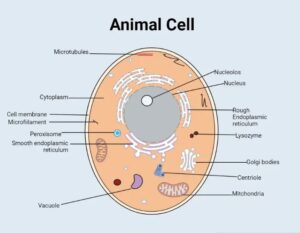
b. The nucleus is the largest cellular organelle enclosed by a double-layered nuclear membrane with many pores. It contains chromosomes and nucleolus which are rich in proteins and nucleic acids.
The nucleus performs the following functions:
- Exchange of materials between the nucleus and the cytoplasm through the nuclear pores.
- Storage of hereditary information by the chromosomes
- Control centre of cellular activities
Structure of a typical animal cell
CELL COMPONENTS AND THEIR FUNCTIONS
| S/N | CELL COMPONENT/ORGANELLE | Functions |
| 1 | Mitochondria | Site of cellular respiration for energy production. It consists of enzymes and DNA. The enzymes convert ADP to ATP. |
| 2 | Vacuole | Surrounded by a membrane called tonoplast. It contains cell sap mineral salt and sugar. It acts as an osmoregulator (removing excess water). |
| 3 | Endoplasmic Reticulum (ER) | Aids transport of materials within the cytoplasm. Rough endoplasmic reticulum(RER) (having ribosome attached) is for protein synthesis and transportation. Smooth endoplasmic reticulum (SER) is for lipids and steroid synthesis and transportation. |
| 4 | Golgi bodies/apparatus | For synthesis, packaging and distribution of materials. |
| 5 | Chloroplast | Contains chlorophyll for photosynthesis in green plants |
| 6 | Lysosome | Site for production of enzymes for respiration and destruction of worn-out cells. |
| 7 | Ribosome | For protein synthesis |
| 8 | Centrioles | Active in cell division by producing spindle fibres to which chromosomes are attached. (present only in animal cells). |
| 9 | Cell plasma/membrane | This is flexible and selectively permeable. It controls the materials entering or leaving the cell |
| 10 | Cell wall | Protects the cell, thus providing mechanical support in plants |
Structure of a typical plant cell

SIMILARITIES BETWEEN PLANT AND ANIMAL CELLS
Both plant and animal cells have the following in common
(a) Nucleus
(b) Golgi bodies
(c) Mitochondria
(d) Cytoplasm
(e) Chromosomes
(f) Endoplasmic reticulum
(g) Nucleolus
(h) Ribosomes
(i) Lysosomes
(j) Cell membrane
DIFFERENCES BETWEEN PLANT AND ANIMAL CELL
| S/N | PLANT CELL | ANIMAL CELL |
| 1 | Has chloroplast | No chloroplast |
| 2 | Rectangular and definite in shape | Usually spherical or shapeless |
| 3 | Has a rigid cellulose cell wall | No cell wall |
| 4 | Centrioles are absent | Centrioles are present for cell division |
| 5 | Cytoplasm is less dense | Cytoplasm is dense granular |
| 6 | Starch granules are present | Glycogen granules are present |
| 7 | The presence of a large central permanent vacuole | Vacuoles are absent or small and temporary when present |
CELL THEORY
This is the summary of the research efforts of many scientists like Robert Hooke, Matthias Schleidein and Theodore Schwann in 1838 and 1839 likewise, as Rudolf Virchow (1855) etc.
The cell theory states that:
- All living organisms are composed of one or more cells.
- The cell is the structural and functional unit of all living organisms i.e. the basic organizational unit of life.
- All existing cells come from pre-existing ones.
- A cell contains information for its structural and functional development in its nucleic acids. This information is passed down from the parents to the offspring
ASSIGNMENT
- A cell that is capable of self-existence is a/an amoeba B. ovum C. amoeba D. onion epidermal cell
- Which of these organelles is common to both plant and animal cells? Chloroplast B. Centriole C. Mitochondrion D. Pyrenoid
- Which scientist did not contribute to the formation of cell theory? Isaac Newton B. Robert Hooke C. Matthias Schliemann D. Theodor Schwann
- The organelle which is contractile in function in Euglena is the eye spot B. gullet C. myoneme D. paramylon
- Which of the following cells are not regarded as specialized? Muscle cells B. Root tip cells C. Somatic cells D. Sperm cells
- Differentiate between prokaryotic and eukaryotic cells
- Describe and state three functions each of :
(a) rough endoplasmic reticulum
(b) vacuoles

First Term Biology Lesson Notes for Other Topics
Reproduction
Explore lesson notes covering all topics.
Movement
Explore lesson notes covering all topics.
Some Properties And Functions Of The Cell III
Explore lesson notes covering all topics.
Some Properties And Functions Of The Cell II
Explore lesson notes covering all topics.
Some Properties And Functions Of The Cell
Explore lesson notes covering all topics.
The Cell And It's Environment
Explore lesson notes covering all topics.
Classification Of Living Things I
Explore lesson notes covering all topics.
Recognizing Living Things
Explore lesson notes covering all topics.
Science Of Living Things
Explore lesson notes covering all topics.
Regulation Of Internal Environment II
Explore lesson notes covering all topics.
Peripheral Nervous System
Explore lesson notes covering all topics.
Sense Organ
Explore lesson notes covering all topics.
The Eye
Explore lesson notes covering all topics.
Genetics
Explore lesson notes covering all topics.
Grassland
Explore lesson notes covering all topics.


Lesson Notes for Other Classes
JSS1 Lesson Note
The complete lesson note to guide your studies.
JSS2 Lesson Note
The complete lesson note to guide your studies.

SS2 Lesson Note
The complete lesson note to guide your studies.

SS3 Lesson Note
The complete lesson note to guide your studies.