
Some Properties And Functions Of The Cell III SS1 Biology Lesson Note
Download Lesson NoteTopic: Some Properties And Functions Of The Cell III
GROWTH
Growth is the irreversible increase in dry mass, size and complexity of an organism brought about by the synthesis of new protoplasm.
For growth to be effective, the building up of materials (anabolism) must exceed the rate of breaking down (catabolism).
In plants, growth is indefinite and apical while it is definite and uniform in animals.
BASIS OF GROWTH
The basis of growth involves three major phases i.e. cell division (mitosis), cell enlargement and cell differentiation.
Life begins as a single fertilized cell, continuous as the cell divides into two daughter cells then into four and so on. After cell division, the daughter cells increase in mass and size (enlargement). Eventually, each cell develops into a special type of cell (specialization) by changing its shape and structure to carry out a particular function. Most specialized cells, at maturity, lose their ability to divide.
TYPES OF CELL DIVISION
There are two types of cell division:
(a) Mitosis
(b) Meiosis
- Mitosis
Mitosis is a cell division to produce two daughter cells with the same number of chromosomes and characteristics as those of the parent cell. This cell division takes place only in somatic cells (i.e. body cells that are not involved in the production of gametes) such as skin, bone marrow and meristematic tissues in plants.
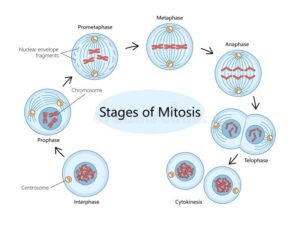
Mitotic cell division involves five main stages:
- Interphase: This is referred to as the resting stage where the chromosomes become elongated and form a network of fine threads called chromatids
- Prophase: in early prophase chromosomes become visible, nucleolus shrinks, centrioles start moving away from each other in opposite directions and the formation of spindle fibres begins. During the late prophase, chromosomes become shorter, thicker and visible. Each chromosome now forms two distinct chromatids joined by a centromere. The nucleolus and nuclear membrane disappear entirely.
- Metaphase: paired chromatids arrange themselves along the equator of the spindle and are attached to the spindle at the centromere.
- Anaphase: sister chromatids separate and start migrating to the opposite poles of the cell and eventually reach the poles.
- Telophase: the cell starts dividing into two by constricting at the equator, nucleolus and nuclear membrane are reformed in each daughter cell, spindle fibres degenerate and chromosomes eventually regain their threadlike form
Importance Of Mitosis
- It brings about growth, development and specialization, especially in multicellular organisms.
- Asexual reproduction binary and multiple fissions in protozoa, budding in yeasts are the result of mitosis.
- It ensures the diploid condition of the cells is retained from generation to generation
- It aids in the repair of damaged cells
Life Processes Involved In Mitosis
- Formation of new cells in the Malpighian layer of the skin
- Production of red and white blood cells in the bone marrow
- Healing of wounds
- Growth in meristem
- Binary fission
ASPECTS OF GROWTH
Growth varies from one organism to another. To measure growth, the following parameters are used:
Man: the dry mass is more accurate and reliable than the wet mass
size and length e.g. height of man
increase in the number of cells e.g. budding in yeast cell
REGIONS OF FASTEST GROWTH IN PLANTS
The regions of fastest growth in plants are the root and stem apices. Since growth in plants is apical, the root and stem apices can be divided into:
- The region of cell division (called the apical meristem) brings about the primary growth of a plant
- Region of elongation
- Region of cell maturation/specialization
GROWTH CURVE
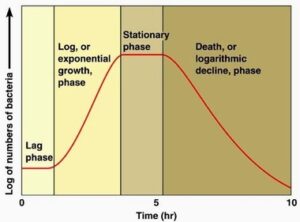
The growth rate of a living organism is measured using a growth curve. The growth pattern of man shows a sigmoid curve. The growth pattern consists of three phases:
- Lag phase: This is the initial stage where slow growth is experienced. At this stage, the cell is still accumulating the necessary material to begin the process.
- Log or exponential phase: This is the phase of rapid of rapid growth.
- Stationary phase: This is a stage where no observable growth is experienced.
The growth curve of insects is like a step. Each growth phase (instar) is interrupted by a period of moulting (ecdysis)
FACTORS AFFECTING GROWTH
- External factors include availability of nutrients, humidity, light, temperature, PH and accumulation of metabolic products.
- Internal factors are mainly hormones. The two major growth hormones in plants are auxin and gibberellins. In animals, the hormones concerned with growth are secreted by the anterior pituitary gland, thyroid gland and the gonads. Over or under-secretion of any of these hormones leads to abnormal growth.
ASSIGNMENT
- Growth includes the following processes except differentiation B. meiosis C. mitosis D. elongation
- When the zygote of an organism continues to grow, it produces new cells by meiosis B. mitosis C. crossing-over D. gestation
- The aspect of growth in living organisms includes all the following except increase in dry weight B. irreversible increase in length C. reversible increase in size D. increase in number of cells
- The organelle involved in tissue respiration is the endoplasmic reticulum B. Golgi body C. mitochondrion D. ribosome
- In the absence of oxygen, the pyruvic acid produced during glycolysis is converted to CO2 and water B. glycerol C. ethanol D. citric acid
- In a tabular form, differentiate between growth in plants and animals
- State three importance of alcoholic fermentation

First Term Biology Lesson Notes for Other Topics

Reproduction
Explore lesson notes covering all topics.

Movement
Explore lesson notes covering all topics.

Some Properties And Functions Of The Cell II
Explore lesson notes covering all topics.
Some Properties And Functions Of The Cell
Explore lesson notes covering all topics.

The Cell And It's Environment
Explore lesson notes covering all topics.
The Cell
Explore lesson notes covering all topics.
Classification Of Living Things I
Explore lesson notes covering all topics.
Recognizing Living Things
Explore lesson notes covering all topics.
Science Of Living Things
Explore lesson notes covering all topics.
Regulation Of Internal Environment II
Explore lesson notes covering all topics.

Peripheral Nervous System
Explore lesson notes covering all topics.

Sense Organ
Explore lesson notes covering all topics.

The Eye
Explore lesson notes covering all topics.
Genetics
Explore lesson notes covering all topics.

Grassland
Explore lesson notes covering all topics.


Lesson Notes for Other Classes
JSS1 Lesson Note
The complete lesson note to guide your studies.

JSS2 Lesson Note
The complete lesson note to guide your studies.

SS2 Lesson Note
The complete lesson note to guide your studies.

SS3 Lesson Note
The complete lesson note to guide your studies.