
The Eye SS3 Biology Lesson Note
Download Lesson NoteTopic: The Eye
SPECIFIC OBJECTIVES: At the end of the lesson, pupils should be able to
- Describe the structure of the eye
- Identify the functions of various parts of the eye
- Discuss the role of the eye in image formation and accommodation
- Identify eye defects
- Identify problems/diseases of the eye
INSTRUCTIONAL TECHNIQUES:
- Identification,
- explanation,
- questions and answers,
- demonstration,
- videos from source
INSTRUCTIONAL MATERIALS: Videos, loudspeaker, textbook, pictures
NOTE
SENSE ORGANS
The Eye
The eye is the organ responsible for vision in humans and many animals. It is a complex sensory organ that detects light and converts it into electrical signals, which are then transmitted to the brain for interpretation.
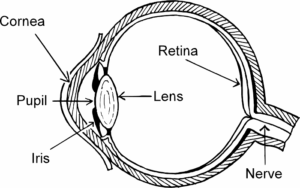
The sense organ for sight is the eye. Its main parts include:
- Cornea: The transparent outermost layer that helps focus light onto the retina.
- Pupil: The adjustable opening in the centre of the eye that controls the amount of light entering.
- Iris: Colored part of the eye surrounding the pupil, controlling the size of the pupil and thus the amount of light that enters.
- Lens: Transparent structure behind the iris that further focuses light onto the retina.
- Retina: Innermost layer containing light-sensitive cells (rods and cones) that convert light into nerve signals.
- Optic Nerve: Transmits nerve signals from the retina to the brain for visual processing.
- Sclera: Tough, white outer layer providing structural support to the eye.
- Vitreous Humor: Gel-like substance filling the inner cavity of the eye, maintaining its shape.
- Aqueous Humor: Clear fluid between the cornea and lens, helping maintain eye pressure.
Functions of the eyes
The eyes perform two primary functions: image formation and accommodation.
- Image Formation
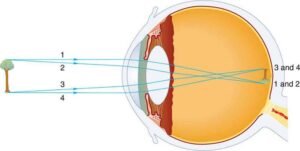
- Light enters the eyes through the cornea, where it undergoes initial refraction.
- The lens further refracts the light to focus it onto the retina at the back of the eye.
- The inverted image formed on the retina is then converted into electrical signals.
2. Accommodation
- Accommodation is the ability of the eyes to adjust their focus for objects at different distances.
- Controlled by the ciliary muscles, accommodation changes the shape of the lens to refine the focus.
- This dynamic process ensures that images of objects at varying distances are sharply focused on the retina.
Eye defects
Common eye defects include:
- Myopia (Nearsightedness):
- Difficulty seeing distant objects.
- Light focuses in front of the retina instead of on it.
- Corrected with concave lenses.
2. Hypermetropia (Farsightedness):
- Difficulty focusing on close objects.
- Light focuses behind the retina.
- Corrected with convex lenses.
3. Presbyopia:
- Age-related conditions affecting near vision.
- Loss of elasticity in the lens, making it harder to focus on close objects.
- Often requires reading glasses or bifocals.
4. Astigmatism:
- Irregular curvature of the cornea or lens.
- Causes distorted or blurred vision at any distance.
- Corrected with cylindrical lenses.
Eye problems/diseases
Various eye problems and diseases include:
- Cataract:
- Clouding of the eye’s lens leads to blurred vision.
- Common with aging but can also result from injury or medical conditions.
- Surgical removal of the affected lens is a common treatment.
2. Night Blindness (Nyctalopia):
- Difficulty seeing in low light conditions.
- Often linked to vitamin A deficiency or conditions affecting the retina.
- Supplements or addressing the underlying cause may improve night vision.
3. Color Blindness:
- Inability to perceive certain colors due to deficiencies in color-sensitive cones.
- Most commonly difficulty distinguishing between red and green.
- Genetic, with no cure, but special lenses may aid color differentiation.
4. Glaucoma:
- Increased intraocular pressure damages the optic nerve.
- Can lead to vision loss and blindness if untreated.
- Managed with medications or surgery to reduce pressure.
5. Dry Eye Syndrome:
- Insufficient tear production or poor-quality tears.
- Causes discomfort, itching, and blurred vision.
- Artificial tears, lifestyle changes, or medical interventions are used for relief.
EVALUATION:
- Identify 3 common eye defects
- Identify 4 functions of eyes
- Mention 3 eye problems/diseases
CLASSWORK: As in evaluation
CONCLUSION: The teacher commends the students positively

First Term Biology Lesson Notes for Other Topics
Reproduction
Explore lesson notes covering all topics.
Movement
Explore lesson notes covering all topics.
Some Properties And Functions Of The Cell III
Explore lesson notes covering all topics.
Some Properties And Functions Of The Cell II
Explore lesson notes covering all topics.
Some Properties And Functions Of The Cell
Explore lesson notes covering all topics.
The Cell And It's Environment
Explore lesson notes covering all topics.
The Cell
Explore lesson notes covering all topics.
Classification Of Living Things I
Explore lesson notes covering all topics.
Recognizing Living Things
Explore lesson notes covering all topics.
Science Of Living Things
Explore lesson notes covering all topics.
Regulation Of Internal Environment II
Explore lesson notes covering all topics.
Peripheral Nervous System
Explore lesson notes covering all topics.
Sense Organ
Explore lesson notes covering all topics.
Genetics
Explore lesson notes covering all topics.

Grassland
Explore lesson notes covering all topics.

Lesson Notes for Other Classes
JSS1 Lesson Note
The complete lesson note to guide your studies.

JSS2 Lesson Note
The complete lesson note to guide your studies.

SS1 Lesson Note
The complete lesson note to guide your studies.

SS2 Lesson Note
The complete lesson note to guide your studies.