
Peripheral Nervous System SS3 Biology Lesson Note
Download Lesson NoteTopic: Peripheral Nervous System
SPECIFIC OBJECTIVES: At the end of the lesson, pupils should be able to
- Describe a flowchart representing different parts of the PNS
- Define PNS
- Identify the systems that make up the PNS
- Identify the functions of the PNS
INSTRUCTIONAL TECHNIQUES:
- Identification,
- explanation,
- questions and answers,
- demonstration,
- videos from source
INSTRUCTIONAL MATERIALS:
- Videos,
- loudspeaker,
- textbook,
- pictures
NOTE
The peripheral nervous system
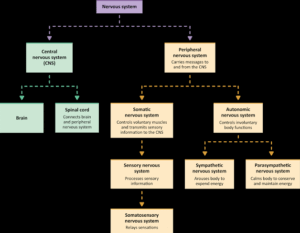
Flow chart representing different parts of the PNS
Peripheral Nervous System
The nervous system is the controlling system of the body and is composed of nerve cells and organs. It is further classified into the central nervous system and the peripheral nervous system. While the central nervous system comprises the brain and the spinal cord. The peripheral nervous system comprises the network of nerves connected to the brain and the spinal cord.
The peripheral nervous system has two divisions:
- Somatic Nervous System
- Autonomic Nervous System
Somatic Nervous System
The main function of the somatic nervous system is to transfer impulses from the CNS to skeletal muscles. It consists of Cranial Nerves and Spinal Nerves.
- Cranial nerves are 12 pairs and they emerge from the brain. Some of the examples of cranial nerves are optic, olfactory, etc.
- Spinal nerves have their point of emergence as the spinal cord. There are 31 pairs of spinal nerves. They emerge from the spinal cords into dorsal and ventral roots. At the junction of these two roots, the sensory fibres continue into the dorsal root, and the motor fibres into the ventral root.
Autonomic Nervous System
The autonomic nervous system relays impulses from the central nervous system to the involuntary organs and smooth muscles of the body. It is divided into two parts.
- Sympathetic Nervous System
- Parasympathetic Nervous System
The sympathetic nervous system consists of nerves arising from the spinal cord between the neck and waist region. It prepares the body for violent actions against abnormal conditions and is generally stimulated by adrenaline.
The parasympathetic nervous system is located anteriorly in the head and neck and posterior in the sacral region. It is mainly involved in the re-establishment of normal conditions when violent action is over.
Peripheral Nervous System Functions
The following are the important functions of the peripheral nervous system:
- The peripheral nervous system connects the brain and the spinal cord to the rest of the body and the external environment.
- It regulates internal homeostasis.
- It can regulate the strength of muscle contractility.
- It controls the release of secretions from most exocrine glands.
EVALUATION:
- What are the three types of nerves which constitute the peripheral nervous system?
- What is the difference between the central nervous system and the peripheral nervous system?
- What are PNS?
CLASSWORK: As in evaluation
CONCLUSION: The teacher commends the students positively

First Term Biology Lesson Notes for Other Topics
Reproduction
Explore lesson notes covering all topics.
Movement
Explore lesson notes covering all topics.
Some Properties And Functions Of The Cell III
Explore lesson notes covering all topics.
Some Properties And Functions Of The Cell II
Explore lesson notes covering all topics.
Some Properties And Functions Of The Cell
Explore lesson notes covering all topics.
The Cell And It's Environment
Explore lesson notes covering all topics.
The Cell
Explore lesson notes covering all topics.
Classification Of Living Things I
Explore lesson notes covering all topics.
Recognizing Living Things
Explore lesson notes covering all topics.
Science Of Living Things
Explore lesson notes covering all topics.
Regulation Of Internal Environment II
Explore lesson notes covering all topics.
Sense Organ
Explore lesson notes covering all topics.
The Eye
Explore lesson notes covering all topics.

Genetics
Explore lesson notes covering all topics.

Grassland
Explore lesson notes covering all topics.

Lesson Notes for Other Classes
JSS1 Lesson Note
The complete lesson note to guide your studies.

JSS2 Lesson Note
The complete lesson note to guide your studies.

SS1 Lesson Note
The complete lesson note to guide your studies.

SS2 Lesson Note
The complete lesson note to guide your studies.