
Fibre Optics SS3 Physics Lesson Note
Download Lesson NoteTopic: Fibre Optics
Fibre Optics
Total internal reflection is a very useful natural phenomenon since it can be used to confine light. One of the most common applications of total internal reflection is in fibre optics. An optical fibre is a thin, transparent fibre, usually made of glass or plastic, for transmitting light. Optical fibres are usually thinner than human hair! The construction of a single
optical fibre is shown in the figure below.
The basic functional structure of an optical fibre consists of an outer protective cladding and an inner core through which light pulses travel. The overall diameter of the fibre is about 125 µm (125 × 10<sup>-6</sup> m) and that of the core is just about 50 µm (50 × 10<sup>-6</sup> m). The difference in refractive index of the cladding and the core allows total internal reflection to occur in the same way as happens at an air-water surface. If light is incident on a cable end with an angle of incidence greater than the critical angle then the light will remain trapped inside the glass strand. In this way, light travels very quickly down the length of the cable.
Structure of a single optical fibre.
Fibre Optics in Telecommunications
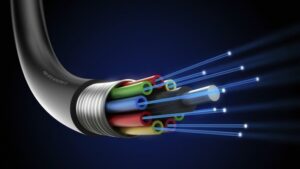
Fibre optic cable. Image credit: iTel Networks
Optical fibres are most common in telecommunications because information can be transported over long distances, with minimal loss of data. This gives optical fibres an advantage over conventional cables.
Signals are transmitted from one end of the fibre to another in the form of laser pulses. A single strand of fibre optic cable is capable of handling over 3,000 transmissions at the same time which is a huge improvement over the conventional co-axial cables. Multiple Signal transmission is achieved by sending individual light pulses at slightly different angles.
For example if one of the pulses makes a 72.23° angle of incidence then a separate pulse can be sent at an angle of 72.26°! The transmitted signal is received almost instantaneously at the other end of the cable since the information coded onto the laser travels at the speed of light! During transmission over long distances, repeater stations are used to amplify the signal which has weakened by the time it reaches the station. The amplified signals are then related towards their destination and may encounter several other repeater stations on the way.
Fibre optics in medicine
Optic fibres are used in medicine in endoscopes.
Fact: Endoscopy means to look inside and refers to looking inside the human body for diagnosing medical conditions.
The main part of an endoscope is the optical fibre. Light is shone down the optical fibre and a medical doctor can use the endoscope to look inside the body of a patient. Endoscopes can be used to examine the inside of a patient’s stomach, by inserting the endoscope down the patient’s throat.
Endoscopes also allow minimally invasive surgery. This means that a person can be diagnosed and treated through a small incision (cut). This has advantages over open surgery because endoscopy is quicker and cheaper and the patient recovers more quickly. The alternative is open surgery which is expensive, requires more time and is more traumatic for the patient.

First Term Physics Lesson Notes for Other Topics
Scalars And Vectors
Explore lesson notes covering all topics.
Rectilinear Acceleration
Explore lesson notes covering all topics.
Speed And Velocity
Explore lesson notes covering all topics.
Motion
Explore lesson notes covering all topics.
Time
Explore lesson notes covering all topics.
Position, Distance, Displacement
Explore lesson notes covering all topics.
Fundamentals And Derived Quantities And Units
Explore lesson notes covering all topics.
Magnet and Magnetic Field
Explore lesson notes covering all topics.

Energy and Society
Explore lesson notes covering all topics.
Introduction to Lasers
Explore lesson notes covering all topics.
Semiconductor(Electronics) Electrical Conduction through Solid Materials
Explore lesson notes covering all topics.
Electric Field, Laws of Electrostatics, Capacitor & Capacitance
Explore lesson notes covering all topics.
Electrolysis: Electrical Conduction through Liquid, and Gases.
Explore lesson notes covering all topics.
Electromagnetic Wave and Capacitance
Explore lesson notes covering all topics.
Gravitational Field
Explore lesson notes covering all topics.

Lesson Notes for Other Classes

JSS1 Lesson Note
The complete lesson note to guide your studies.

JSS2 Lesson Note
The complete lesson note to guide your studies.

SS1 Lesson Note
The complete lesson note to guide your studies.

SS2 Lesson Note
The complete lesson note to guide your studies.