
Electromagnetic Wave and Capacitance SS3 Physics Lesson Note
Download Lesson NoteTopic: Electromagnetic Wave and Capacitance
DEFINITION AND CONCEPT
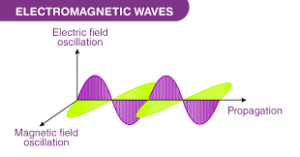
Electromagnetic waves are produced by electromagnetic vibrations. Electromagnetic waves have an electrical origin and the ability to travel in a vacuum. So, electromagnetic waves are regarded as a combination of travelling electric and magnetic forces which vary in value and are directed at right angles to each other and to the direction of travel. In other words, they are transverse waves.
TYPES OF RADIATION
Electromagnetic waves consist of the following:
- Radio waves with wavelengths 10-3m to 1000m.
- Infra-red waves with average wavelengths of 10-6m.
- The visible spectrum, known as light waves, with wavelengths of 7 x 10⁻⁷ m for red rays.
- Ultraviolet rays with a wavelength of 10-8m
- X-rays with wavelengths of 10-10 m.
- Gamma–rays with wavelengths of 10-11m.
- Radio waves: Radio waves have the longest wavelengths. Radio waves are emitted from transmitters and carry radio signals to radio sets. The shortest radio waves are called microwaves. Microwaves are used in radar and heating hence they are used in cooking.
- Infra-red waves: Infra-red waves are found just beyond the red end of the visible spectrum. They are present in the radiation from the sun or the filament of an electric lamp. Many manufacturing industries used infra-red lamps to dry paints on painted items. They are also used for the treatment of muscles.
- Visible Spectrum or Light Waves: The visible spectrum is made up of red, orange, yellow, green, blue, indigo and violet rays. These are all colours of the rainbow. When these rays combine, they form a white light. In the visible spectrum, red rays have the longest wavelengths while violet rays have the shortest wavelengths. The main source of light is the sun
- Ultra Violet Rays: Ultraviolet rays are located just beyond the violet end of the visible spectrum. Ultraviolet rays can be produced by quartz, mercury filaments, or the sun. Ultraviolet rays can cause certain materials to fluoresce (i.e. glow)
- X-rays: X-rays are produced when fast-moving electrons strike a metal target, which reduces their velocity. X- Rays are used in hospitals to destroy malignant growth in the body and to produce x-ray photographs which can locate broken bones. Much of the x-ray in the body is harmful and can lead to sterility and adverse changes in the blood. X-rays are used in industry to locate cracks in metal castings and flows in pipes. X-rays ionise gases and have a penetrating effect such that they pass through substances opaque to white light that are diffracted by crystals and unaffected by either electric or magnetic fields.
- Gamma–Rays: Gamma rays are emitted by radioactive substances such as cobalt. 60. Like x-rays, gamma rays ionise gases and darken photographic plates. Because of their shorter wavelengths, gamma rays have a greater penetrating power.
DETECTORS
The detectors of the various radiations in the electromagnetic spectrum are
- Gamma rays – Geiger-Muller tube
- X-rays – Photographic films
- Ultraviolet rays – Photographic films, fluorescent substances
- Visible rays – Eye, photographic film, photoelectric cell
- Infra-red rays – Skin, thermometer, phototransistor, photographic film.
- Radio waves – Radio set, Television set, Aerials
USES
- Radio waves are very important for effective communication especially when radio sets, television sets, and walkie-talkies are involved.
- Knowledge of infrared rays is used in developing infrared telescopes, and infrared signalling lamps which are useful to soldiers fighting in darkness.
- With the aid of photographic film which is sensitive to infrared, it is possible to take clear photographs through mist and haze.
- X-rays are useful in hospitals (e.g. to inspect broken bones), industry (to inspect metal castings), and in science to study the crystal structure of matter.
- Gamma rays are used to kill cancer cells in patients’ bodies as well as bacteria in foods and hospital equipment.
- Knowledge of ultraviolet rays is used in developing ultraviolet lamps; the lamps are useful in conducting experiments on photo-electric effect.
CLASSWORK
- A radio station transmits at a frequency of 1200KHZ. What is the wavelength of the radio wave? (c = 3.0 x 10⁸ ms-1).
- Give three similarities of electromagnetic waves. Mention two distinguishing properties of infrared and ultraviolet rays.
- State two properties that distinguish light waves and radio waves
- Mention and describe two important uses of X-rays.
ASSIGNMENT
SECTION A
- Which of the following is not electromagnetic radiation? (a) x-ray (b) radio waves (c) sunlight (d) sound waves
- In which of the following groups are the radiations arranged in the increasing order of their wavelength? (a) Radio waves, gamma rays, x-rays (b) x-rays, gamma rays, radio waves (c) x-rays, radio waves, gamma rays (d) gamma rays, radio waves, x-rays
- The velocity of light in vacuum is (a) 3.0×10⁶ m/s (b) 3.0×07 m/s (c) 3.0×10⁸ m/s (d) 3.0109 m/s
- Which of the following radiations is found useful by soldiers fighting in darkness? (a) Gamma-rays (b) x-rays (c) infra-red rays (d) ultraviolet rays
- Which of the following radiation is of nuclear origin? (a) X-rays (b) Visible –rays (c) Radio waves (d) Gamma rays.
SECTION B
- How can you detect the following radiations? (i) X-rays (ii) Visible rays (iii) Infra-red rays
- (a) What is radar? (b) What type of electromagnetic radiation does it use? (c) How does it function?
- Name five uses of electromagnetic radiation

First Term Physics Lesson Notes for Other Topics

Scalars And Vectors
Explore lesson notes covering all topics.

Rectilinear Acceleration
Explore lesson notes covering all topics.

Speed And Velocity
Explore lesson notes covering all topics.

Motion
Explore lesson notes covering all topics.

Time
Explore lesson notes covering all topics.

Position, Distance, Displacement
Explore lesson notes covering all topics.

Fundamentals And Derived Quantities And Units
Explore lesson notes covering all topics.
Magnet and Magnetic Field
Explore lesson notes covering all topics.
Energy and Society
Explore lesson notes covering all topics.
Introduction to Lasers
Explore lesson notes covering all topics.
Fibre Optics
Explore lesson notes covering all topics.
Semiconductor(Electronics) Electrical Conduction through Solid Materials
Explore lesson notes covering all topics.

Electric Field, Laws of Electrostatics, Capacitor & Capacitance
Explore lesson notes covering all topics.
Electrolysis: Electrical Conduction through Liquid, and Gases.
Explore lesson notes covering all topics.

Gravitational Field
Explore lesson notes covering all topics.

Lesson Notes for Other Classes

JSS1 Lesson Note
The complete lesson note to guide your studies.

JSS2 Lesson Note
The complete lesson note to guide your studies.

SS1 Lesson Note
The complete lesson note to guide your studies.

SS2 Lesson Note
The complete lesson note to guide your studies.